a. As the net linear momentum of the system (skater`+`pole) is zero, the centre of mass will be at rest before and after the collision.
The skaters and the pole will rotate around the cente of mass (at the midpoint of the pole).
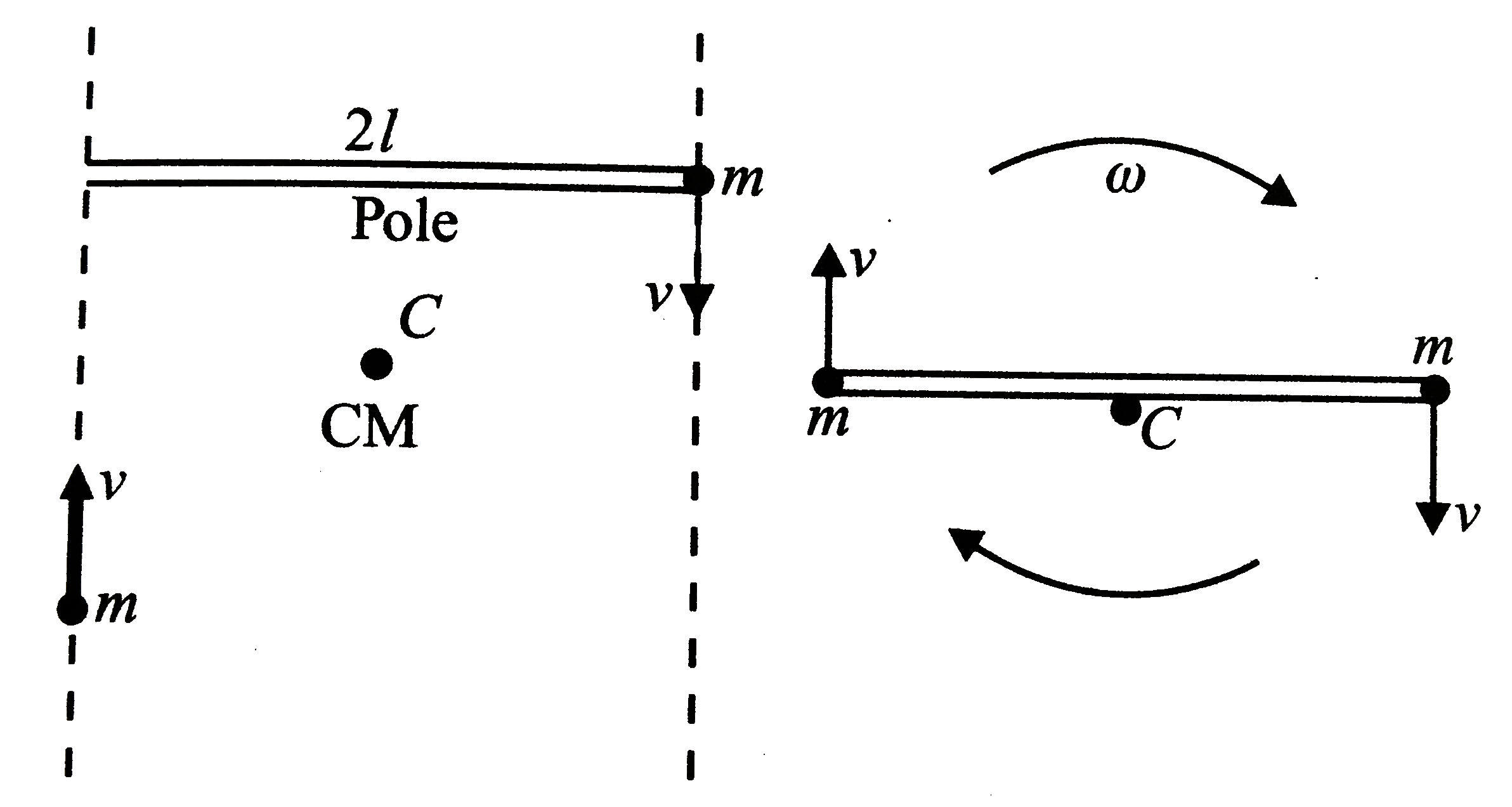
Applying the conservation of angular moment about an axis through `C` and perpendicular to the plane of the figure
`mvl+mvl=Iomega`, where `I=2m(l)^(2)`
`omegamvl/I=v/l=20/3rad/s`
b. As the separation reduces to `2l'=1m`
`Iomega=I'omega`
Again applying conservation of angular mometum, we get
`omega^(')=(Iomega)/I^(')=(2ml^('2)omega)/(2ml^('2))=9omega=60rad//s`
Therefore, angular velocity increases
c. `(KE_(i))/(KE_(f))=(1/2I'omega^('2))/(1/2Iomega^(2))=(l'omega^('2))/(l^(2)omeg^(2))=9`
The kinetic energy increase because the skaters do positive work in pulling themselves towards the centre of pole.


