Home
Class 11
PHYSICS
A string is wrapped several times on a c...

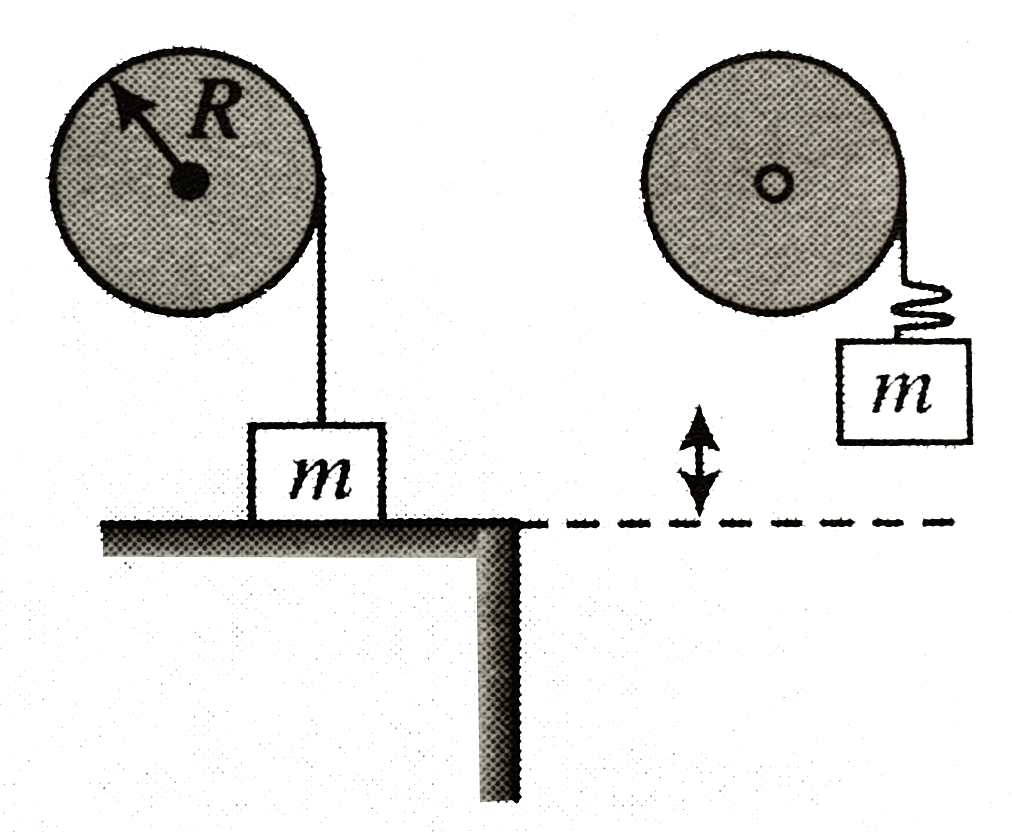
A string is wrapped several times on a cylinder of mass `M` and radius `R`. the cylinder is pivoted about its adxis of block symmetry. A block of mass `m` tied to the string rest on a support positioned so that the string has no slack. The block is carefully lifted vertically a distance `h`, and the support is removed as shown figure.
a. just before the string becomes taut evalute the angular velocity `omega_(0)` of the cylinder ,the speed `v_(0)` of the falling body, `m` and the kinetic energy `K_(0)` of the system.
b. Evaluate the corresponding quanitities `omega_(1), v_(1)` and `K_(1)` for the instant just after the string becomes taut.
c. Why is `K_(1)` less than `K_(0)`? Where does the energy go?
d. If `M=m`, what fraction of the kinetic energy is lost when the string becomes taut?

Text Solution

Verified by Experts

a. Just before the stirng becomes taut, the block falls freely, so `v_(0)=sqrt(2gh),` There is no tension in the string so nothing causes the cylider to spin so `omega_(0)=0`. The kinetic energy of the system is `K_(0)=1/2mv_(0)^(2)+1/2lomega_(0)^(2)=mgh`.
b. When the string experiences a jerk, the large impulse developed of very short duration so that the contribution of weight `mg` can be neglected during this time interval. The angular momentum of the system is conserved, as the tension is internal force for the system. Thus we have
`vecL_(i)=vecL_(f)`
`mv_(1)R+1/2MR^(2)omega_(1)=mv_(0)R=msqrt(2gh)R`
The string is inextensible so `v_(1)=Romega_(1).` On solving for `omega_(1)`, we get ltbr `omega_(1)=sqrt((2gh))/(R[1+(M/2m)]),v_(1)=Romega_(1)=(sqrt(2gh)/([1+(M/2m)])`
The final kinetic energy `K_(1)` is given by
`K_(1)=1/2mv_(1)^(2)+omega_(1)^(2)`
`=1/2mv_(1)^(2)+1/2(1/2MR^(2))((v_(1)^(2))/R^(2))=1/2(m+M/2)v_(1)^(2)`
`=1/2[(mv_(0)^(2))/(1+(M/2m))]=(K_(0))/(1+(M/2m))`
c. The situation in this case is analogous to the energy loss is complete inelastic two body collisions. The lost kinetic energy is converted to heat energy or elastic potential energy of the string or in the two objects.
d.For `M=m, K_(1)=(2K_(0))/3,` so the fraction lost is
`((K_(0)-K_(1))/K_(0))=1/3`
Promotional Banner

Topper's Solved these Questions

  • RIGID BODY DYNAMICS 2

    CENGAGE PHYSICS|Exercise Solved Examples|12 Videos
  • RIGID BODY DYNAMICS 2

    CENGAGE PHYSICS|Exercise Exercise 3.1|11 Videos
  • RIGID BODY DYNAMICS 1

    CENGAGE PHYSICS|Exercise Integer|11 Videos
  • SOUND WAVES AND DOPPLER EFFECT

    CENGAGE PHYSICS|Exercise Integer|16 Videos

Similar Questions

Explore conceptually related problems

A string is wrapped several time on a cylinder of mass M and radius R , the cylinder is pivoted about its axis of symmetery . A block mass of m tied to the string rests on support so that the string is black. The block is lifted upto a height h and the support is removed. (shown in figure) What is the angular velocity of cylinder just before the string becomes taut

A string is wrapped several time on a cylinder of mass M and radius R , the cylinder is pivoted about its axis of symmetery . A block mass of m tied to the string rests on support so that the string is black. The block is lifted upto a height h and the support is removed. (shown in figure) If M=m , what friction of KE is lost due to the jerk developed in the string

A string is wrapped several time on a cylinder of mass M and radius R , the cylinder is pivoted about its axis of symmetery . A block mass of m tied to the string rests on support so that the string is black. The block is lifted upto a height h and the support is removed. (shown in figure) When the string experience a jerk, a large impulsive force is generated for a short duration, so that contribution of weight mg can be neglected suring this duration. then what will be speed of blocks m , just after string has becomes taut

A string is wrapped around a cylinder of mass M and radius R . The string is pulled vertically upwards to prevent the centre of mass from falling as the cylinder unwinds the string. The tension in the string is

The block of mass m is at rest. Find the tension in the string A .

A solid cylindrical pulley of mass m and radius R = 10 cm is hinged about its horizontal axis of symmetry. A light spring is wrapped around it, and small block of mass 'm' is suspended from the string. Now the block is lefted vertically by a distance h = 1.8 m and released. Just after the string becomes taut again, find the angular velocity of the cylinder in rad/s (Take g = 10 m//sec^(2) )

A string of negligible mass is wrapped on a cylindrical pulley of mass M and radius R. The other end of string is tied to a bucket of mass m. If the pulley rotates about a horizontal axis then the tension in the string is :

A blocked of mass m is attached with two strings as shown in figure .Draw the free body diagram of the block.
