Home
Class 11
PHYSICS
AB is a horizontal diameter of a ball o...

`AB` is a horizontal diameter of a ball of mass `m=0.4 kg` and radius `R=0.10m`. At time `t=0`, a sharp impulse is applied at `B` at angle of `45^@` with the horizontal as shown in figure so that the ball immediately starts to move with velocity `v_(0)=10ms^(-1)`
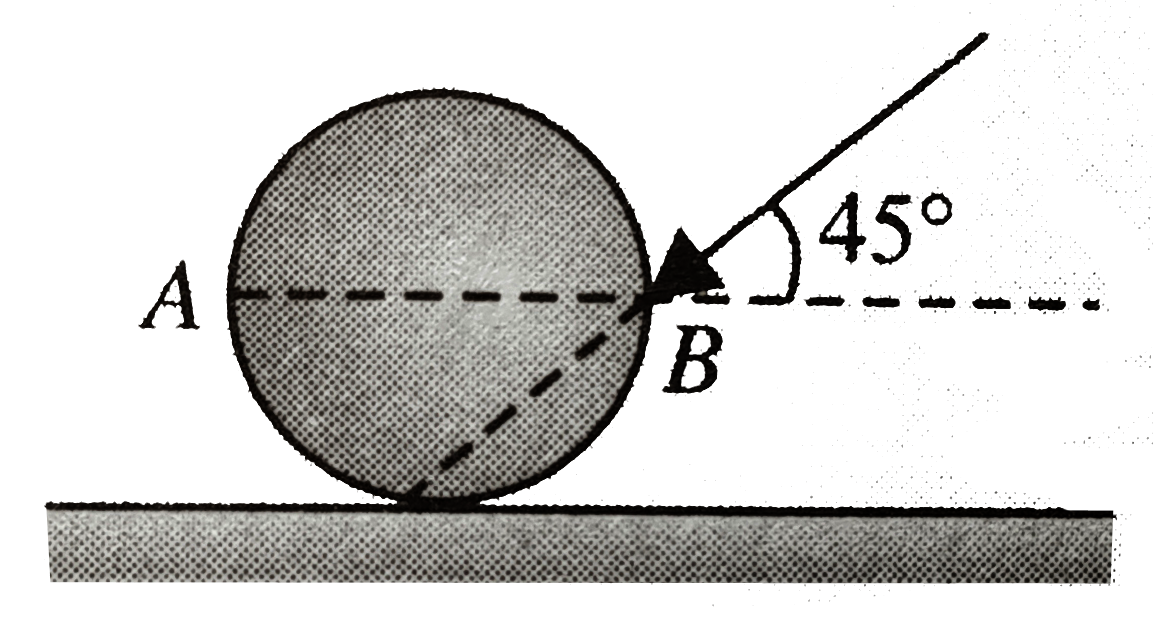
a. Calculate the impulse and angular velcity of ball just after impulse provided.
If coefficient of kinetic friction between the floor and th ball is `mu=0.1`. Calculate. The
b. velocity of ball when it stops sliding,
c. time t at that instant
d. horizontal distance travelled by the ball up to that instant.
e. angular displacement of the ball about horizontal diameter perpendicular to `AB`, up to that instant, and
f. energy lost due to friction (`g=10ms^(-2))`


Text Solution

Verified by Experts

Since, line of action of impulse does not pass through centre of mass of the sphere, therefore, just after application of impulse, the sphere starts to move, both translationally and rotationally. Translation motion is produced by horizontal component of the impulse, while rotational motion is produced by momnt of the impulse. Let the impulse applied be `J`.
Then its horizontal coponent provides horizontal motion.
`J.cos45^@` which gives `J=4sqrt(2)kgms^(-1)`
Moment of inertial of ball about centroidal axis is
`I=2/4mR^(2)=1.6xx10^(-30kgm^(2)`
Initial angular moment of ball (about centre) =`J(Rsin45^@)`
Angular impule will change angular momentum of the ball.
`J.R sin 45^@=/_\L=(Iomega_(0)-0)`
Which gives `omega_(0)=250rads^(-1)`(clockwise)
Promotional Banner

Topper's Solved these Questions

  • RIGID BODY DYNAMICS 2

    CENGAGE PHYSICS|Exercise Solved Examples|12 Videos
  • RIGID BODY DYNAMICS 2

    CENGAGE PHYSICS|Exercise Exercise 3.1|11 Videos
  • RIGID BODY DYNAMICS 1

    CENGAGE PHYSICS|Exercise Integer|11 Videos
  • SOUND WAVES AND DOPPLER EFFECT

    CENGAGE PHYSICS|Exercise Integer|16 Videos

Similar Questions

Explore conceptually related problems

A ball of mass m=1kg strikes a smooth horizontal floor as shown in figure. The impulse exerted on the floor is

A solid spherical ball of radius R collides with a rough horizontal surface as shown in figure. At the time of collision its velocity is v_(0) at an angle theta to the horizontal and angular velocity omega_(0) as shown . After collision, the angular velocity of ball may

A sphere of mass m and radius R is kept on a rough floor. A sharp impulse is applied in the horizontal direction at the height of centre of sphere so that sphere acquires a linear velocity v_(0) without any angular velocity. Calculate the velocity of sphere when pure rolling starts.

A ball of mass m moving with velocity v_0 collides a wall as shown in figure. After impact it rebounds with a velocity 3/4v_0 . The impulse acting on ball during impact is

Three identical balls eah of mass m=0.5 kg are connected with each other as shown in figure and rest over a smooth horizontal table At moment t=0, ball B is imparted a horizontal velocity v_(0)=9ms^(-1) calculate velocity of A just before it collides with ball C.

A ball of radius R=20 cm has mass m=0.75 kg and moment of inertia (about its diameter) I=0.0125 kg m^(2) . The balls rolls with velocity V_(0)=10 ms^(-1) towards a smooth vertical wall. If coefficient of restitution between the wall and the ball is e=0.7 , velocity V of the ball after the collision is (g=0ms^(-2))

A ball of mass 1 kg is attached to an inextensible string. The ball is released from the position shown in figure. Find the impulse imparted by the string to the ball immediately after the string becomes taut.

A ball of mass 0.1 kg is thrown against a wall. It strikes the wall normally with a velocity of 30 ms^(-1) and rebounds with a velocity of 20 ms^(-1) . Calculate the impulse of the force exerted by the wall.

A ball of mass 0.2 kg moves with a velocity of 20m//sec and it stops in 0.1 sec , then the force on the ball is