When the body is rolling on the rough surface, the friction force acting on the surface acts in the backward direction. The force `F` increases acceleration of centre of mass while friction force provides torque for providing angular acceleration. The velocity of centre of mass is always such that `v_(c)=omegaR`, i.e, rolling is present. when the body enters on the smooth surface, the pulling force `F` is still acting i.e., `F!=0`
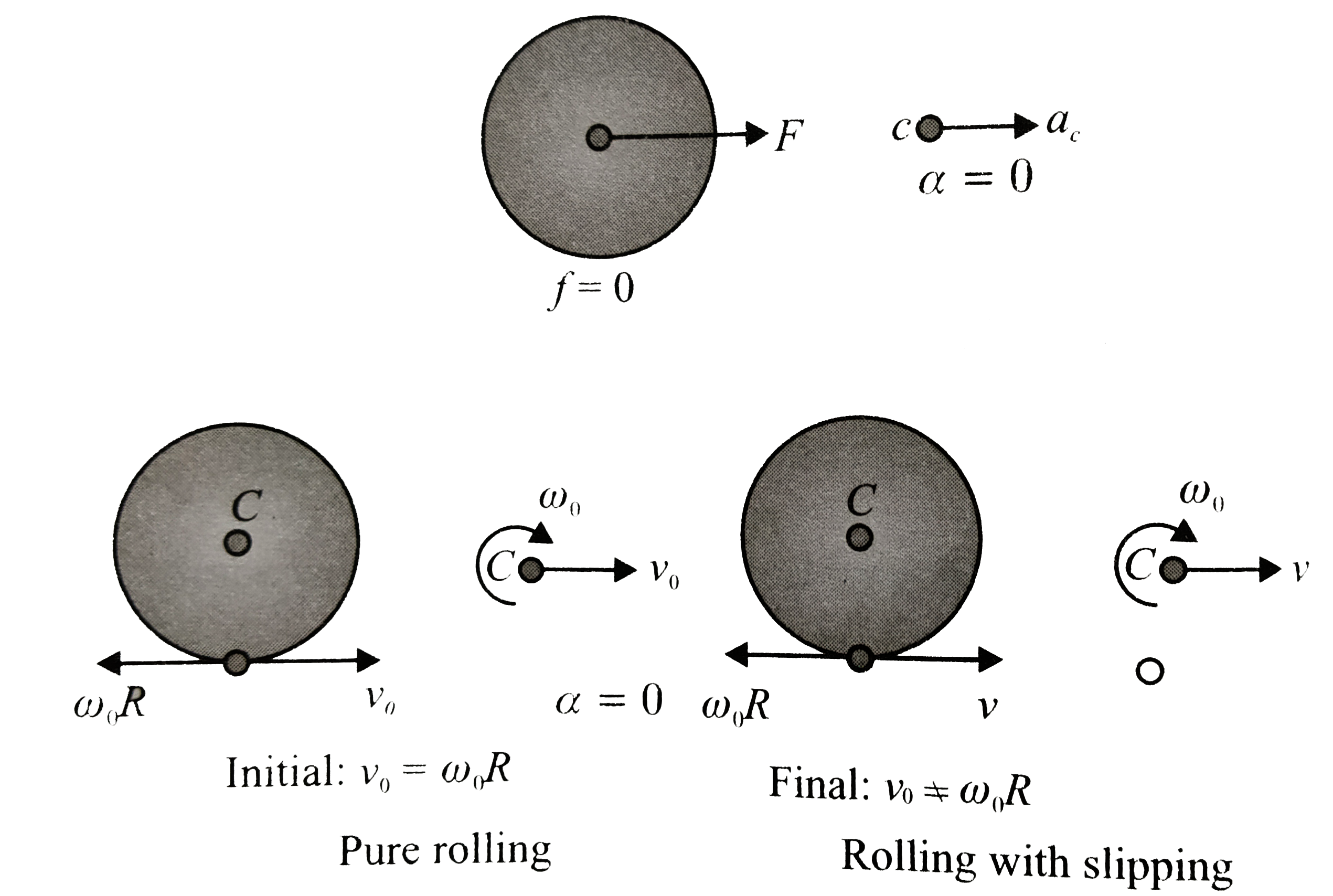
When the rolling body enters on a smooth surface, the force of friction disappears, i.e, `f=0`. As a result angular acceleration of the body about its centre of mass becomes zero.
What ever is the angular speed attained by the body, it continues to rotate with that. On the conntrary, the linear acceleration of the centre of mass suddenly increases to `F/m`
As a result its linear speed starts increasing and the condition `v_(c)=omegaR` does not hold true and the body will not roll on the smooth surface. The point of contact slips forward `(vgtomega_(0)R).`