Home
Class 11
PHYSICS
Two plates 1 and 2 move with velocities ...

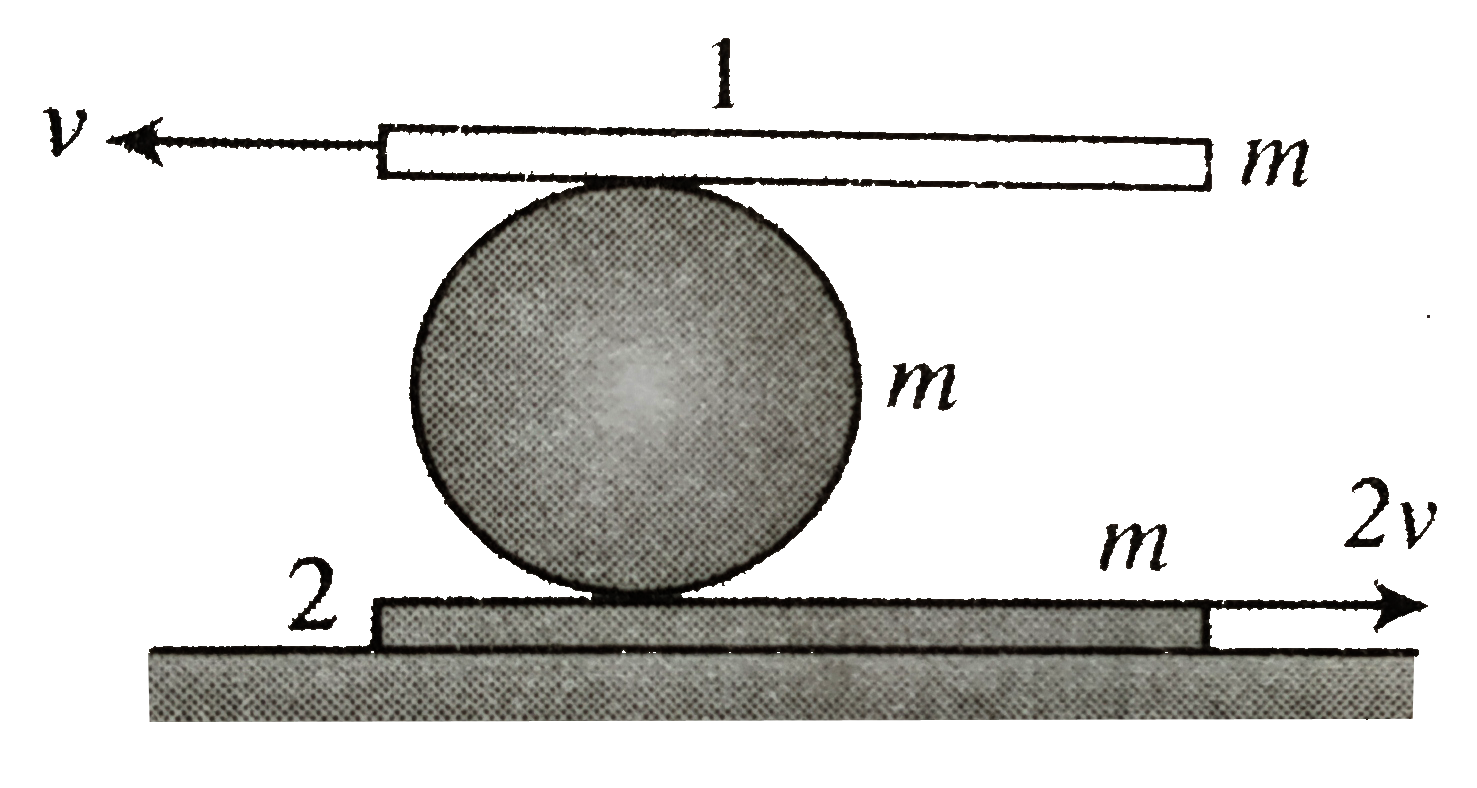
Two plates `1` and `2` move with velocities `-v ` and `2v` respectively. If the sphere does not slide relative to the plates, assuming the masses of each body as `m`, find the kinetic energy of the system (plates+sphere).

Text Solution

Verified by Experts

Top point of sphere in having velocity `v(larr)` and bottom point in moving with `2v(rarr)`
We can find position of `IRC`
`y/v=(2R-y)/(2v)=y=2/3R`
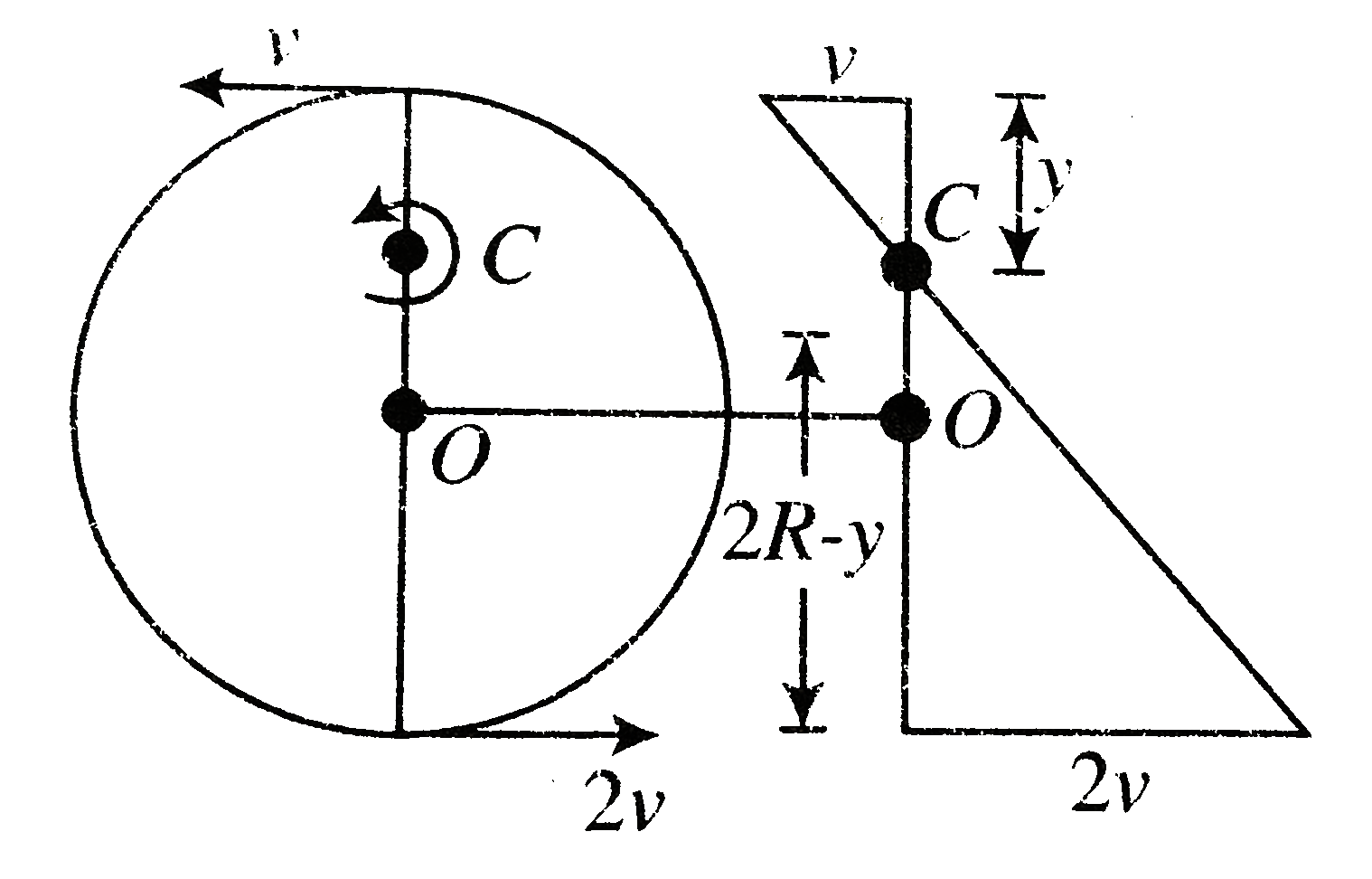
Hence we can assure the sphere will have pure rotation about `C (ICR)`
Hence the motion sphere can be considered as pure rotation about `C`.
The angular velocityi of shere `omega=v/y=(3v)/(2R)`
The kinetic energy of sphere `k_("rotation")=1/2I_(C)omega^(2)`
`implies k_("rotatioal")=1/2[2/5mR^(2)+m(OC)^(2)]omega^(2)`
`OC=R-2/3R=R/3`
`K_("rotational")=1/2(23/45mR^(2))omega^(2)=23/90momega^(2)R^(2)`
`=23/90m((3v)/(2R))^(2)R^(2)=23/40mv^(2)`
Hence total kinetic energy
`K_("total")=1/2mv^(2)+1/2m(2v)^(2)+23/40mv^(2)=123/40mv^(2)`
Promotional Banner

Topper's Solved these Questions

  • RIGID BODY DYNAMICS 2

    CENGAGE PHYSICS|Exercise Solved Examples|12 Videos
  • RIGID BODY DYNAMICS 2

    CENGAGE PHYSICS|Exercise Exercise 3.1|11 Videos
  • RIGID BODY DYNAMICS 1

    CENGAGE PHYSICS|Exercise Integer|11 Videos
  • SOUND WAVES AND DOPPLER EFFECT

    CENGAGE PHYSICS|Exercise Integer|16 Videos

Similar Questions

Explore conceptually related problems

Two particles having masses m_(1) and m_(2) are moving with velocities vec(V)_(1) and vec(V)_(2) respectively. vec(V)_(0) is velocity of centre of mass of the system. (a) Prove that the kinetic energy of the system in a reference frame attached to the centre of mass of the system is KE_(cm) = (1)/(2)mu V_(rel)^(2) . Where mu=(m_(1)m_(2))/(m_(1)+m_(2)) and V_(rel) is the relative speed of the two particles. (b) Prove that the kinetic energy of the system in ground frame is given by KE=KE_(cm)+(1)/(2)(m_(1)+m_(2))V_(0)^(2) (c) If the two particles collide head on find the minimum kinetic energy that the system has during collision.

Two identical particles move towards each other with velocity 2v and v respectively. The velocity of centre of mass is

Two bodies of masses m_1 and m_2 are moving with velocity v_1 and v_2 respectively in the same direction. The total momentum of the system in the frame of reference attached to the centre of mass is ( v is relative velocity between the masses)

Two particles of mass 2m and m moving with speed v and 2v respectively perpendicular to each other collides perfectly inelastically, then Loss in kinetic energy of the system

A particle of mass m moving with velocity 2v collides with another particle of mass 3m moving with velocity v in the same direction.If it is perfect inelastic collision,the loss of kinetic energy of the system is

Two masses, m_(1) and m_(2) , are moving with velocities v_(1) and v_(2) . Find their total kinetic energy in the reference frame of centre of mass.

Two objects having same mass 'm' are moving with velocities v and 2v. Find ratio of their kinetic energies.

A rod of mass m is kept on a cylinder and sphere each of radius R . The masses of the sphere and cylinder are m_(1) and m_(2) respectively. If the speed of the rod is V , find the KE of the system ("rod"+"cylider"+"sphere") . Assume that the surfaces do not slide relative to each other.

