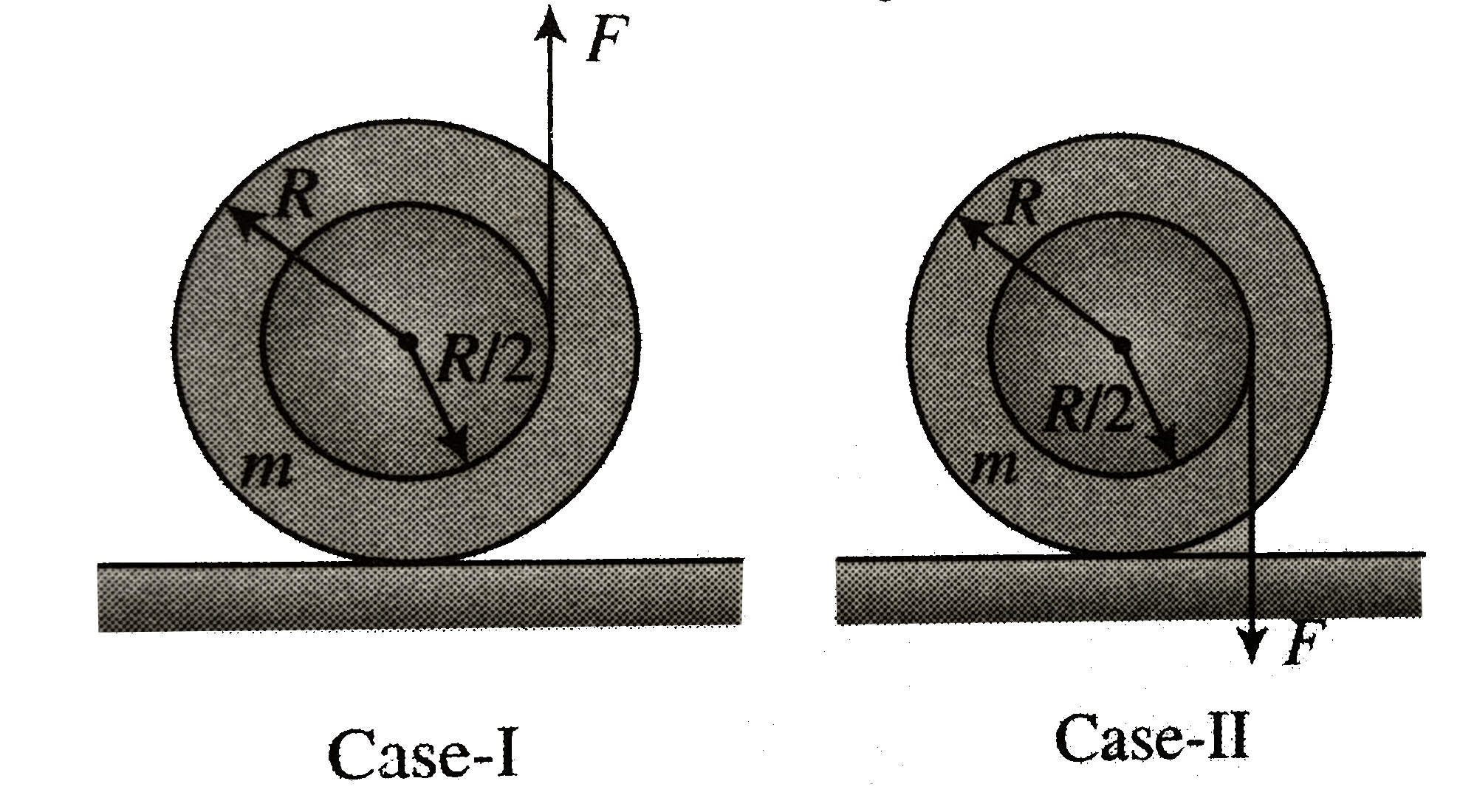
As the cylinder is rolling. The point of contact will be instantaneus centre of rotation (`ICR`). The rollig body can be considered as pure rotation about the point of contact.
Case I: The force `F` provides anticlockwise torque about `P`. The cylinder will rotate in antclockwise direction about `P`. The point `P` is in instantaneous centre of rotation (`ICR`). The cylinder wil also rotate in anticlock wise direction about its centre of mass. The cylinder will accelerate in left direction. Hence friction will act in left direction.
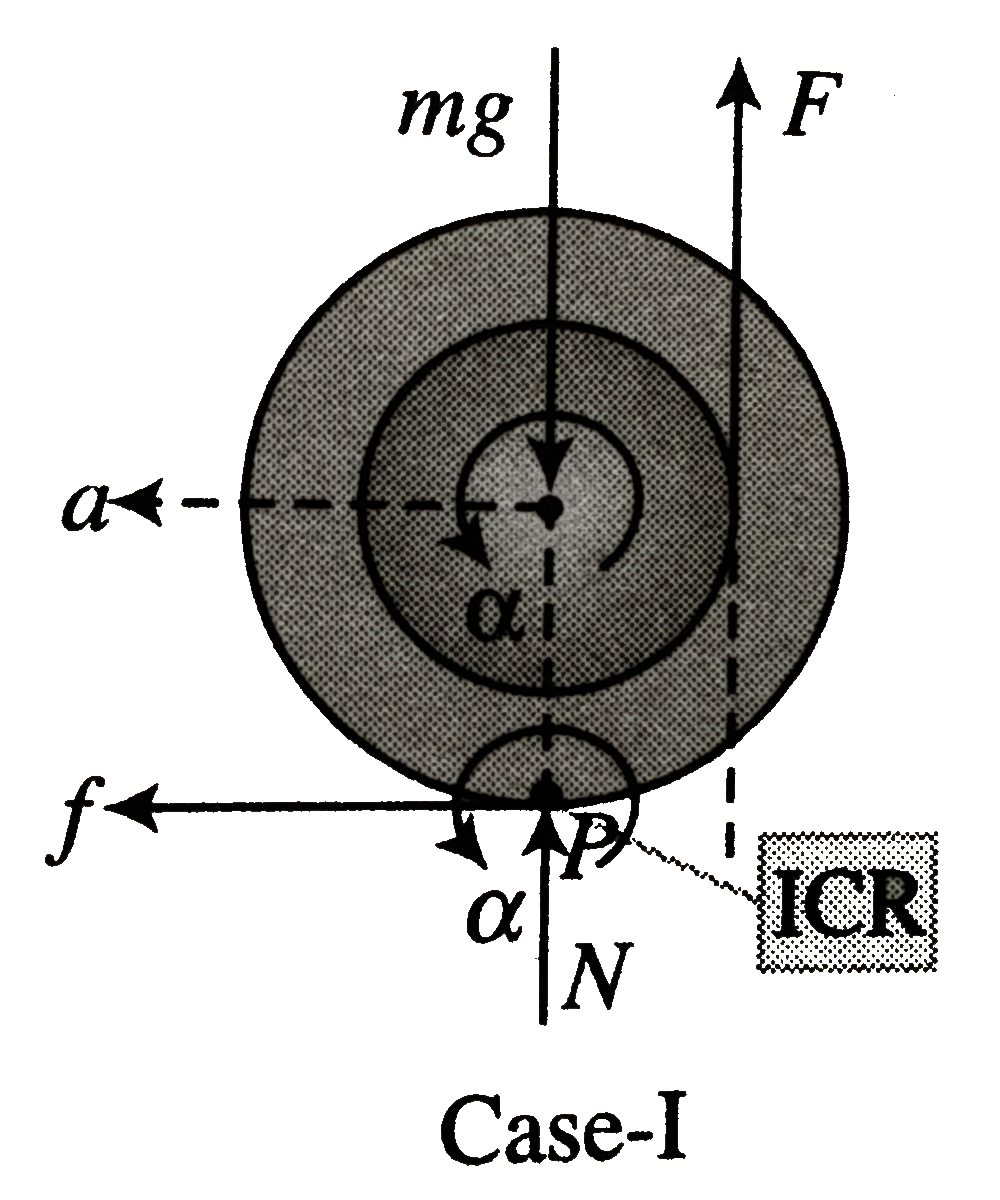
Applying torque equation about `P`
`F(R/2)=I_(P)alpha=m(k^(2)+R^(2))alpha=m((R^(2))/(k^(2))+R^(2))alpha`
which gives `Ralpha=F/(3m)`
But acceleration of cylinder is `alpha=Ralpha`
Hence `a=F/(3m)` (towards left).
Case II. In this cae the torque of `F` about instantaneous centre of rotation (ICR) is in clockwise direction. the cylinder will also rotate in clockwse direction about its centre of mass. Hence, the acceleration of cylinder will e towards right and friction will act towars right.
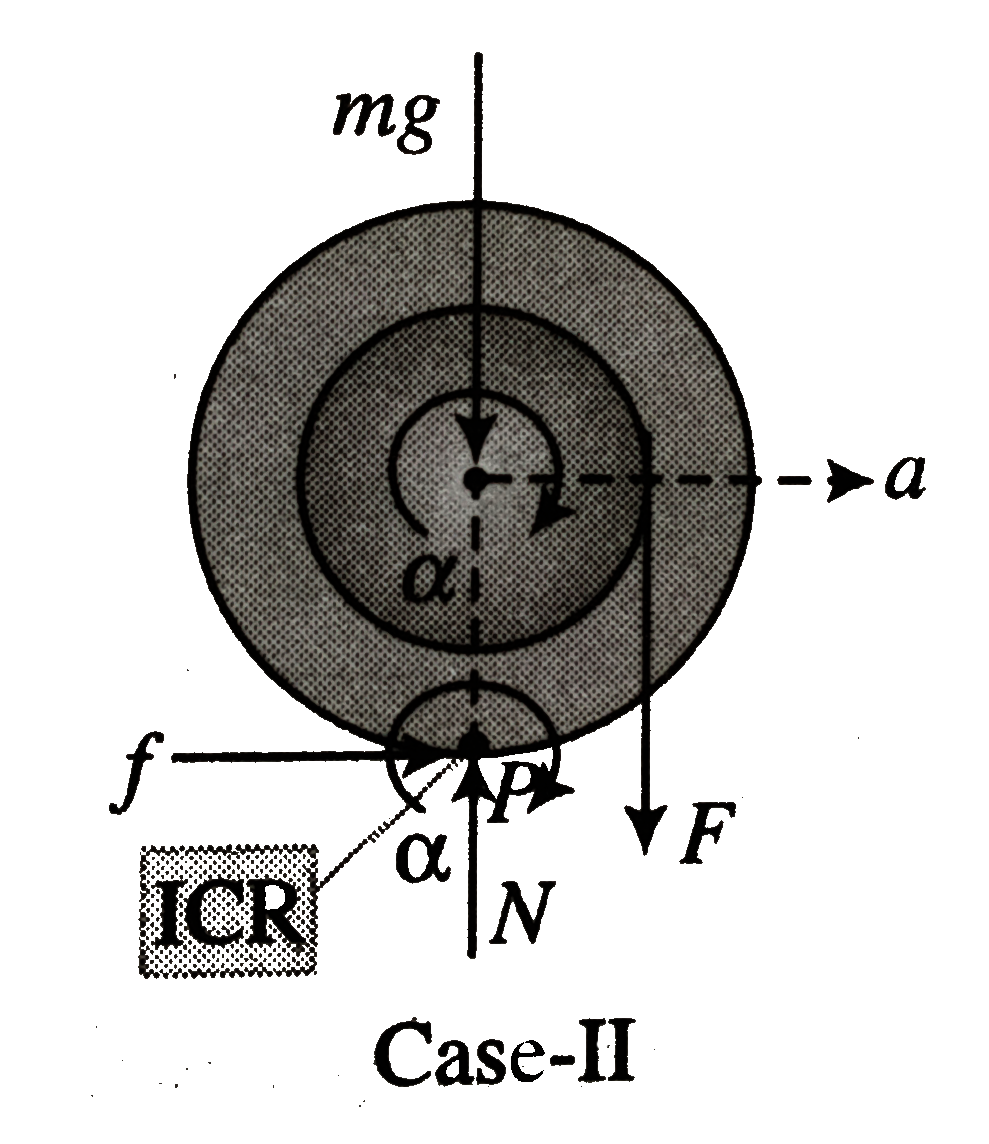
Now the torque equation about `P` will be same as we got in previous case. We will get the same value of acceleration but direction be towards right.