Energy Method: Let `v` and `omega` be the velocity of the centre of mass and the angular velocity of cylinder, respectively, that the bottom of the plane.
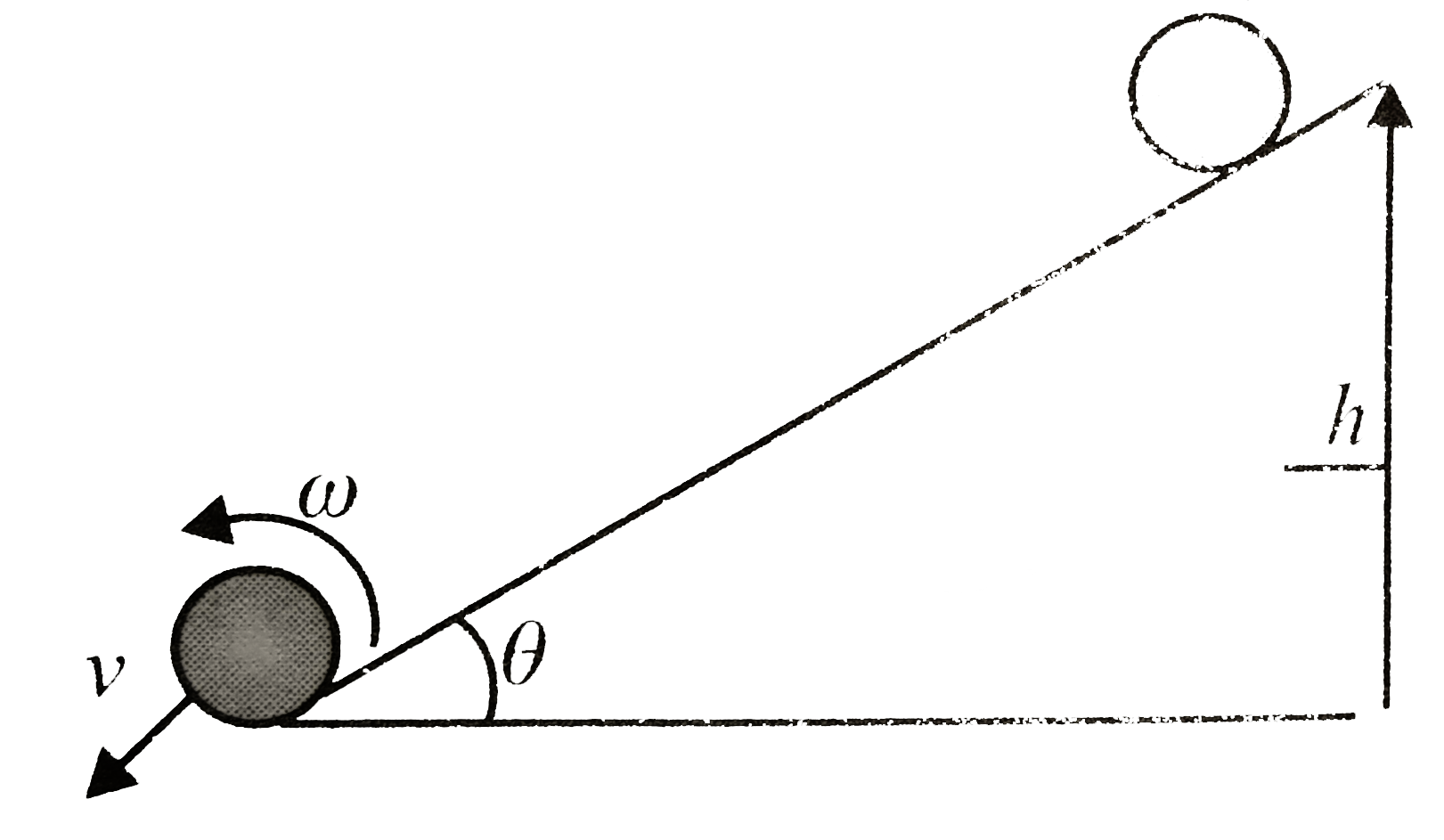
As the cylinder rolls down
Loss in GPE`=` Gas in in translation `KE+` gain in rotational `KE`
`mgh=1/2mv^(2)+1/2omega^(2)`
As the cylinder is rolling without slipping `v=Romega`
`implies mgh=1/2 mv^(2)+1/2((mR^(2))/2)(v^(2))/(R^(2))`
`implies v=sqrt((4gh)/3)`
"Force /Torque" Method: From the result of the last example `("using " k^(2)=R^(2)//2)`, the acceleration of the cylinder is
`(gsintheta)/(1+1/2)=2/3gsintheta`
Using `v^(2)=u^(2)+2as` down the plane (taking downward directioin positive)
`implies v=sqrt(0+2ah/(sintheta))`
`sqrt(2(2/3gsinntheta)h/(sintheta))=sqrt((4gh)/(3)`
Time to reach bottom `=t=(v-u)/a=sqrt((4th)/(3-0))/(2/3gsintheta)=sqrt((3h)/(g)) (1)/(sintheta)`
In the forth coming illustration, we will learn the application of various methods i.e, force /torque, conservation of mechanical energy, work energy theorem and concept of angular momentum in problem solving.


