Home
Class 11
PHYSICS
A particle, moving horizontally, collide...

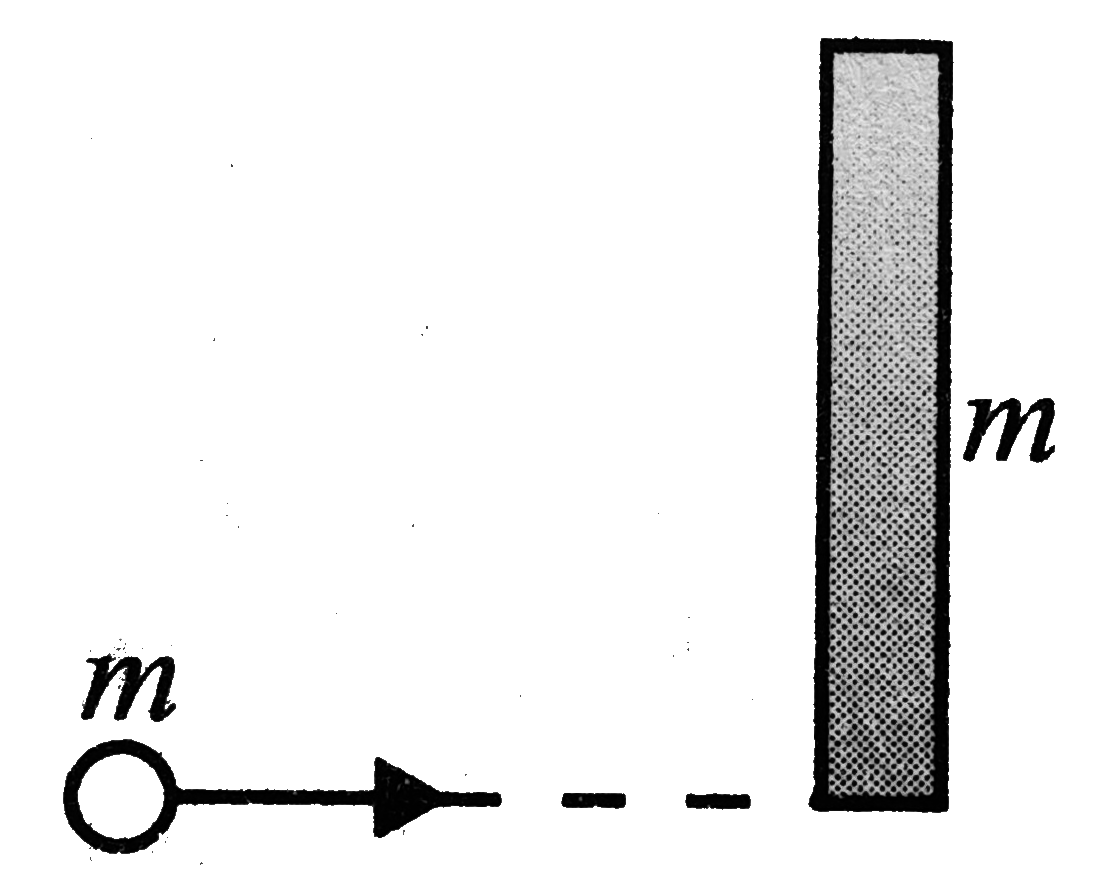
A particle, moving horizontally, collides perpendicularly at one end of a rod having equal mass and placed on a smooth horizontal surface.

A

Particle comes to rest if collision is perfectly elastic and centre of m rod starts to move with the same velocity.

B

Particle continues to move along the same direction, whatever is the value of `e`.

C

Particle may get rebound back.

D

Velocity of mid-point of the rod will be less than `v//2` if the particle gets stuck.

Text Solution

Verified by Experts

The correct Answer is:

B, D

Whenever two paticles having equal mass collide head on elastically, their velocities get interchanged. Therefore, if the particle collides at midpoint of the rod then velocities would get interchanged. In that case option a would be correct. But now the particle strikes at an end of the rod, hence particle head on collision does not take place. Therefore, option a is incorrect.
If the particle gets rebound back to its original path, then its final mometum will become negative. Since mass of the particle and rod is equal, therefore law of conservation of momenum will be satisfied only when velocity of centre of mass of the rod is greater than orginal velocity of te particle. Hence, kinetic energy of the system (just after collision) will become greater than that (just before the collision), which is impossible. Hence, the particle cannot rebound back or it will colntinue to move along the same direction. Hence, option b is correct but option c is incorrect. if the paticle gets stick to the rod, centre of mass o the system will lie at a distance `l//4` from theend at which the particle sticks. According to the law of conservation of momentum cenre of mass will start ot move wit velocity `v//2`. But the particle will simultaneously start to rotate about tecentre of mass m an anticlockwise direction. Angular velocity `omega` of that rotational motion can be calculated by applying law of mass `m` an anticlockwise direction. Angular velocity `omega` of that rotational motion can be calculated by applying law of conservation of angular momentum. Hence the resultant velocity of the midpoint of the rod will be equal to `[(v_(0))//2)-(lomega//4)]` which is obviously less than `v_(0)//2`. Therefore option d correct.
Promotional Banner

Topper's Solved these Questions

  • RIGID BODY DYNAMICS 2

    CENGAGE PHYSICS|Exercise Multiple Correct|26 Videos
  • RIGID BODY DYNAMICS 2

    CENGAGE PHYSICS|Exercise Linked Comprehension|71 Videos
  • RIGID BODY DYNAMICS 2

    CENGAGE PHYSICS|Exercise Subjective|19 Videos
  • RIGID BODY DYNAMICS 1

    CENGAGE PHYSICS|Exercise Integer|11 Videos
  • SOUND WAVES AND DOPPLER EFFECT

    CENGAGE PHYSICS|Exercise Integer|16 Videos

Similar Questions

Explore conceptually related problems

A man of mass m is standing at one end of a trolley of mass M and length L placed at rest on a smooth horizontal surface. The man starts moving towards the other end and covers distance L, then distance moved by man w.r.t ground is

A particle of mass m is placed at rest on the top of a smooth wedge of mass M, which in turn is placed at rest on a smooth horizontal surface as shown in figure. Then the distance moved by the wedge as the particle reaches the foot of the wedge is :

A uniform rod is kept vertically on a horizontally smooth surface at a point O. IF it is rotated slightly and released, it falls down on the horizontal surface. The lower end will remain

A uniform rod of length L lies on a smooth horizontal table. A particle moving on the table strikes the rod perpendicularly at an end and stops. Find the distance travelled by the centre of the rod by the time it turns through a right angle. Show that if the mass of the rod is four times that of the particle, the collision is elastic

A block of mass m is placed at rest on a smooth wedge of mass M placed at rest on a smooth horizontal surface. As the system is released

A uniform rod of length L lies on a smooth horizontal table. The rod has a mass M . A particle of mass m moving with speed v strikes the rod perpendicularly at one of the ends of the rod sticks to it after collision. Find the velocity of the centre of mass C of the system constituting 'the rod plus the particle'.

A uniform rod of length L lies on a smooth horizontal table. The rod has a mass M . A particle of mass m moving with speed v strikes the rod perpendicularly at one of the ends of the rod sticks to it after collision. Find the angular momentum of the particle and of then about the centre of mass C before the collision.

A uniform rod of length L lies on a smooth horizontal table. The rod has a mass M . A particle of mass m moving with speed v strikes the rod perpendicularly at one of the ends of the rod sticks to it after collision. Find the velocity of the particle with respect to C before the collision

A uniform rod of length L lies on a smooth horizontal table. The rod has a mass M . A particle of mass m moving with speed v strikes the rod perpendicularly at one of the ends of the rod sticks to it after collision. Find the velocity of the centre of mass C and the angular, velocity of the system about the centre of mass after the collision.

A uniform rod of length L lies on a smooth horizontal table. The rod has a mass M . A particle of mass m moving with speed v strikes the rod perpendicularly at one of the ends of the rod sticks to it after collision. Find the velocity of the rod with respect to C before the collision

CENGAGE PHYSICS-RIGID BODY DYNAMICS 2-Single Correct
  1. A constant external torque tau acts for a very brief period /\t on a r...

    Text Solution

    |

  2. Two identical spheres A and B are free to move and I, rotate about the...

    Text Solution

    |

  3. A disc of circumference s is at rest at a point A on a horizontal surf...

    Text Solution

    |

  4. A ring (R), a disc (D), a solid sphere (S) and a hollow sphere with th...

    Text Solution

    |

  5. A solid sphere rolls without slipping on a rough horizontal floor, mov...

    Text Solution

    |

  6. A thin uniform rod of mass m and length l is free to rotate about its ...

    Text Solution

    |

  7. Which of the following statements are correct for instantaneous axis o...

    Text Solution

    |

  8. Inner and outer radii of a spool are r and R I, respectively. A thread...

    Text Solution

    |

  9. A horizontal plane supports a fixed vertical cylinder of radius R and ...

    Text Solution

    |

  10. A uniform rod is resting freely over a smooth horizontal plane. A part...

    Text Solution

    |

  11. A ball rolls down an inclined plane and acquires a velocity v(r) when ...

    Text Solution

    |

  12. A plank with a uniform sphere placed on it rests on a smooth horizonta...

    Text Solution

    |

  13. A uniform cylinder of mass m rests on two rough horizontal planks. A ...

    Text Solution

    |

  14. Consider the rotation of a rod of mass m and length I from position AB...

    Text Solution

    |

  15. A 1 kg solid sphere rolls without slipping on a rough horizontal surfa...

    Text Solution

    |

  16. A particle, moving horizontally, collides perpendicularly at one end o...

    Text Solution

    |

  17. A uniform cylinder of mass M and radius R is placed on a rough horizon...

    Text Solution

    |

  18. A sphere A moving with speed u and rotating With angular velocity omeg...

    Text Solution

    |

  19. A thin bar of mass M and length L is free to rotate about a fixed hori...

    Text Solution

    |

  20. Three spools A, B and C each having moment of inertia I=MR2//4 are pla...

    Text Solution

    |
