Home
Class 11
PHYSICS
Find out bulk stress on the spherical ob...

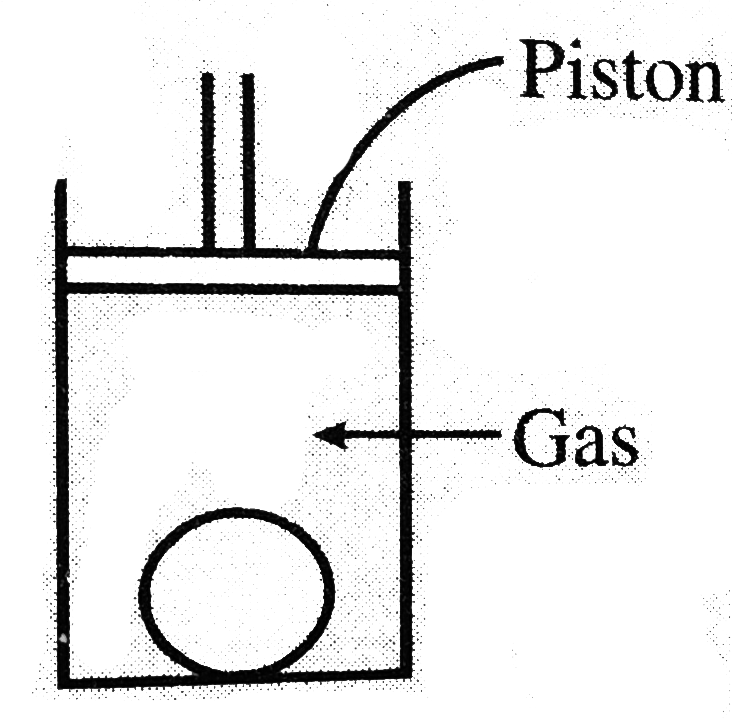
Find out bulk stress on the spherical object of radius `10//pi` cm Piston if area and mass of piston are `50 cm^(2)` and `50 kg`, respectively, for a cylinder filled with gas as Gas shown in figure.

Text Solution

Verified by Experts

`p_("gas")=(mg)/A+p_(a)=(50xx10)/(50xx10^(-4))+1xx10^(5)`

`=2xx10^(5)N//m^(2)`
Bulk stress `=p_("gas")=2xx10^(5)N//m^(2)`
Promotional Banner

Topper's Solved these Questions

  • PROPERTIES OF SOLIDS AND FLUIDS

    CENGAGE PHYSICS|Exercise Exercise 5.2|6 Videos
  • PROPERTIES OF SOLIDS AND FLUIDS

    CENGAGE PHYSICS|Exercise Exercise 5.3|9 Videos
  • PROPERTIES OF SOLIDS AND FLUIDS

    CENGAGE PHYSICS|Exercise Solved Examples|11 Videos
  • NEWTON'S LAWS OF MOTION 2

    CENGAGE PHYSICS|Exercise Integer type|1 Videos
  • RIGID BODY DYNAMICS 1

    CENGAGE PHYSICS|Exercise Integer|11 Videos

Similar Questions

Explore conceptually related problems

2 moles of a diatomic gas are enclosed in a cylinder piston arrangment. The area of cross section and mass of the piston are 1 cm^(2) and 1 kg respectively. A heater is supplying heat to the gas very slowly. Find heat supplied (in joule) by the heater is the piston moves through a distance of 10 cm. .

In a hydraulic press, the area of smaller and larger pistons are 5 cm^(2) and 20 cm^(2) , respectively. Calculate the weight which can be raised by larger piston if a force of 100 kgf is applied on smaller piston.

An object of weight 500 kg_(wt) is lifted by using a hydraulic press. The radii of the cross sections of the pump piston and press piston are 10 cm and 20 cm, respectively. Calculate the effort required to lift the object. Calculate the displacement of the load if the effort is moved through a distance of 20 cm.

In a hydraulic press used for lifting heavy loads, the diameters of smaller and larger pistons are 2 cm and 5 cm, respectively. If the smaller piston is pushed in through 5 cm, then by how much distance will the larger piston move out?

Two syringes of different cross-section (without needle filled with water are connected with a tightly fitted rubber tube filled with water. Diameters of the smaller piston an larger piston are 1 cm and 3 cm respectively. If a force of 10N is applied to the smaller piston then the force exerted on the larger piston is

Two syringes of different cross-sections (with out needles) filled with water are connected with a tightly fitted rubber tube filled with water. Diameters of the smaller pison and larger pistom are 1.0cm and 3.0 cm respectively. (a) Find the force on the larger piston when a force of 10N is applied to the smaller piston. (b) The smaller piston is pused in through 6.0 cm, much does the larger piston move out?

The fixed non-conducting cylinder shown in figure has a noconducting heavy piston of mass M that can slide without friction. The area of piston is S and the cylinder is filled with an ideal gas (lambda=1.5) with an initial volume V and an initial pressure P . Assume that the outside pressure on the piston is zero (vaccum). (Neglect acceleration due to gravity). For the temperature of the gas to drop to one half of its original value. the piston will have to move by a distance:

A piston of mass M=3kg and radius R=4cm has a hole into which a thin pipe of radius r=1 cm is inserted the piston can enter a cylinder tightly and without friction an initially it is at the bottom of the cylinder 750 gm of water is now poured into the pipe so that the piston&pipe and lifted up as shown find the height H of water in the cylinder and height h of water in the pipe.

