Home
Class 12
PHYSICS
Two particles A and B having charges 8....

Two particles A and B having charges ` 8.0 xx 10 ^(-6) C` and `-2.0 xx 10(-6) C` respectively are held fixed with a. separtion of 20cm. Where should a thired charged. particle be placed so that it dose not experience a net electric force?.

Text Solution

Verified by Experts
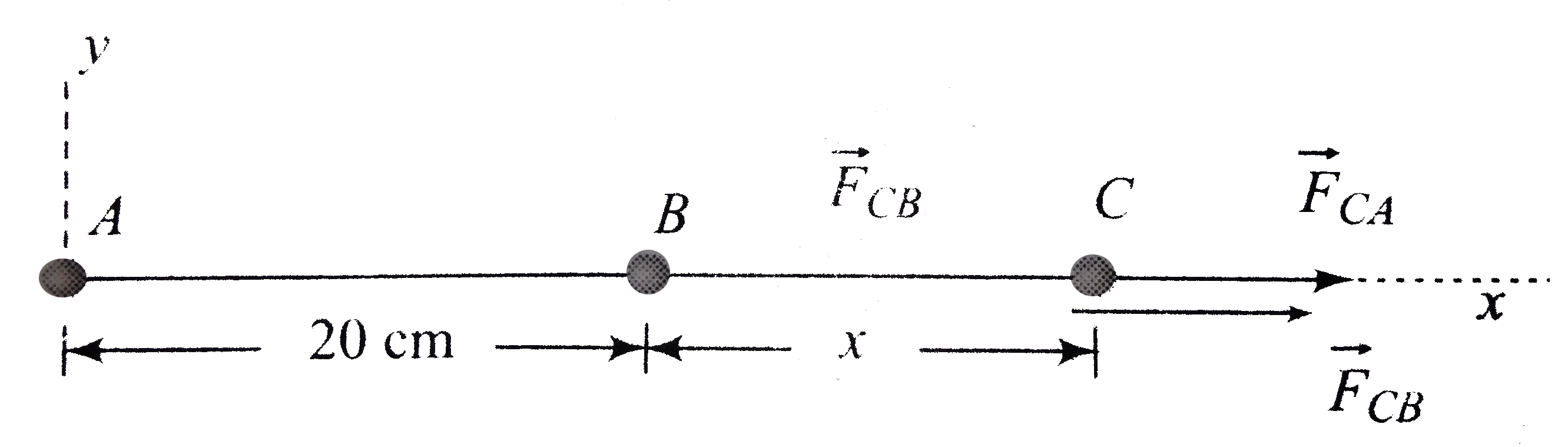
As the net electric force on C should be equal to zero, the forces due to A and B must be opposite in direction. Hence, the particle should be placed on the line AB, as A and B have charges of opposite signs, C cannot be between A and B also, A had larger magnitude of beloxx charge than B. Hence, C should be placed closer to B than A. The situationis shown in figure suppose BC=x and the charge on C is Q.
`vecF_(CA)=(1)/(4 pi epsilon_(0))((8.0xx10^(-6))Q)/((0.2+x)^(2))hat i`
and `vecF_(CB)=(1)/(4 pi epsilon_(0))((2.0xx10^(-6))Q)/(x^2)hat i`

`vecF_(C)+vecF_(CA)+vecF_(CB)=(1)/(4 pi epsilon_(0))[((8.0xx10^(-6))Q)/((0.2+x)^(2))-((2.0xx10^(-6))Q)/(x^2)]i`
But `|vecF_(C)|=0`
Hence, `(1)/(4 pi epsilon_(0))[((8.0xx10^(-6))Q)/((0.2+x)^(2))-((2.0xx10^(-6))Q)/(x^(2))]=0`
Which goves `x=0.2m`
Promotional Banner

Topper's Solved these Questions

  • COULOMB LAW AND ELECTRIC FIELD

    CENGAGE PHYSICS|Exercise Subjective|32 Videos
  • COULOMB LAW AND ELECTRIC FIELD

    CENGAGE PHYSICS|Exercise Single Correct|47 Videos
  • COULOMB LAW AND ELECTRIC FIELD

    CENGAGE PHYSICS|Exercise Solved examples|10 Videos
  • COMMUNICATION SYSTEM

    CENGAGE PHYSICS|Exercise QUESTION BANK|19 Videos
  • Current Electricity

    CENGAGE PHYSICS|Exercise QUESTION BANK|40 Videos

Similar Questions

Explore conceptually related problems

Two-particles A and B having charges 8xx10^(-6)C and -2xx10^(-6)C respectively are held fixed with a separation of 20 cm. Where should a third charged particle C be placed so that it does not experience a net electric force?

Two particles A and B having charges 20 mu C and -5 mu C respectively are held fixed with a separation of 5 cm. At what position a third charged particle should be placed so that it does not experience a net electric force ?

Two particles A and B having charges of 4xx10^(-6)C and -8xx10^(-6) C respectively, are held fixed at a separation of 60 cm. Locate the point (s) on the line AB where the electric potential is zero.

Two particles A and B having charges of +2.00 xx 10^(-6) C and of - 4.00xx 10^(-6) respectively are held fixed at a separation of 20.0 cm . Locate the point(s) on the line AB where (a) the electric field is zero (b) the electric potential is zero.

Two chargea 2.0xx10^(-6) C are placed at a separation of 10 cm. where should a third charge be placed such that it experiences no net force due to these charges.

Two point particle A and B having charges of 4xx10^(-6) C and -64xx10^(-6) C respectively are held at a separation of 90 cm. Locate the point(s) on the line AB or on its extension where the electric field is zero

Two particles A and B, having opposite charges 2.0xx 10^(-6) and -2.0 xx10^(-6) C , are placed at a separaton of 1.0 cm.(b) Calculate the electric field at a point on the axis of the dipole 1.0 m away from the centre. (c ) Calculate the electric field at a point on the perpendicular bisector of the dipole and 1.0 m away from the centre.

Two particles A and B having charges q and 2q respectively are placed on a smooth table with a separation d. A third particle C is to be clamped on the table in such a way that the particles A and B remain at rest on the table under electrical forces. What should be the charge on C and where should it clamped?

Two equal charges, 2.0xx10^(-7) C each, are held fixed at a separation of 20cm. A third charge of equal magnitude is placed midway between the two both the charges. How much work is done by the electric field during the process?

Charges 5.0 xx ^(-7) C and 1.0 xx 10^(-7) C are held fixed at the three cornners A, B, C of an equilateral . charge at C due to the rest two.

CENGAGE PHYSICS-COULOMB LAW AND ELECTRIC FIELD-Exercises
  1. Two small balls having equal poistive charges Q( coulomb) on each are ...

    Text Solution

    |

  2. Find the force on a charge q(1)(=20 mu C) due to the charge of q(2)(=1...

    Text Solution

    |

  3. Two particles A and B having charges 8.0 xx 10 ^(-6) C and -2.0 xx 1...

    Text Solution

    |

  4. A particle of mass m carrying a charge -q(1) starts moving around a fi...

    Text Solution

    |

  5. A particle with positive charge Q is held fixed at the origen. A secon...

    Text Solution

    |

  6. Fig. shows some of the electric field lines due to three point charges...

    Text Solution

    |

  7. Two point charge Q and 4Q are fixed at a distance of 12cm from each ot...

    Text Solution

    |

  8. Is an electric field of the type shown by the electric lines in fig. p...

    Text Solution

    |

  9. Fig. shows three electric field lines. (a) What is the direction of ...

    Text Solution

    |

  10. In fig, two particles, each of charge -q are arranged symmetrically ab...

    Text Solution

    |

  11. In fig. a plastic rod in the form of circular are with charge +Q unfor...

    Text Solution

    |

  12. Figure shows that E has the same value for all points is front fo an i...

    Text Solution

    |

  13. Figure shows the tracks of three charged particles in a unform electro...

    Text Solution

    |

  14. Three small spheres x,y, and z carry charges of equal magnitudes and w...

    Text Solution

    |

  15. Two identical positive charges are fixed on the y-axis, at equal dista...

    Text Solution

    |

  16. An electric field is defined in terms of q(0) a small positive charge....

    Text Solution

    |

  17. Three identical positive charges Q are arranged at the vertices of an...

    Text Solution

    |

  18. Two point charges +5xx10^(-19)C and +20xx10^(-19)C are separated by a ...

    Text Solution

    |

  19. An electron (mass m(e ))falls through a distance d in a uniform electr...

    Text Solution

    |

  20. Two charged metal plates in vacuum are 10cm apart. A uniform electric ...

    Text Solution

    |

