Home
Class 12
PHYSICS
Two point charges (Q each are placed at ...

Two point charges (Q each are placed at (0,y) and (0-y) A point charge q of the sme polarity can move along the x-axis. Then

A

the force on q is maximum at `x=+-y//sqrt(2)`

B

the charge q is in equilibrium at the origin

C

the charge q performs an oscillatory motion about the origin

D

for any position of q other than origin the force is directed away from origin

Text Solution

Verified by Experts

The correct Answer is:
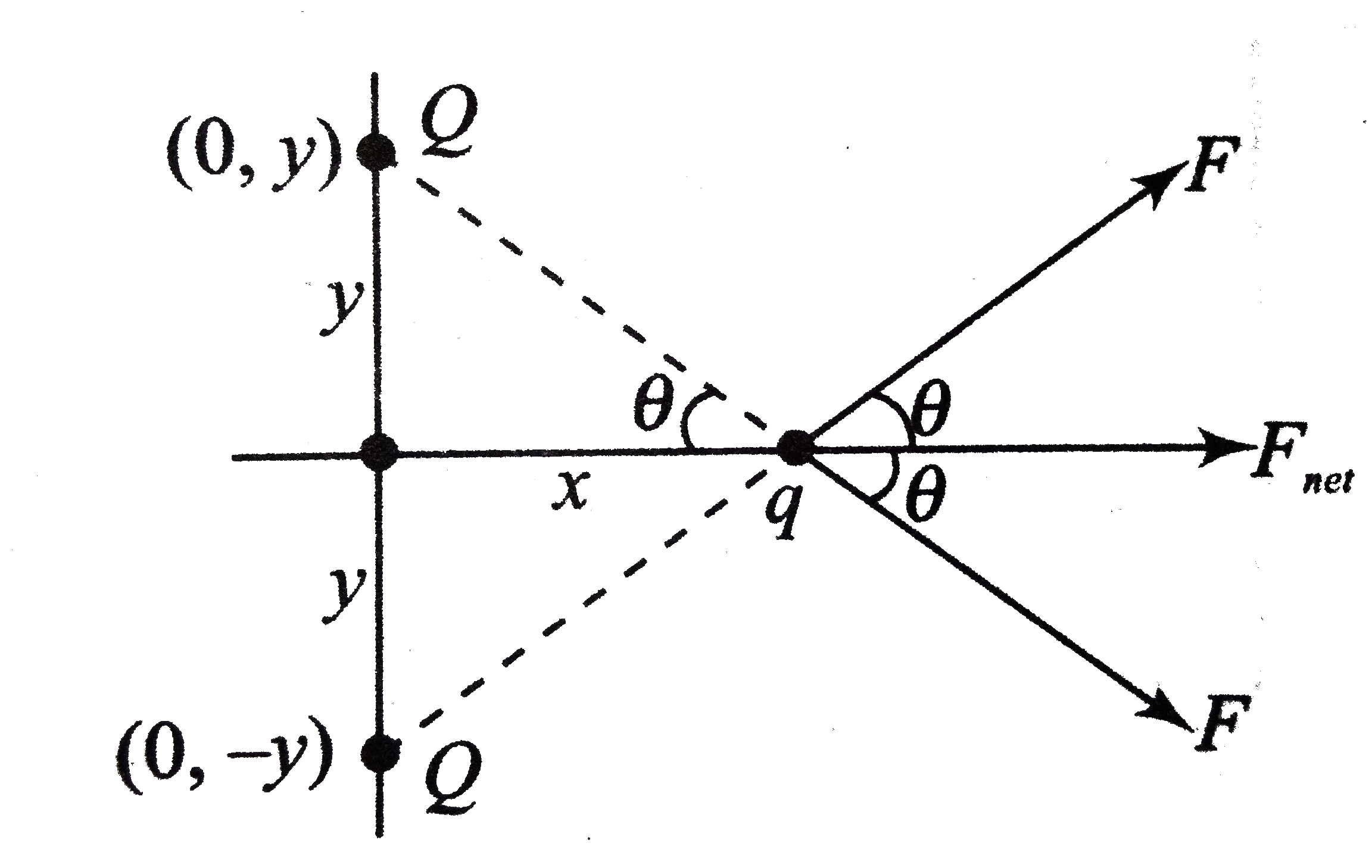
A, B, D

Net force on q
`F_("net")=2F cos theta =(2)/(4 pi epsilon_(0))(Qq)/((x^(2)+y^(2))) (x)/(sqrt(x^(2)+y^(2)))`
`(Qq)/(2 pi epsilon_(0)) (x)/((x^(2)+y^(2))^(3//2))`

To maximize `F_("net")`
`(dF_("net"))/(dx)=0 or x =+-(y)/(sqrt(2))`. Hence (a) is correct.
At origin x=0 `F_("net")=0`. Hence (b) is correct. since net force is away form origin particle will not perform oscillatory motion. Hence (c ) is incorrect and (d) is correct.
Promotional Banner

Topper's Solved these Questions

  • COULOMB LAW AND ELECTRIC FIELD

    CENGAGE PHYSICS|Exercise Comprehension|25 Videos
  • COULOMB LAW AND ELECTRIC FIELD

    CENGAGE PHYSICS|Exercise Integer|8 Videos
  • COULOMB LAW AND ELECTRIC FIELD

    CENGAGE PHYSICS|Exercise Single Correct|47 Videos
  • COMMUNICATION SYSTEM

    CENGAGE PHYSICS|Exercise QUESTION BANK|19 Videos
  • Current Electricity

    CENGAGE PHYSICS|Exercise QUESTION BANK|40 Videos

Similar Questions

Explore conceptually related problems

Two identical positive charges Q each are placed on the x axis at point (-a,0) and (a,0) A point charge of magnitude q is placed at the origin. For small displacement along x axis, the charge q executes simple harmonic motion if it is poitive and its time period is T_(1) . if the charge q is negative, it perform oscillations when displaced along y axis. in this case the time period of small oscillations is T_(2). find (T_(1))/(T_(2))

Two point charges q each are fixed at (a,0) and (-a,0). A third charge Q is placed at origin. Electrons potential energy of the system will

Two point charges +q and fixed at (a,0,0) and (-a,0,0) . A third point charge -q is at origin. State whether ite equlilbrium is stable, unstable or neutral if it is slightly displaced: (a) along x-axis. , (b) along y-axis.

Two point charge +-q are placed on the axis at x= -a and x= +-a , as shown in fig. (i) Plot the variation of E along the x-axis. (ii) Plot the variation of E along the y-axis.

Two equal negative charges are fixed at points and on y-axis. A positive charge Q is released from rest at the point on the x-axis. The charge Q will:

Two point charge -q and +q//2 are situated at the origin and the point (a,0,0) respectively. The point along the X -axis where the electic field Vanishes is

A point charge q_1 = 4.00 nC is placed at the origin, and a second point charge q_2 = -3.00 nC , placed on the x-axis at x = + 20.0 cm. A third point charge q_3 = 2.00 nC is placed on the X-axis between q_1, and q_2 . (Take as zero the potential energy of the three charges when they are infinitely far apart). (a) What is the potential energy of the system of the three charges if q_3 is placed at x= + 10.0 cm? (b) Where should q_3 be placed to make the potential energy of the system equal to zero?

Two point charges of +q each are placed at two diagonally opposite corners of a square. Another two point charges of -q charge each are placed at the two remaining corners. Take the edge length of square equal to l. Calculate (i) work needed to move these charges slowly from an infinite separation to this given configuration. (ii) Assume that four charges at corners of the square are held fixed. Another charge Q is to be moved from infinity to the centre of this square slowly. What additional work is required to do so?

