Home
Class 12
PHYSICS
Four balls, each with mass m, are connec...

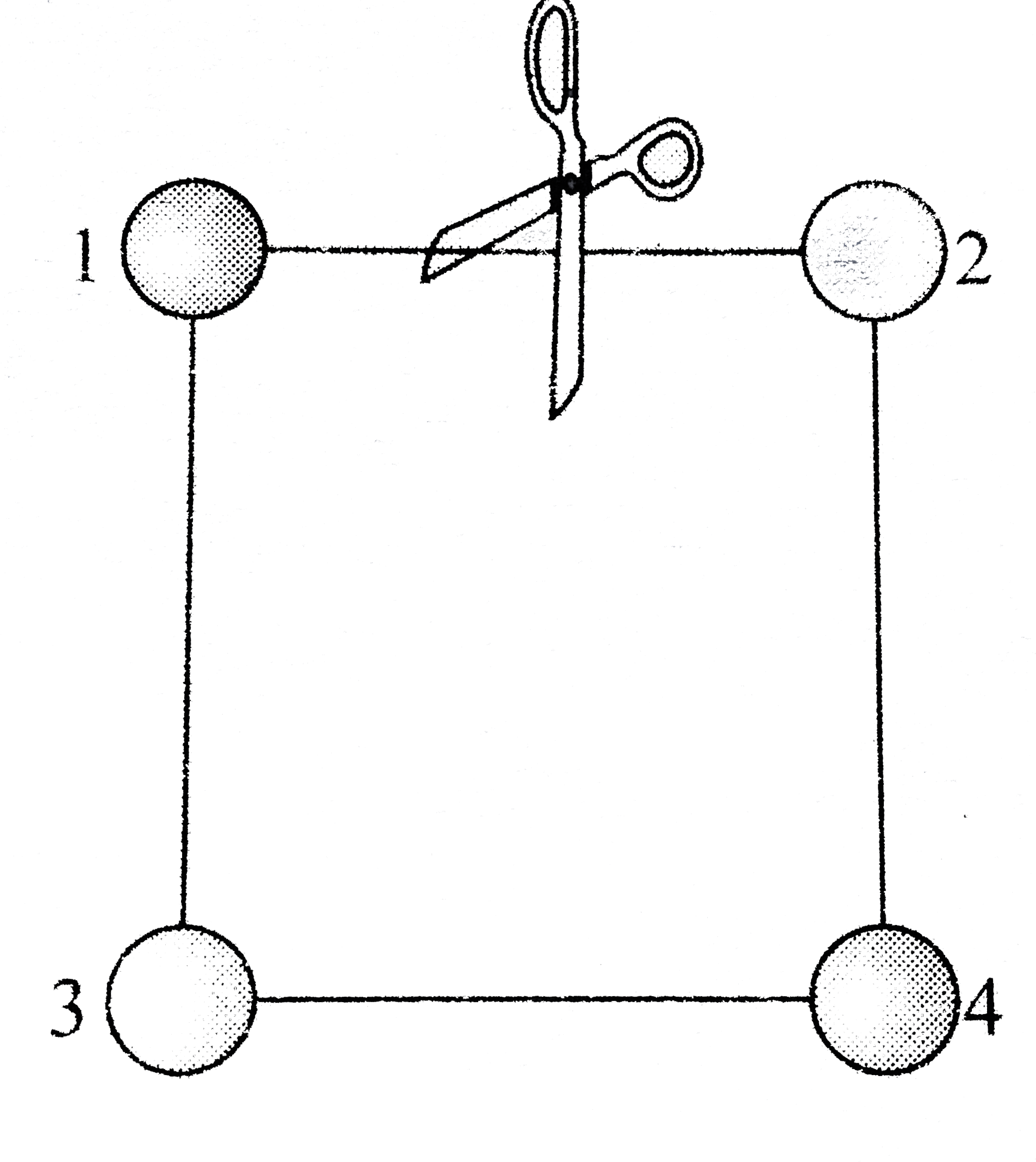
Four balls, each with mass m, are connected by four nonconducting strings to from a square with side with A, as shown in (Fig. 3.43.) The assembly is placed on a horizontal nonconducting frictionless surface. Balls 1 and 2 each have charge q, and balls 3 and 4 are uncharged. Find the maximum speed of balls 1 and 2 after the string connecting them is cut.
.

Text Solution

Verified by Experts

Take the illustration presented with the problem as an initial picture. No external horizontal forces act on the set of four balls, so its center of mass stays fixed at the location of the center of the square. As the charged balls 1 and 2 swing out and away from each other, balls 3 and 4 move up with equal y- components of velocity. The maximum - kinetic energy point is illustrated. System energy is conserved, so
`(k_e q^2)/a = (k_e q^2)/(3 a) + (1)/(2) m v^2 + (1)/(2) m v^2 + (1)/(2)m v^2 + (1)/(2)m v^2`
or `(2 k _eq^2)/(3a) = 2 mv^2` or `v = sqrt((k_e q^2)/(3 a m))`.
.
Promotional Banner

Topper's Solved these Questions

  • ELECTRIC POTENTIAL

    CENGAGE PHYSICS|Exercise Exercise 3.2|9 Videos
  • ELECTRIC POTENTIAL

    CENGAGE PHYSICS|Exercise Exercise 3.3|9 Videos
  • ELECTRIC POTENTIAL

    CENGAGE PHYSICS|Exercise Examples|9 Videos
  • ELECTRIC FLUX AND GAUSS LAW

    CENGAGE PHYSICS|Exercise MCQ s|38 Videos
  • ELECTRICAL MEASURING INSTRUMENTS

    CENGAGE PHYSICS|Exercise M.C.Q|2 Videos

Similar Questions

Explore conceptually related problems

Four blocks each of mass M connected by a massless strings are pulled by a force F on a smooth horizontal surface, as shown in figure.

A ball of mass 1.00 kg is attached to a loose string fixed to a ceiling. The ball is released from rest and falls 2.00 m, where the string suddenly stops it. Find the impulse on it from the string.

A boy revolves two balls each of mass 100 gm and tied with strings of 1 metre length each in horizontal circle as shown in figure. If the speed of outermost ball is 6 m/s , then tension in string-1 is-

Two indentical pith balls, each carrying charge q, are suspended from a common point by two strings of equal length l. Find the mass of each ball if the angle between the strings is 2theta in equilibrium.

Two small balls A and B are interconnected by an inextensible string of legth L. Mass of ball A =m, mass of ball B = m. the balls are resting on a frictionlesss harixontal surgace , with the distance between them =3L.5 In this position ball A is suddenly given a harizontal velocity v_(0) perpendicular to the line joining the two balls. (see fig 4E . 18 (a)) (a) Find the speed of ball B houst after the string becomes taut (b) find the impulse of the tension in string when the string becomes taut. (c) Find the steady tension in string much after the string has become taut.

A ball of mass 0.5 kg is attached to a light string of length 2m. The ball is whirled on la horizontal smooth surface is a circle of rdius 2 m as shown in fig. If the string can withstand tension up to 100 N, what is the maximum speed at which the bal can be whirled.

Two balls having masses m and 2m are fastened to two light strings of same length l figure. The other ends of the strings ar fixed at O. The strings are kept in the same horizontal line and the system is released from rest. The collision between the balls is elastic. a. Find velocities of the balls just after their collision. b. How high will the balls rise after the collision.

Two small balls, each having equal positive charge Q are suspended by two insulationg strings of equal length l from a hook fixed to a stand. It mass of each ball =m and total angle between the two strings is 60^(@) m, then find the charge on each ball.

CENGAGE PHYSICS-ELECTRIC POTENTIAL-Exercise 3.1
  1. If yoy know ( E) at a given point, can yoy calculate V at that point ?...

    Text Solution

    |

  2. Can there be a potential difference between two adjacent conductors th...

    Text Solution

    |

  3. An electron moves from the positive to the negative terminal of a batt...

    Text Solution

    |

  4. We want to produce a proton with kinetic energy 4.3 xx 106-15 J. Throu...

    Text Solution

    |

  5. The potential produced by a point charge is V = kQ// r. Use this infor...

    Text Solution

    |

  6. a. A circle is drawn with center as a charge +q. What is the work done...

    Text Solution

    |

  7. A uniform electric field E exists between two oppositely charged plate...

    Text Solution

    |

  8. Show that if at some part of a field the lines of force have the from ...

    Text Solution

    |

  9. If you carry out the integral of the electric field int vec E. vec d l...

    Text Solution

    |

  10. (Figure 3.41) shows the lines of constant potential in region in which...

    Text Solution

    |

  11. A charge 2 muC is taken from inifinity point in an electric field, wit...

    Text Solution

    |

  12. When charge 10 mu C is shifted from inifinity to a point in an electri...

    Text Solution

    |

  13. A charge 3 mu C is released at rest from a point P where electric pote...

    Text Solution

    |

  14. Find out the following a. VA - VB b. VB - VC c. VC - VA d. VD...

    Text Solution

    |

  15. Four balls, each with mass m, are connected by four nonconducting stri...

    Text Solution

    |

  16. Consider the configuration of a system of four charges each of value (...

    Text Solution

    |

  17. The electric potential in a region is represented a v = 2x + 3y - z. O...

    Text Solution

    |

  18. Find V(ab) in an electric fields vec E = (2 hat I + 3 hat j + 4 hat k)...

    Text Solution

    |

  19. A uniform electric field exists in x y plane as shown in Fig. 3.45. Fi...

    Text Solution

    |

  20. The electric field in a region is given by E = (4 axy sqrt(z))hat i + ...

    Text Solution

    |