Home
Class 12
PHYSICS
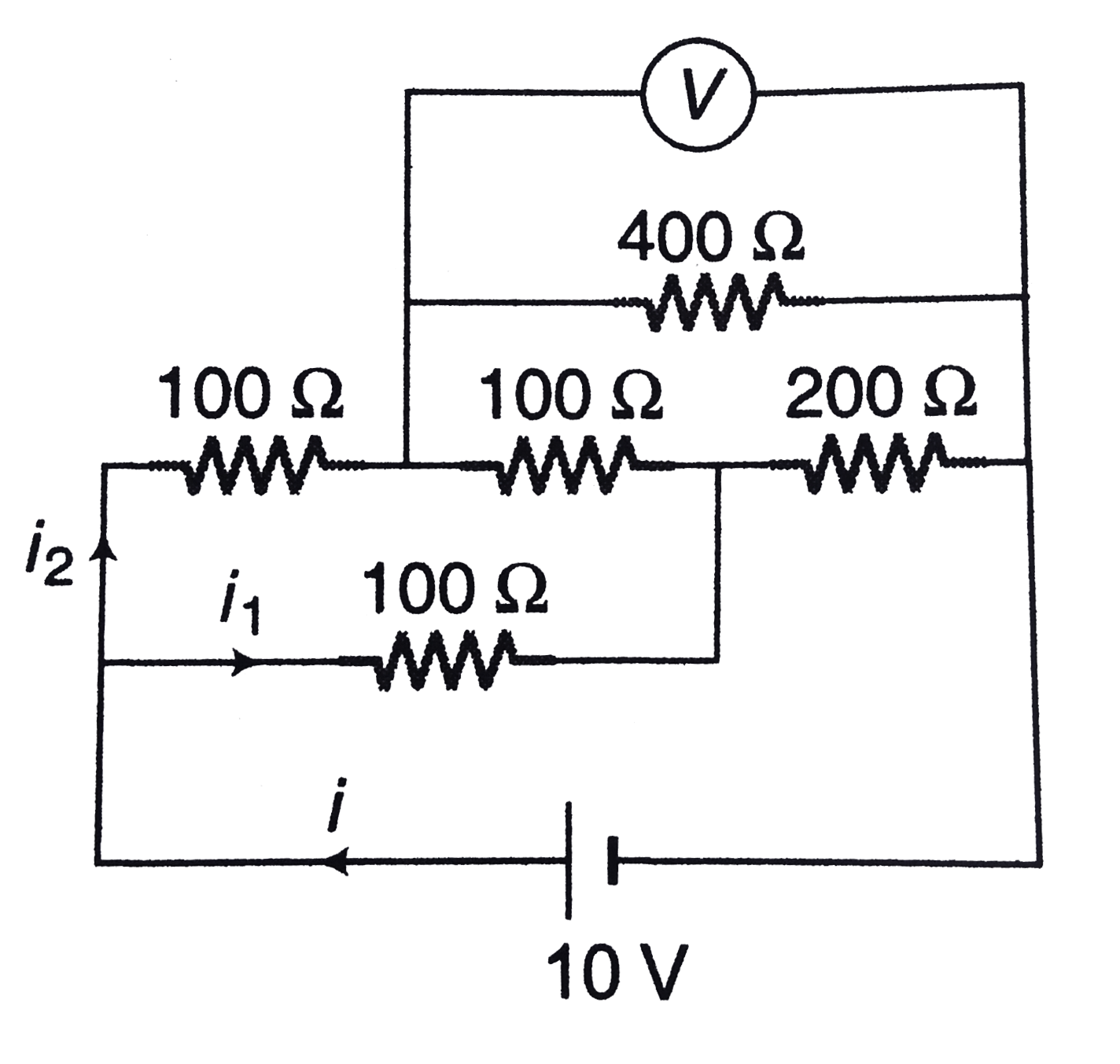
An electrical circuit is shown in figure...

An electrical circuit is shown in figure. Calculate the potential difference across the resistor of `400 Omega` as will be measured by the voltmeter Vof resistance `400 Omega` either by applying Kirchhoff's rules or otherwise.

Text Solution

Verified by Experts
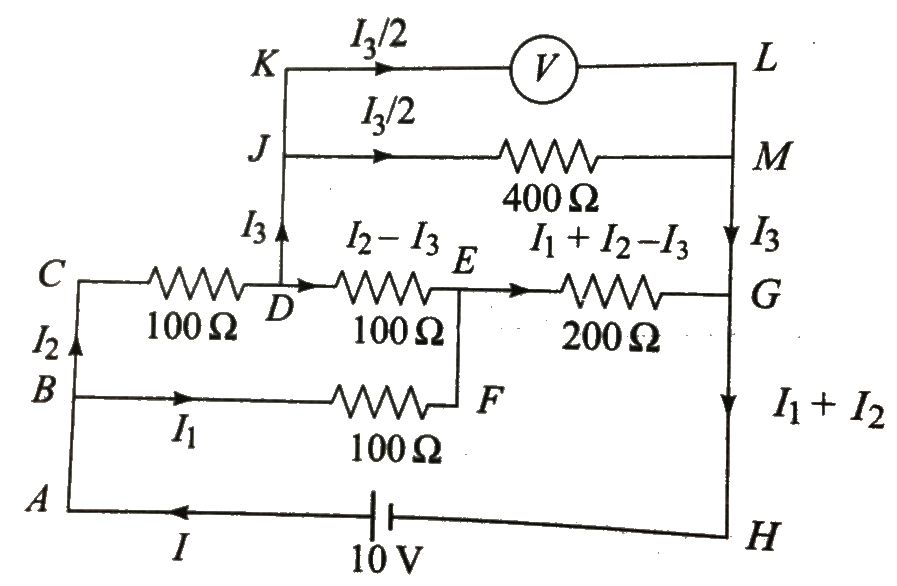
Applying kirchhoff's law in loop `JMGDJ`, we get

`-(I_(3))/(2) xx 400 + (I_(1) + I_(2) - I_(3)) 200 + (I_(2) - I_(3)) 100 = 0`
or `- 500 I_(3) + 200 I_(1) + 300 I_(2) = 0` or `2 I_(1) + 3I_(2) - 5I_(3) = 0` (i)
Applying kirchhoff's law in `CDEFBC`, we get
`- 100I_(2) - 100(I_(2) - I_(3)) + 100I_(1) = 0`
or `I_(1) - 2I_(2) + I_(3) = 0` (ii)
Mulplying Eq. (i) by `2` and subracting from Eq. (i), we have
`2I_(1) + 3I_(2) - 5I_(3) - 2I_(1) + 4I_(2) - 2I_(3) = 0` or `I_(2) = I_(3)` (iii)
Applying kirchhoff's law in `ABEFGHA`, we get
`- 3I_(1) - 2I_(2) + 2I_(3) + 0.1 = 0` (iv)
Multiplying Eq.(ii) by `3` and adding it to Eq.(iv), we get
`3I_(1) - 6I_(2) + 3I_(3) - 3I_(1) - 2I_(2) + 2I_(3) + 0.1 = 0`
or `-8I_(2) + 5I_(3) + 0.1 = 0` or `-8I_(3) + 5I_(3) + 0.1 = 0`
or `3I_(3) = 0.1` or `I_(3) = (0.1)/(3)`
Therefore, potential difference across `JM` is
`(0.1//3)/(2) xx 400 = (0.1)/(2 xx 3) xx 400`
`= (20)/(3) = 6.67 V`
Alternative method
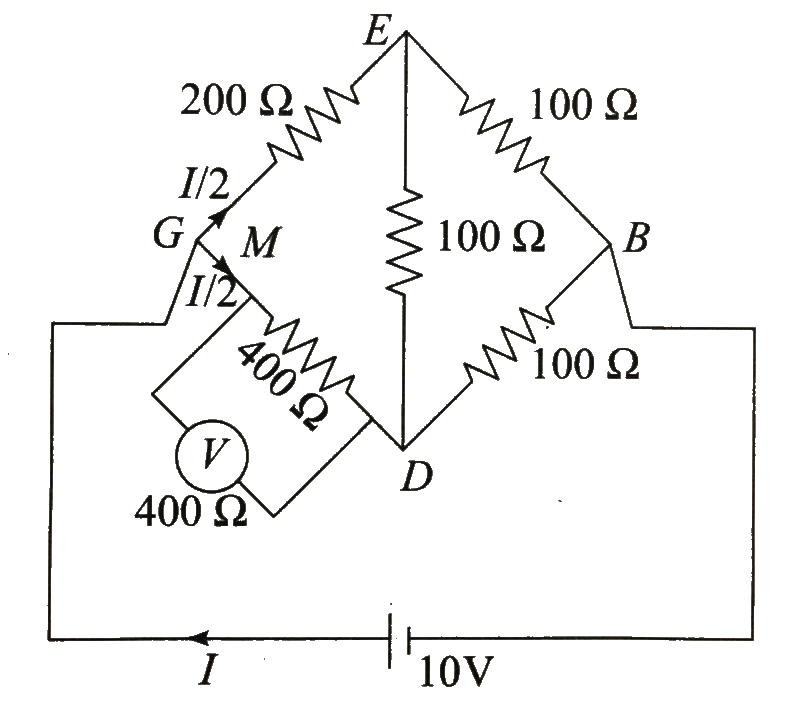
We can redraw the circuit as shows in Fig. `6.26`. The equivalent resistance between `G` and `D` is
`R_(GD) = (400 xx 400)/(400 + 400) = 200 Omega ("Since" (R_(GE))/(R_(GD)) = (R_(EB))/(R_(DB))) `
Therefore, it is a case of a balanced wheatstone bridge. The equivalent resistance across `G` and `B` is
`R_(GB) = (300 xx 300)/(300 + 300) = 150 Omega`
Therefore, current is
`I = (V)/(R_(GB)) = (10)/(150) = (1)/(15) A`

Since `RGEB = RGDB`, the current is divided at `G` into two equal
parts. The current `I//2` is further divided into two equal parts at
`M`. Therefore, the potential difference across the voltmeter is
`(1)/(4) xx 400 = (1)/(15) xx 100 = (20)/(3) V`
Promotional Banner

Topper's Solved these Questions

  • ELECTRICAL MEASURING INSTRUMENTS

    CENGAGE PHYSICS|Exercise Exercise 6.1|15 Videos
  • ELECTRICAL MEASURING INSTRUMENTS

    CENGAGE PHYSICS|Exercise Subjective|18 Videos
  • ELECTRICAL MEASURING INSTRUMENTS

    CENGAGE PHYSICS|Exercise M.C.Q|2 Videos
  • ELECTRIC POTENTIAL

    CENGAGE PHYSICS|Exercise DPP 3.5|14 Videos
  • ELECTROMAGENTIC INDUCTION

    CENGAGE PHYSICS|Exercise QUESTION BANK|40 Videos

Similar Questions

Explore conceptually related problems

An elctrical circuit is shown in Fig. Calculate the potential difference across the resistor of 400 ohm, as will be measured by the voltmeter V of resistance 400 ohm, either by applying Kirchhoff's rules or otherwise. .

In the circuit shown below: The potential difference across the 3 Omega resistor is:

In the electrical network shown in the figure, What will be the potential difference (in volt) across 3Omega resistance ?

Calculate the potential difference across the 2k Omega resistor in the circuit shown in figure. The internal resistance of the cells are negligible.

In the given circuit diagram, potential difference across 2 Omega resistance is

To measure a potential difference across a resistor of resistance RS, a voltmeter of resistance Ry is used. To measure the potential with a minimum accuracy of 95%, then

In the circuit shown in figure-3.387, the voltmeter is having a resistance 4000 Omega . Find the percentage error in reading of this voltmeter.

The potential difference across the 100 Omega resistance in the following circuit is measured by a voltmeter of 900 Omega resistance. The percentage error made in reading the potential difference is