Home
Class 12
CHEMISTRY
An orgnic compound (A) contains 79.25% C...

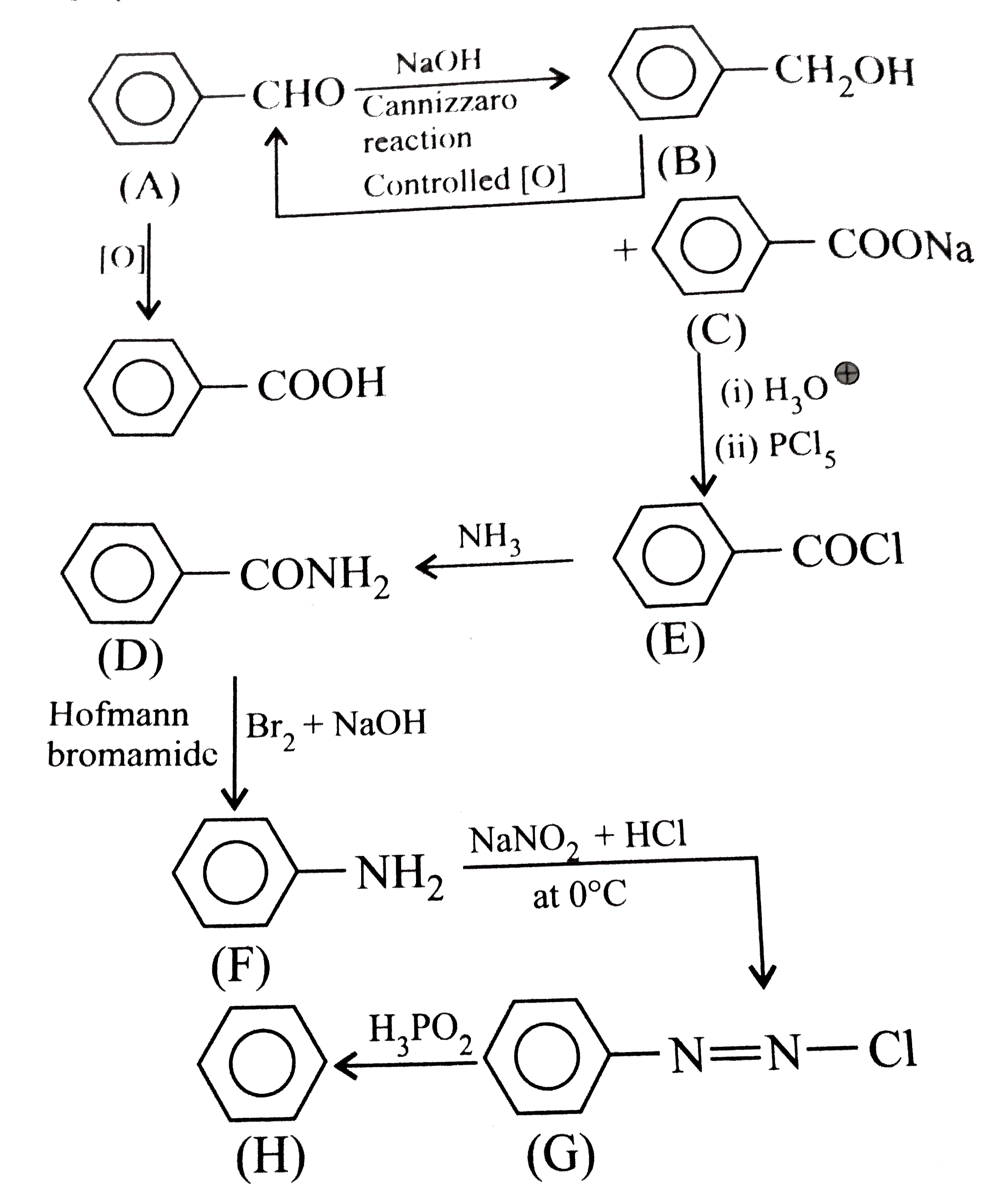
An orgnic compound (A) contains `79.25%` C, `5.66%` H, and `15.09%` O. It has a vapour density of 53 and reduces the Tollens reagent. Action of NaOH on (A) produces (B) and (C ). (B) on controlled oxidation gives (A) which on further oxidation produces (C ). (C ) on distillation with `PCl_(5)` gives (D). (D) reacts with aq. `NH_(3)` giving (E ) which reacts with `NaOH` and `Br_(2)` forming (F). The latter on reaction which hypo-phoshorus acid yield (H). Identify the compounds (A) to (H).

Text Solution

Verified by Experts
`C =(79.25)/(12)`, `H =(5.66)/(1)`, `O =(15.09)/(16)`
`=6.604` `=5.66` `=0.81`
Simplest formula `(6.6)/(0.81)`, `(5.66)/(0.81)`, `(0.81)/(0.81)`
Formula `=C_(7)H_(6)O=84+6+16=106`
V.D. = 53, Mw = 106
Degree of unsaturation `=C_(7)H_(6)`
`(C_(7)H_(16)=H_(16)-H_(6)=H_(10))`
`=5^(@)` unsaturation `=4^(@)` (due to benzene) and `1^(@)` (due to aldehyde).
Promotional Banner

Topper's Solved these Questions

  • ALIPHATIC AND AROMATIC ALDEHYDES AND KETONES

    CENGAGE CHEMISTRY|Exercise Exercises Concept Application|20 Videos
  • ALIPHATIC AND AROMATIC ALDEHYDES AND KETONES

    CENGAGE CHEMISTRY|Exercise Exercises Linked Comprehension|59 Videos
  • ALIPHATIC AND AROMATIC ALDEHYDES AND KETONES

    CENGAGE CHEMISTRY|Exercise Solved Examples|13 Videos
  • ALCOHOL,PHENOL AND ETHERS

    CENGAGE CHEMISTRY|Exercise Archives Analytical And Descriptive|15 Videos
  • AMINES

    CENGAGE CHEMISTRY|Exercise QUESTION BANK|1 Videos

Similar Questions

Explore conceptually related problems

An organic compound (A) containing 60.12% (C ) and 13.3% H has vapour density of 30. On oxidation it gives (B) (C_(3)H_(6)O) which on further oxidation by NaOH and I_(2) gives compound (C ) (C_(2)H_(3)O_(2)Na) . When (B) is treated with hydroxylamine, a compound (D) (C_(3)H_(7)NO) is formed. what are (A), (B), (C ) and (D) ?

An organic compound (A) contains 87.27% C and 13.73% H. Its vapour density is 55. Ozonolysis of (A) gives three compounds (B), (C ), and (D). (B) undergoes a positive iodoform reaction and reacts with phenylhdrazine. Compounds (C ) and (D) are not positive to Iodoform test. (C ) on controlled oxidation gives (E ) (C_(4)H_(6)O_(4)) , which reacts with two equivalents of NaOH for complete neutralisation. (E) on heating above its melting point yields (F) (C_(4)H_(4)O_(3)) along with H_(2)O . Compound D reacts with NaOH solution to form (G) and (H). Acidified solution of (G) yields with a voltile acid (I) which reduces ammonical AgNO_(3) solution. (I) undergoes reduction with LiAlH_(4) to produce (H). Assign structures for the lettered compounds (A) to (I).

An organic compound (A) has 76.6% C and 6.38% H. Its vapour density is 47. It gives characteristic colour with FeCl_(3) solution. (A) when treated with CO_(2) and NaOH at 140^(@)C under pressure gives (B) which on acidification gives (C ). (C ) reacts with acetyl chloride to give (D) which is a well known pain killer. Identify (A), (B), (C ), (D) and explain the reactions involved.

Boron reacts with oxygen at 700^@C to give (A) . Compound (A) reacts with carbon and dry chloride to give (B) and carbon monoxide. (B) on reduction with LiAlH_(4) gives ( C) along with LiCl and AlCl_(3). ( C) on reaction with ammonia gives (D) . Which on heating gives (E).(C) on reaction with NaH gives (F) . Compound (A) is

Calcium imide on hydrolysis will give gas (B) which on oxidation by beaching powder gives gas (C) gas (C) on reaction with magnesium give compound (D) . (D) on hydrolysis gives gas (B) . (B), (C) and (D) are

CENGAGE CHEMISTRY-ALIPHATIC AND AROMATIC ALDEHYDES AND KETONES-Exercises Subjective
  1. p-Hydroxybenzaldehyde does not undergo Cannizzaro reaction. Explain.

    Text Solution

    |

  2. Complete the following reaction

    Text Solution

    |

  3. Convert HCHO to glycol in one step only.

    Text Solution

    |

  4. Convert and vice versa.

    Text Solution

    |

  5. Convert benzence to PhCHO in one step only.

    Text Solution

    |

  6. An aromatic kentone (X) has the molecular formula C(10)H(12)O(2). On v...

    Text Solution

    |

  7. A natural compound (A) (C(7)H(6)O) forms an oxime. When (A) is treated...

    Text Solution

    |

  8. An organic compound (A) (C(8)H(14)O) forms an oxime and gives a positi...

    Text Solution

    |

  9. Compound (A) (C(6)H(12)O(2)) on reduction with LiAlH(4) yielded two co...

    Text Solution

    |

  10. Hydrocarbon (X), C(7)H(12), on reaction with boron hydride followed by...

    Text Solution

    |

  11. An organic compound (A) (C(6)H(10)) on reaction with CH(3)MgBr followe...

    Text Solution

    |

  12. An organic compound (A) contaning C, H, and O (16.32%) does not decolo...

    Text Solution

    |

  13. A 0.535 gm mixture of ethanol and acetaldehyde when heated with Fehlin...

    Text Solution

    |

  14. An orgnic compound (A) contains 79.25% C, 5.66% H, and 15.09% O. It ha...

    Text Solution

    |

  15. An organic compound (A) containing 60.12% (C ) and 13.3% H has vapour ...

    Text Solution

    |

  16. Two organic compounds (A) and (B) containing 62.01% C and 10.3% H reac...

    Text Solution

    |

  17. An organic compound (A) (C(5)H(7)OCl) reacts rapidly with ethanol to g...

    Text Solution

    |

  18. An organic compound (A) contains 87.27% C and 13.73% H. Its vapour den...

    Text Solution

    |

  19. An organic compound (A) C(4)H(9)Cl on reacting with aqueous KOH gives ...

    Text Solution

    |

  20. An alkyne with five carbon atoms per molecule when passed through dilu...

    Text Solution

    |

