Home
Class 12
CHEMISTRY
An aldehyde (A) (C(11)H(8)O), which does...

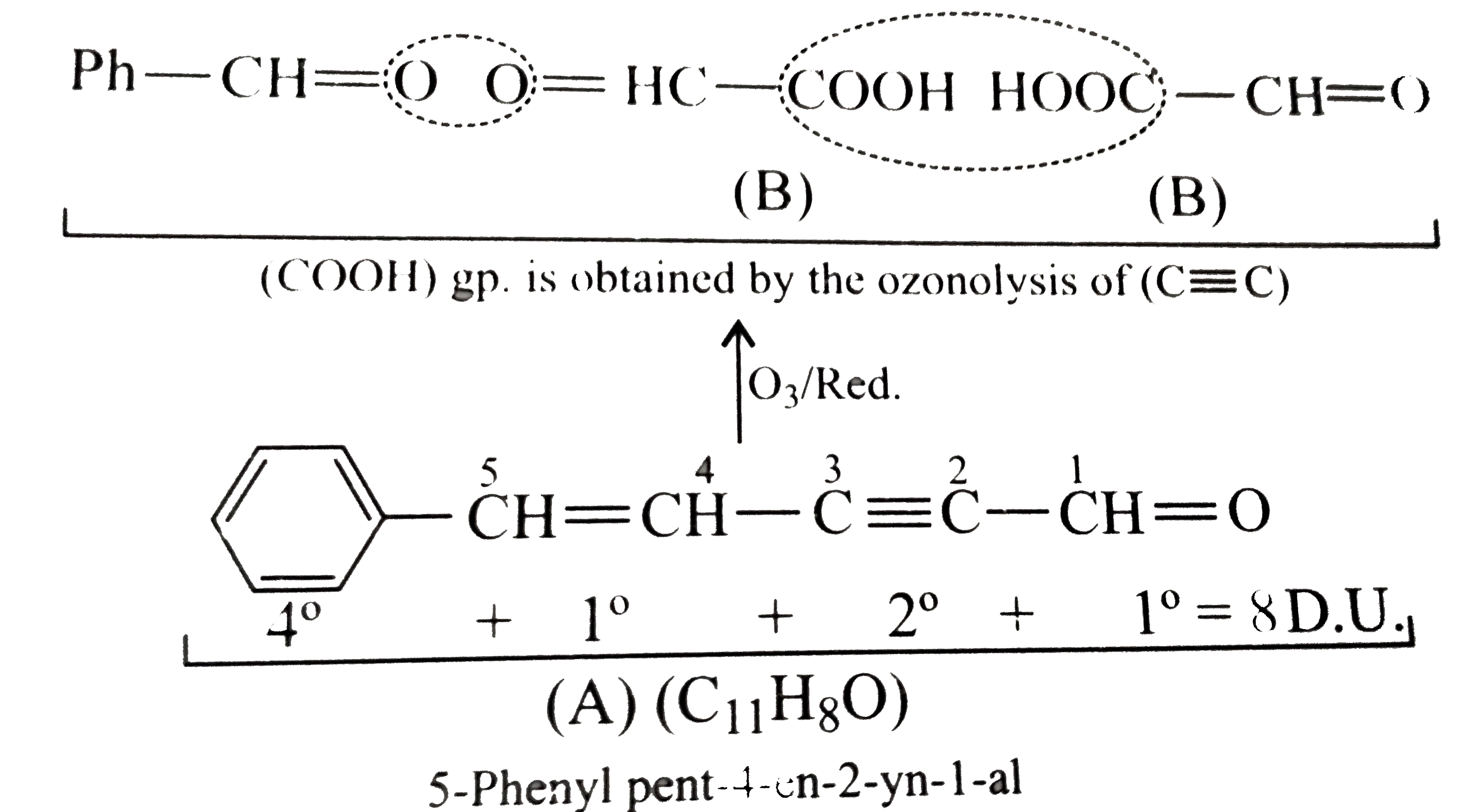
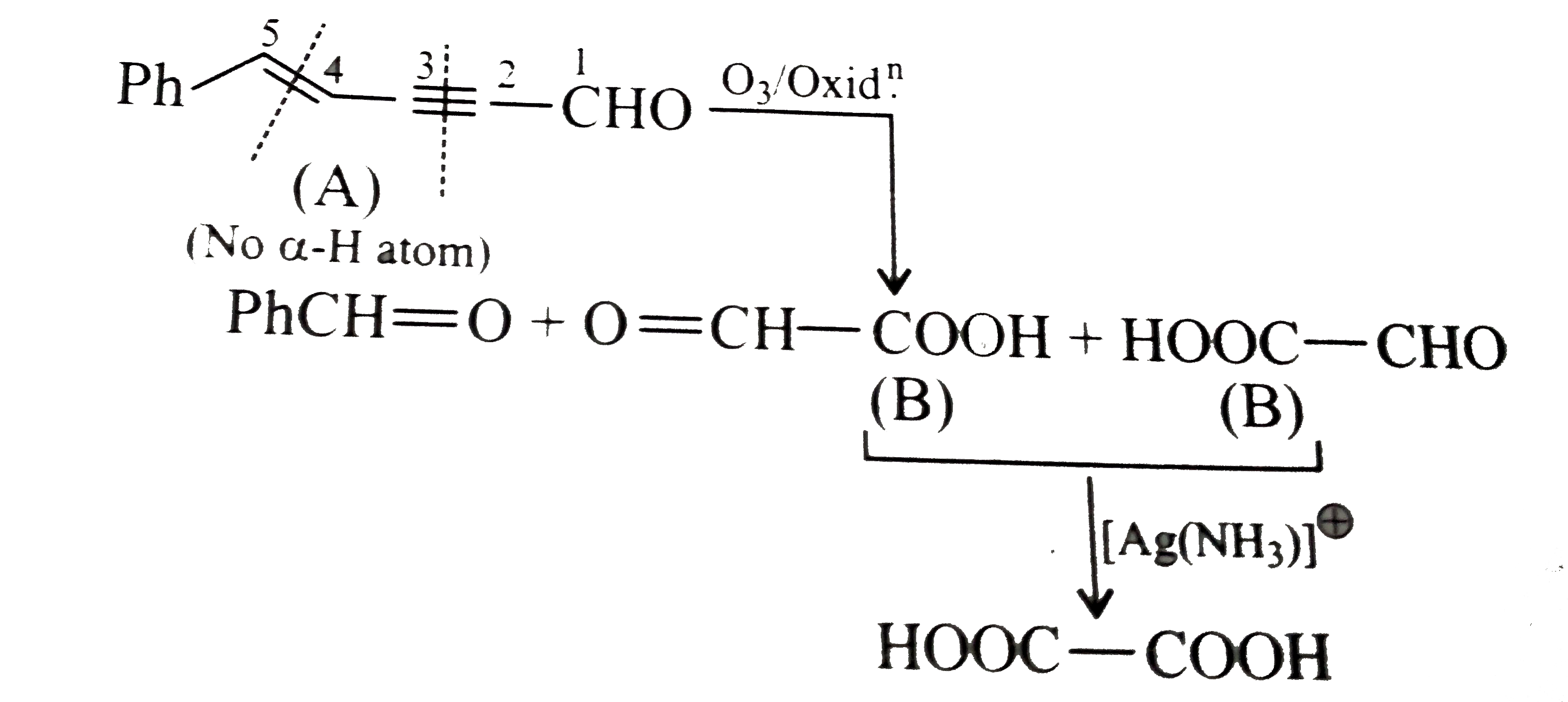
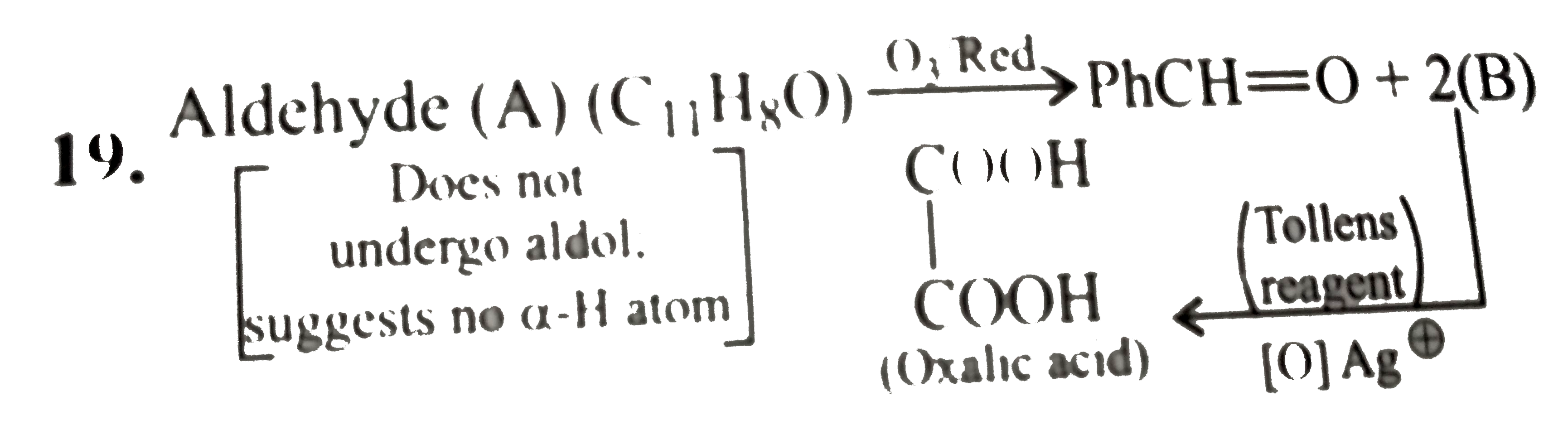
An aldehyde (A) `(C_(11)H_(8)O)`, which does not undergo self aldol condensation, gives benzaldehyde and 2 mol of (B) on ozonolysis. Compound (B) on oxidation with silver ion gives oxalic acid. Identify the compounds (A) and (B).

Text Solution

Verified by Experts

(Tollens reagent oxidises `(-CHO)` group to `(COOH)` group, without breaking `(C=C)` or `(C=C)` or `(C-=C)` bond.
compound (B) is `underset(COOH)underset(|)(CHO)` (Glyoxalic acid).
Proceed reverse to obtained the structure of (A).

Reactions:
Promotional Banner

Topper's Solved these Questions

  • ALIPHATIC AND AROMATIC ALDEHYDES AND KETONES

    CENGAGE CHEMISTRY|Exercise Archives Linked Comprehension|6 Videos
  • ALCOHOL,PHENOL AND ETHERS

    CENGAGE CHEMISTRY|Exercise Archives Analytical And Descriptive|15 Videos
  • AMINES

    CENGAGE CHEMISTRY|Exercise QUESTION BANK|1 Videos

Similar Questions

Explore conceptually related problems

A compound C_(9)H_(7)O_(2)CI exists predominanthly in enol from (A) and also in keto from (B) On oxideation with KMnO_(4) it gives m-chlorobenzoic acid as one of the products. Identify the compounds (A) and (B).

A hydrocarbon (A) of the formula C_(7)H_(12) on ozonolysis gives a compound (B) which undergo aldol condensation giving 1-acetylcyclopentene. Identify (A) and (B).

An organic compound (A) (C_(6)H_(10)O) on reaction with CH_(3)MgBr followed by acid treatment gives compound (B). The compound (B) on ozonolysis gives compound (C ), which in the presence of a base gives 1-acetyl cyclopentane (D). The compound (B) on reaction with HBr gives compound (E ). Write the structures of (A), (B), (C ), (D), and (E ). Show how (D) is formed from (C ).

A compound 'X' on ozonolysis followed by reduction gives an aldehyde, C_(2)H_(4)O and 2-butanoic. Compound 'X' is:

An compound (A) which undergo halogorm reaction give compound (B) on reduction . Compound (B) on dehydration with conc. H_(2)SO_(4) gives compound ( C ) which forms secondary butylbromide with HBr. Identify (A).

CENGAGE CHEMISTRY-ALIPHATIC AND AROMATIC ALDEHYDES AND KETONES-Archives Subjective
  1. Compound (A) (C(6)H(12)O(2)) on reduction with LiAlH(4) yielded two co...

    Text Solution

    |

  2. Arrange the following in the increasing order of expected enol content...

    Text Solution

    |

  3. Write the structure of major organic product expected from the followi...

    Text Solution

    |

  4. How will you bring about the following conversions ? '4-nitrobenzaldeh...

    Text Solution

    |

  5. Complete the following reaction with appropriate structure. C(6)H(5)...

    Text Solution

    |

  6. Complete the following reaction with appropriate structure:

    Text Solution

    |

  7. Suggest appropriate structure of the missing compounds. (The number of...

    Text Solution

    |

  8. Complete the following, giving the structures of principal organic pro...

    Text Solution

    |

  9. Acetophenone on reaction with hydroxyl amine hydrochloride can produce...

    Text Solution

    |

  10. An aldehyde (A) (C(11)H(8)O), which does not undergo self aldol conden...

    Text Solution

    |

  11. Complete the following reactions with appropriate structures of produc...

    Text Solution

    |

  12. Compound (A) (C(8)H(8)O) on treatment with NH(2)OH.HCl gives (B) and (...

    Text Solution

    |

  13. o-Hydroxy benzaldehyde is more soluble in water than p-hybroxy benzald...

    Text Solution

    |

  14. Carry out the following transformation in not more than three steps. ...

    Text Solution

    |

  15. What would be the major product in the following reaction ?

    Text Solution

    |

  16. An organic compound (A) (C(6)H(10)O) on reaction with CH(3)MgBr follow...

    Text Solution

    |

  17. Identify (A), (B), (C ), (D), and (E ) in the following reactions and ...

    Text Solution

    |

  18. (C(6)H(12))overset(HCl)rarr underset((C(6)H(13)Cl))(B)+(C ) (B)overs...

    Text Solution

    |

  19. Identify (A) to (D).

    Text Solution

    |

  20. Identify (X) and (Y).

    Text Solution

    |