
Home
Class 11
PHYSICS
A body performs simple harmonic oscillat...

A body performs simple harmonic oscillations along the straight line `ABCDE` with `C` as the midpoint of `AE`. Its kinetic energies at `B` and `D` are each one fourth of its maximum value. If `AE = 2R`, the distance between `B` and `D` is

A

`sqrt(3)/(2) R`

B

`(R )/(sqrt(2)`

C

`sqrt(3)R`

D

`sqrt(2)R`

Text Solution

Verified by Experts

The correct Answer is:
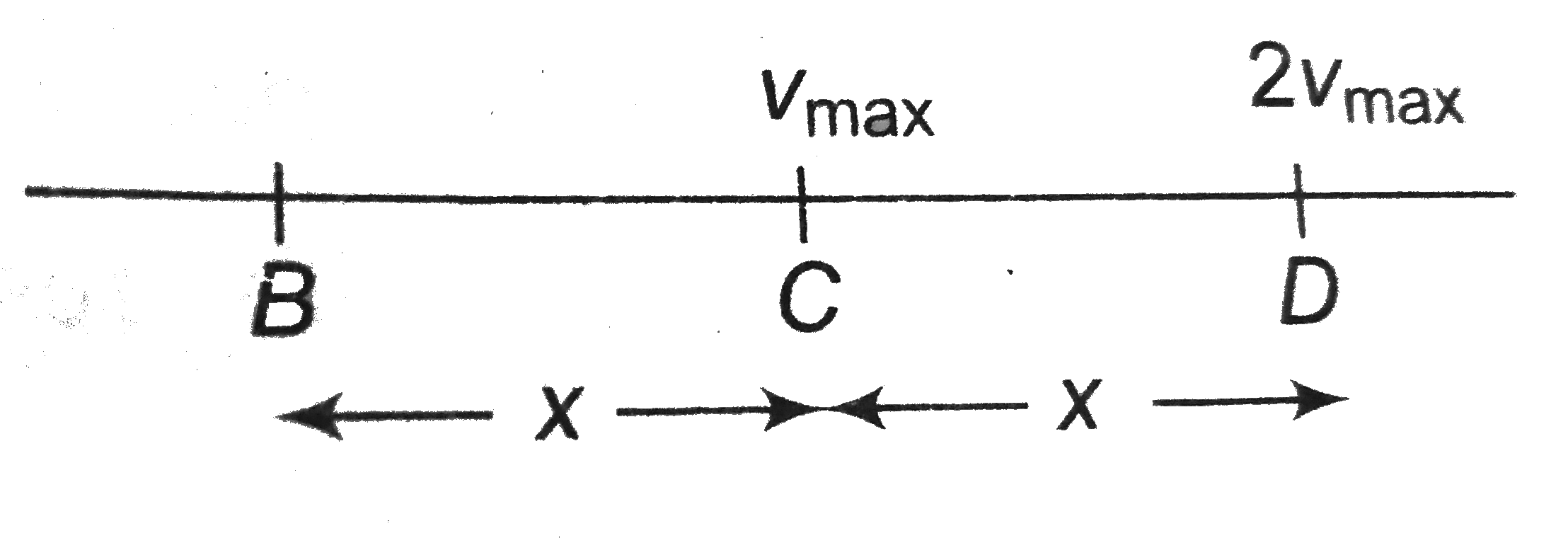
C

When the particle crosses `D` , its speed is half the maximum speed.

`:. V = (v_(max))/(R ) sqrt(R^(2) - x^(2))`
`or (v_(max))/(2) = (v_(max))/(R)sqrt(R^(2) - x^(2))` or `x = sqrt(3)/(2)R`
`:.` Distance `BD = 2x = sqrt(3)R`
Promotional Banner

Topper's Solved these Questions

  • OSCILLATION AND SIMPLE HARMONIC MOTION

    A2Z|Exercise Spring Particle System|24 Videos
  • OSCILLATION AND SIMPLE HARMONIC MOTION

    A2Z|Exercise Simple Pendulum And Different Cases Of Shm|25 Videos
  • OSCILLATION AND SIMPLE HARMONIC MOTION

    A2Z|Exercise Chapter Test|29 Videos
  • NEWTONS LAWS OF MOTION

    A2Z|Exercise Chapter Test|30 Videos
  • PROPERTIES OF MATTER

    A2Z|Exercise Chapter Test|29 Videos

Similar Questions

Explore conceptually related problems

A point performs harmonic oscillations along a straight line with a period T=0.60 s and amplitude a = 10.0 cm . Find the mean velocity of the point averaged over the time interval during which it travels a distance z//2 , starting from (a) the extreme position. (b) the equilibrium position.

A body performs SHM along the straight line MNOPQ. Its kinetic energy at N and at P is half of its peak value of O. If the time period is T, then the time taken to travel from N to P directly along MOP is

Four ships A,B,C and D are at sea in the following relative positions: B is on the straight line segment AC, B is due north of D and D is due west of C. The distance B and D is 2km. angleBDA = 40^(@), angleBCD = 25^(@) . What is the distance between A and D. ( sin 25^(@) = 0.423 ).

A particle of mass 10 g is describing SHM along a straight line with a period of 2 s and amplitude of 10 cm. what is the kinetic energy when it is (i) 2 cm (ii) 5 cm, from its equilibrium positio ? How do you account for the difference between its two values.?

A particle oscillates simple harmonically along a straight line with period 8 seconds and amplitude 8 sqrt(2) m. It starts from the mean position, then the ratio of the distances travelled by it in the second second and first second of its motion is

The maximum seperation between two particles executing simple harmonic motion of the equal amplitude and same frequency along the same straight line and about the same mean position, is sqrt(3) times the amplitude of oscillation. IF the phase difference between them is phi , determine 2pi//phi .

A body A mass m_(1) = 1 kg and body B of mass m_(2) = 4.1 kg . The body A perform free vertical harmonic oscillations with the amplitude 1.6 cm and frequency 25 Hz . Neglecting the mass of the spring , find the maximum and m inimum value of force that the system exerts on the hearing surface.

A particle performs SHM of amplitude A along a straight line. When it is at distance sqrt(3)/2 A from mean position, its kinetic energy gets increased by an amount 1/2momega^(2)A^(2) due to an impulsive force. Then its new amplitude becomes.

A particle performs SHM of amplitude A along a straight line .When it is a distance sqrt(3)/(2) A from mean position its kinetic energy gats increase by on amount (1)/(2) m omega^(2)A^(2) due to an implusive force. Then its new amplitude because

In the shown arrangement, both the spring are in their natural lengths. The coefficient of friction between m_(2) and m_(1) is mu . There is no friction between m_(1) and the surface. If the blocks are displaced slightly, they together perform simple harmonic motion. Obtain (a) Frequency of such oscillations. (b) The condition if the friction force on clock m_(2) is to act in the direction of its displacement from mean position. ( c) If the condition obtained in (b) is met, what can be maximum of their oscillations ?

A2Z-OSCILLATION AND SIMPLE HARMONIC MOTION-Velocity , Acceleration And Energy Of Simple Harmonic Motion
  1. A verticle mass-spring system executed simple harmonic ascillation wit...

    Text Solution

    |

  2. A body executes simple harmonic motion. The potential energy (P.E), th...

    Text Solution

    |

  3. A block of mass 2kg executes simple harmonic motion under the reading ...

    Text Solution

    |

  4. The velocity v of a particle of mass in moving along a straight line c...

    Text Solution

    |

  5. A 4 kg particle is moving along the x- axis under the action of the fo...

    Text Solution

    |

  6. Which of the following is correct about a SHM, along a straight line?

    Text Solution

    |

  7. A body performs simple harmonic oscillations along the straight line A...

    Text Solution

    |

  8. A particle moving on x - axis has potential energy U = 2 - 20x + 5x^(2...

    Text Solution

    |

  9. The potential energy of a particle executing SHM change from maximum t...

    Text Solution

    |

  10. A particle performs SHM of amplitude A along a straight line .When it ...

    Text Solution

    |

  11. A particle of mass 10gm is placed in a potential field given by V = (...

    Text Solution

    |

  12. Which of the following is greater in SHM (assuming potential energy = ...

    Text Solution

    |

  13. The total mechanical energy of a particle executing simple harmonic mo...

    Text Solution

    |

  14. A particle is executing linear SHM. The average kinetic energy and ave...

    Text Solution

    |

  15. A linear harmonic oscillator of force constant 2 xx 106Nm^(-1) and amp...

    Text Solution

    |

  16. A body is executing SHM under action of the a force of whose maximum ...

    Text Solution

    |

  17. A particle of m is executing SHMabout the origin on x- axis frequencxy...

    Text Solution

    |

  18. A particle is exeuting SHM. At a point x = A//3, kinetic energy of the...

    Text Solution

    |

  19. The mass of particle is 1 kg it is moving along x- axis The period of ...

    Text Solution

    |

  20. The frequency of oscilation is ((10)/(pi)) (in Hz) of a particle of ma...

    Text Solution

    |

