Home
Class 11
PHYSICS
Two partical A and B execute simple harm...

Two partical `A and B` execute simple harmonic motion according to the equation `y_(1) = 3 sin omega t` and `y_(2) = 4 sin [omega t + (pi//2)] + 3 sin omega t`. Find the phase difference between them.

A

`(pi)/(2)`

B

`tan^(-1)((4)/(5))`

C

`tan^(-1)((3)/4))`

D

None of these

Text Solution

Verified by Experts

The correct Answer is:
B

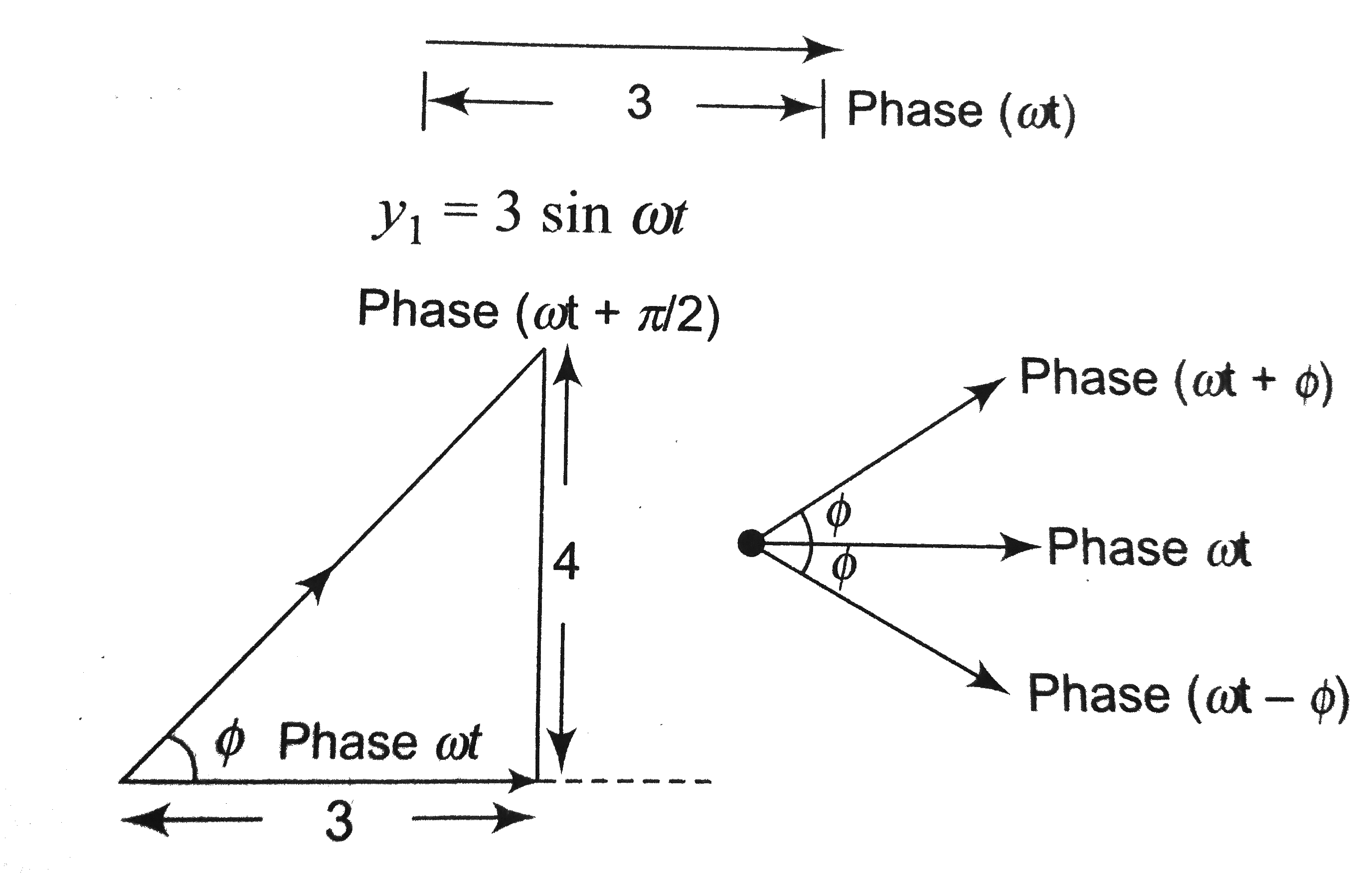
Representing a quantity with phase `(omegat)` along `X`-axis any quantity with a phase `(omegat + phi)` can be represented by a vector making an angle `phi` with a phase `(omegat - phi)` can be represented by a vector making an angle `phi` with x- axis in the clokwise sense

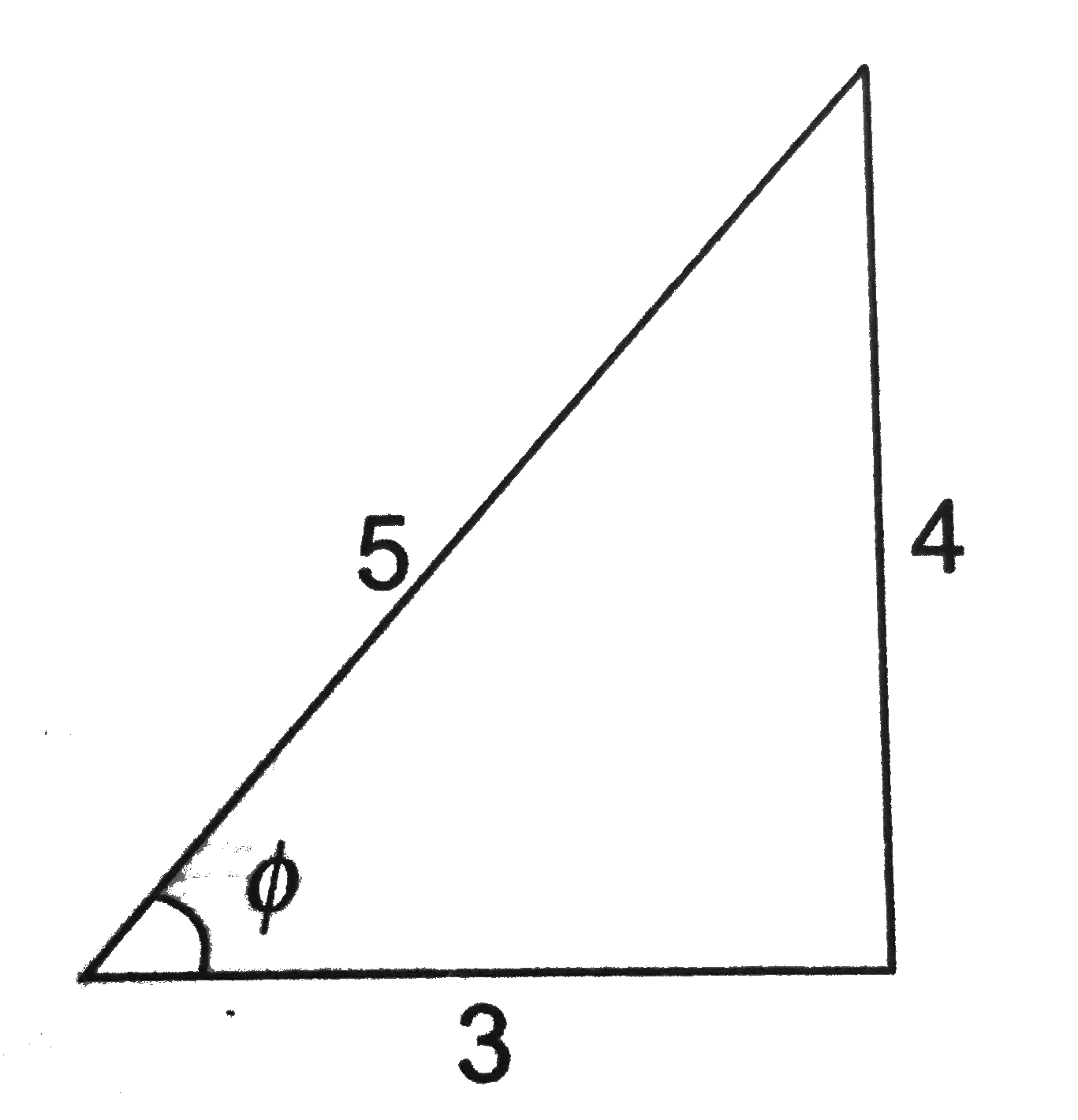
Phase difference `phi = tan ^(-1) ((4)/(5))`
Altmetively given `y_(1) = 3 sin omega t `....(1)
And `y_(2) = 4 sin (omega t + (pi)/(2)) + 3 sin omega t`
`= 4 cos omega t + 3 sin omega t = 5 [(4)/(5) cos omega t + (3)/(5) sin omega t]`
`= 5[sin phi cos omega t + cos omega t sin omega t]`
`= 5 sin (omega t + phi)`

`cos phi = (3)/(5) sin phi = (4)/(5) and tan phi = (4)/(5)`
From (i) and (ii) the result follows
Promotional Banner

Topper's Solved these Questions

  • OSCILLATION AND SIMPLE HARMONIC MOTION

    A2Z|Exercise Problems Based On Mixed Concepts|24 Videos
  • OSCILLATION AND SIMPLE HARMONIC MOTION

    A2Z|Exercise Assertion Reasoning|22 Videos
  • OSCILLATION AND SIMPLE HARMONIC MOTION

    A2Z|Exercise Simple Pendulum And Different Cases Of Shm|25 Videos
  • NEWTONS LAWS OF MOTION

    A2Z|Exercise Chapter Test|30 Videos
  • PROPERTIES OF MATTER

    A2Z|Exercise Chapter Test|29 Videos

Similar Questions

Explore conceptually related problems

If i_(1)=3 sin omega t and (i_2) = 4 cos omega t, then (i_3) is

y_1 =4sin( omega t + kx), y2 = -4 cos( omega t + kx), the phase difference is

The equations of two SH M's are X_(1) = 4 sin (omega t + pi//2) . X_(2) = 3 sin(omega t + pi)

Two waves are given by y_(1) = a sin (omega t - kx) and y_(2) = a cos (omega t - kx) . The phase difference between the two waves is

Find the amplitude of the harmonic motion obtained by combining the motions x_(1) = (2.0 cm) sin omega t and x_(2) = (2.0 cm) sin (omega t + pi//3) .

Two wave are represented by equation y_(1) = a sin omega t and y_(2) = a cos omega t the first wave :-

Two particle are executing simple harmonic motion. At an instant of time t their displacement are y_(1)=a "cos"(omegat) and y_(2)=a "sin" (omegat) Then the phase difference between y_(1) and y_(2) is

Two waves are represented by y_(1)=a_(1)cos (omega t - kx) and y_(2)=a_(2)sin (omega t - kx + pi//3) Then the phase difference between them is-

Two simple harmonic motions are represented by the equations y_(1)=2(sqrt(3)cos3 pi t+sin3 pi t) and y_(2)=3sin(6 pi t+pi/6)

A2Z-OSCILLATION AND SIMPLE HARMONIC MOTION-Superposition Of Shm And Compound Pendulum
  1. The displacement of a particle from its mean position (in mean is give...

    Text Solution

    |

  2. The displacement of a perticle varies with time as x = 12 sin omega t ...

    Text Solution

    |

  3. A particle is acted simultaneously by mutually perpendicular simple ha...

    Text Solution

    |

  4. The resulting amplitude A' and the vebrations S = A cos (omega t) + (A...

    Text Solution

    |

  5. A disc of radius R and mass M is plvoted at the rim and is set for sma...

    Text Solution

    |

  6. Four types of oscillatory system a simple pendulum a physic pendulum a...

    Text Solution

    |

  7. A particle is subjected to two simple harmonic motion in the same dire...

    Text Solution

    |

  8. A particle is executing a motion in which its displacement as a functi...

    Text Solution

    |

  9. Three simple harmonic motion of equal amplitudes A and equal time peri...

    Text Solution

    |

  10. Time S.H.M. of equal amplitude a and equal time period in the same dir...

    Text Solution

    |

  11. The displacement of a particle varies according to the relation y = 4(...

    Text Solution

    |

  12. Two partical A and B execute simple harmonic motion according to the ...

    Text Solution

    |

  13. The equation of the resulting oscillation obtained by the summation at...

    Text Solution

    |

  14. A charged particle as deflected by two mutually perpendicular oscillat...

    Text Solution

    |

  15. Two SHMs s(1) = a sin omega t and s(2) = b sin omega t are superimpose...

    Text Solution

    |

  16. Time period of a simple pendulum of length L is T(1) and time period o...

    Text Solution

    |

  17. A 25kg uniform solid sphere with a 20cm radius is suspended by a verti...

    Text Solution

    |

  18. Two identacal rods each of length l and mass m weided toeather at righ...

    Text Solution

    |

  19. A square plate of mass M and side length L is hinged at one of its ver...

    Text Solution

    |