Home
Class 11
PHYSICS
Two stones are thrown up simultaneously...

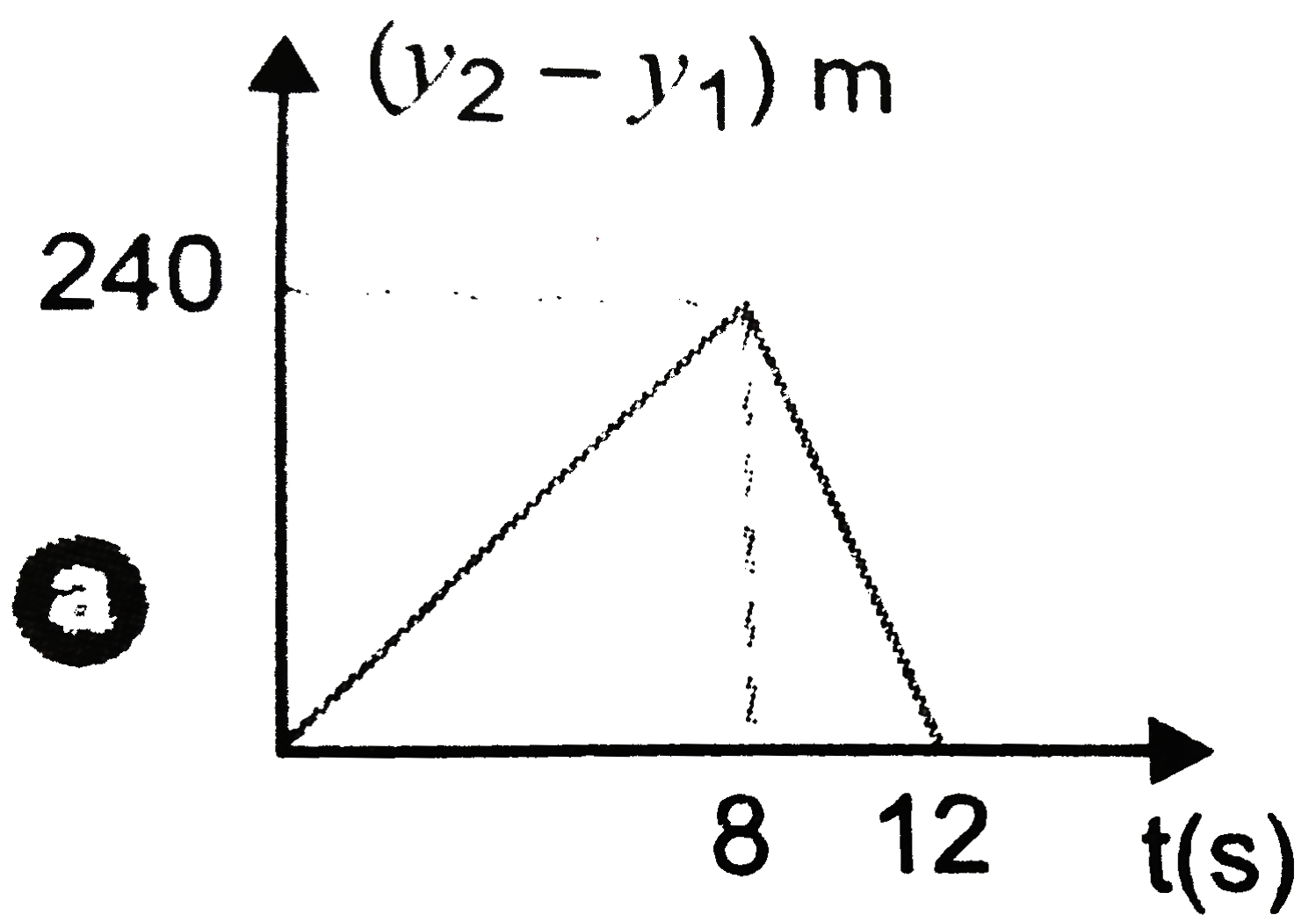
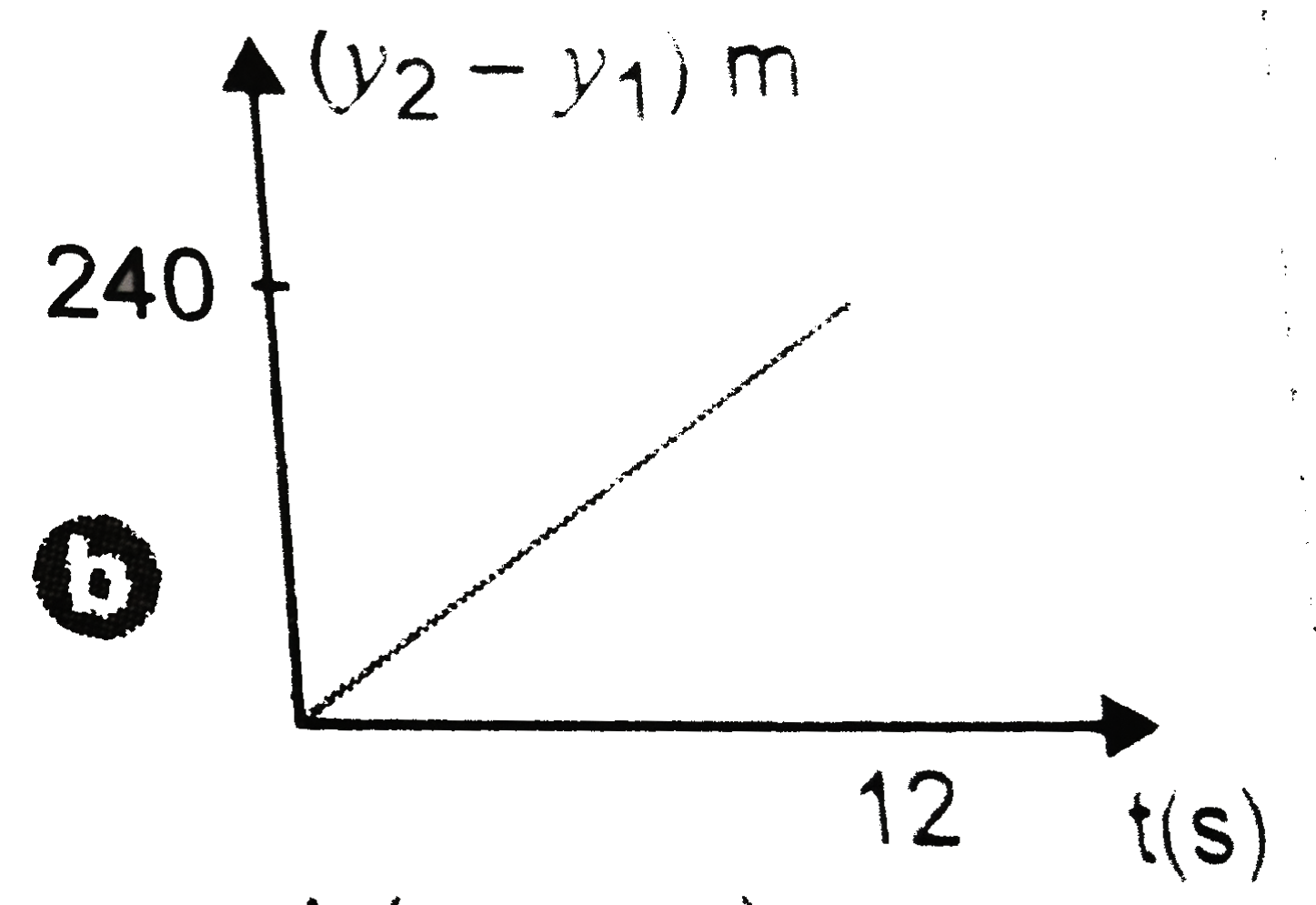
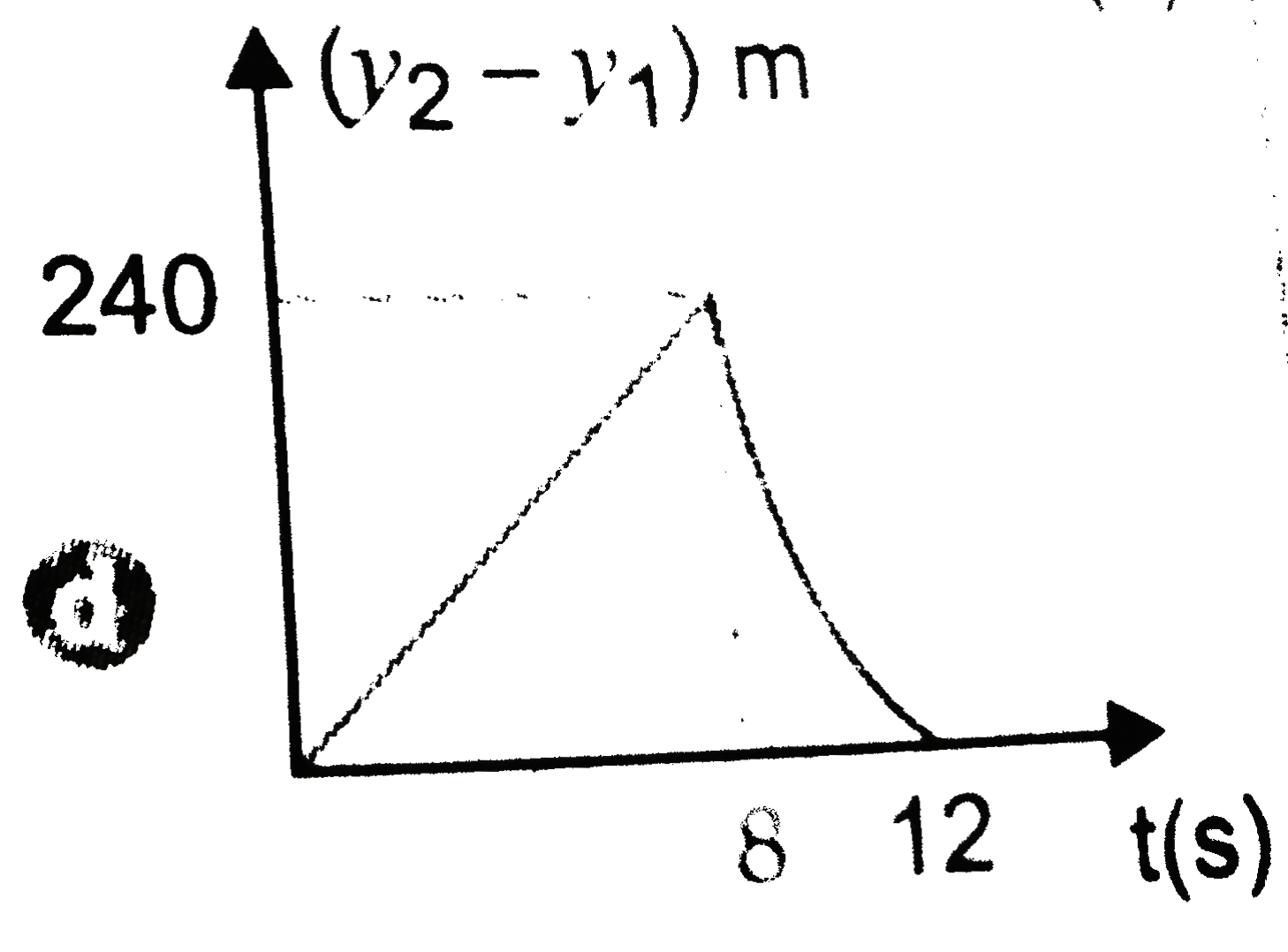
Two stones are thrown up simultaneously from the edge of a cliff ` 240 m ` high with initial speed of ` 10 m//s and 40 m//s` respectively . Which of the following graph best represents the time variation of relative position of the speed stone with respect to the first ?
( Assume stones do not rebound after hitting the groumd and neglect air resistance , take ` g = 10 m//s^(2))`
( The figure are schematic and not drawn to scale )

A

(a)

B

(b)

C

(c )

D

(d) .

Text Solution

Verified by Experts

The correct Answer is:

C

Taking vertical upward motion of first stone for tiem (t) we have
` y_0 = 240 m, u= 10 m//s, a =- 10 m//s`
` t=t, y =y`
As ` y =y_0 + ut + 1/2 at^2`
:. ` y_1 = 240 + 10t + 1/2 (-10) t^2 = 240 + 10 t- 5 t^`
Taking vertical upward motion of second stone for time (t) we have ` y_0 = 240 , u = 40 m//s`,
` a=- 10 m//s , t= t, y= y_2`
`y _2 = 240 + 40 t- 1/2 xx 10 xx t^2 = 240+ 40 t - 5 t^2`
When first stone hits the ground, ` y_1 =0`, ltbRgt :. `0= 240 + 10 t- 5 t^2` or ` t^2 - 2 48 =0`
pr ` t= ( 2 +- sqrt((2)^2 + 4xx 48 )/2 = 8 s ` or `-6 sec`
`-6` s is meaningless so time ` t= 8 sec`
When second stone hits the ground, ` y_2 =0`
:. ` =0= 240 + 40 t- 5 t^2` or `t^2 - 8 t- 48 =0`
on solving we get, ` t = 12 s ` or ` -4 s`
as `-4` s is meaningless so, ` t= 12 s`
Relatve position of `2 nd` stone w.r.t. first is
` y_2 -y_1 = 30 t...(i) [0 ltt-lt 8 s]` ltbRgt Since ` y_2 -y_1` and (t) are lojearly related.
` graph will be straight line from ` t= 0` to ` t=8 s`.
After ` 8sec` only second stone would be in motion for further ` 4 s`. Now ` y_1 = 240 m` and
` y_2 = 240 + 40 t- - 5 t^2`
:. ` y_2 - y-1 = 40 t- 5 t^2` ....(ii) ` (8 -lt t-lt12 s)` ltbRgt Thes potion (c ) is true.
Promotional Banner

Topper's Solved these Questions

  • KINEMATICS

    PRADEEP|Exercise 4 NCERT multiple Choice|10 Videos
  • KINEMATICS

    PRADEEP|Exercise 4 NCERT Integer type|4 Videos
  • KINEMATICS

    PRADEEP|Exercise 2 NCERT multiple|15 Videos
  • GRAVIATION

    PRADEEP|Exercise Assertion-Reason Type Questions|19 Videos
  • LAWS OF MOTION

    PRADEEP|Exercise Assertion- Reason Type Questions|17 Videos

Similar Questions

Explore conceptually related problems

Two stones are through up simultaneously from the edge of a cliff 240 m high with initial speed of 10 m/s and 40 m/s respectively. Which of the following graphs best represents the time variation of relative position of the second stone with respect to the first? Assume stones do not rebound after hitting the ground and neglect air resistance, take . g= 10 m//s^(2) (The figures are schematic and not drawn to scale)

Two stones are thrown up simultaneously from the edge of a cliff 200 m high with initial speeds of 15 ms?^(-1) and 30^(-1) . Verify that the graph shown in Fig. 2 ( NCT). 13 , correctly represents the time variation of the relativ e position of the second stone with respect to the first. Neglect the air resistance and assume that the stones do not rebound after hitting the ground. Taje g= 10 ms^(-2) .Give equations for the linear and curved parts of the plot. .

Two stones are thrown up simultaneously with initial speeds of u_(1) and u_(2)(u_(2)gt_(1) u_(1)) . They hit the ground after 6 s and 10 s respectively. Which graph in fig. correctly represents the time variation of Deltax=(x_(2)-x_(1)) the relative position of the second stone with respect to the first upto t=10 s? Assume that the stones do not rebound after hitting the ground.

Two stones are thrown up simultaneously from the edge of a cliff with initial speed v and 2 v . The relative position of the second stone with respect to first varies with time till both the stones strike the ground as.

One stone is projected horizontally from a 20 m high cliff with an initial speed of 10 ms^(-1) . A second stone is simultaneously dropped from that cliff. Which of the following is true?

A stone is thrown upwards and it rises to a height 0f 200m. The relative velocity of the stone with respect to the earth will be maximum at :-

PRADEEP-KINEMATICS-3 NCERT multiple
  1. The acceleration time graph of a particle is shown in the Fig. 2 (CF)....

    Text Solution

    |

  2. Two particles (A) and (B) are connected by a rigid rod AB. The rod sl...

    Text Solution

    |

  3. Two stones are thrown up simultaneously from the edge of a cliff 240...

    Text Solution

    |

  4. For the velocity tiem graph shown in Fig. 2 (CF).14, the distance cove...

    Text Solution

    |

  5. The speed-time graph of a particle moving along a fixed direction is s...

    Text Solution

    |

  6. A particle starts from rst at t= 0 and undergoes and acceleration (a)...

    Text Solution

    |

  7. In the given v-t graph, the distance travelled by the body in 5 secon...

    Text Solution

    |

  8. What will be the (a) ve (x) graph for the graph shown in Fig. 2 (CF). ...

    Text Solution

    |

  9. A body is at rest at x =0 . At t = 0, it starts moving in the posi...

    Text Solution

    |

  10. If the magnitude of sum of two vectors is equal to the magnitude of di...

    Text Solution

    |

  11. A particle is moving eastwards with a velocity of 5 m//s. In 10 s the...

    Text Solution

    |

  12. A person moves 30 m north, then 30 m est, then 30sqrt(2) south-west. H...

    Text Solution

    |

  13. A truck travelling due North at 50 km h^(-1) turns Westamd travels at...

    Text Solution

    |

  14. A vector vec A of magniude (A) is turned through an angle theta. Calc...

    Text Solution

    |

  15. An aeroplane fles a straight path from town (A) to town B, 500 km way...

    Text Solution

    |

  16. In the arrangement shown in the Fig, the ends P and Q of an unstretcha...

    Text Solution

    |

  17. A body is moving with velocity 30 m//s towards east. After 10 s its ve...

    Text Solution

    |

  18. The sum of two forces at a point is 16N. if their resultant is normal...

    Text Solution

    |

  19. If vector P, Q and R have magnitude 5,12,and 13 units and vec(P)+vec(Q...

    Text Solution

    |

  20. An object of mass 3 kg is at rest. Now a force of vec F = 6 t^2 hat...

    Text Solution

    |
