Home
Class 12
CHEMISTRY
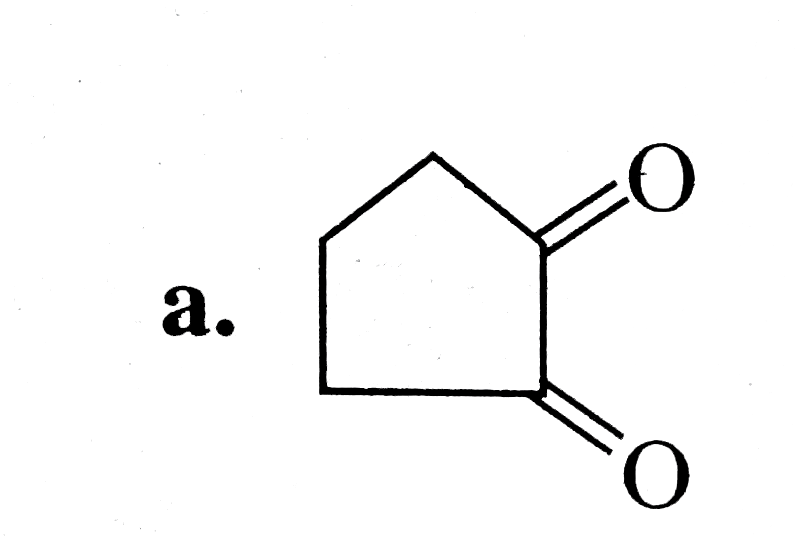
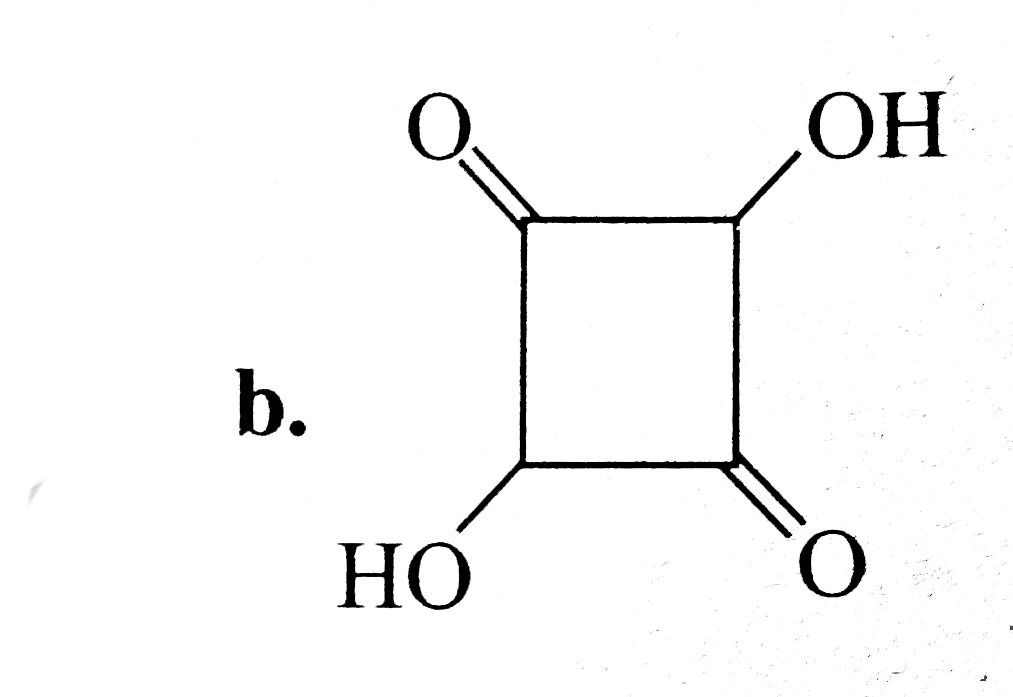
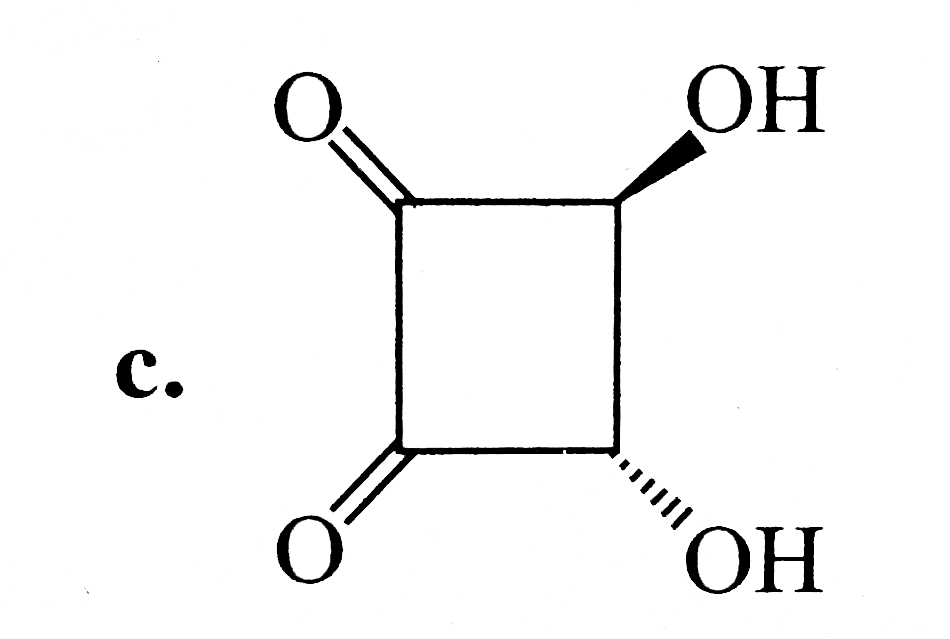
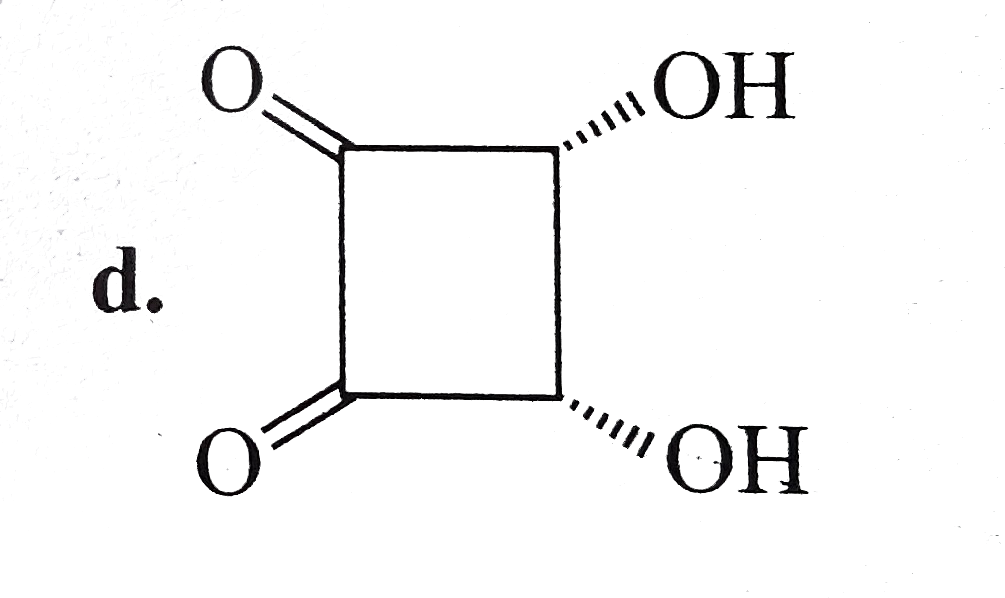
Conpound (A) underset(HIO(4))overset(2 m...

Conpound `(A) underset(HIO_(4))overset(2 mol of)(rarr) 2` mol of glyoxalic acid.
The compound `(A)` is:

A

a.

B

b.

C

c.

D

d.

Text Solution

AI Generated Solution

The correct Answer is:

To determine the compound (A) that reacts with 2 moles of HIO4 to produce 2 moles of glyoxalic acid, we can follow these steps: ### Step 1: Understand the Reaction HIO4 (periodic acid) is known to react with diols (compounds containing two hydroxyl groups -OH on adjacent carbons) through a mechanism called "syn addition." This means that both hydroxyl groups will be added to the same side of the molecule. ### Step 2: Identify the Product The product of the reaction is glyoxalic acid, which has the structure: ``` O || H-C-C(OH)-C(OH)-H ``` Glyoxalic acid has two carbonyl groups (C=O) and two hydroxyl groups (OH). ### Step 3: Determine the Structure of Compound (A) Since the reaction consumes 2 moles of HIO4 and produces 2 moles of glyoxalic acid, compound (A) must have a structure that can yield two glyoxalic acid molecules upon oxidation. The likely candidate for compound (A) is a 1,2-diol that can be oxidized to produce two molecules of glyoxalic acid. The simplest structure that fits this description is 1,2-ethanediol (ethylene glycol), which has the following structure: ``` HO-CH2-CH2-OH ``` ### Step 4: Reaction Mechanism 1. The two hydroxyl groups in 1,2-ethanediol are oxidized by HIO4. 2. The syn addition leads to the formation of intermediate structures that eventually rearrange to form glyoxalic acid. 3. The reaction results in the cleavage of the carbon-carbon bond and the formation of two molecules of glyoxalic acid. ### Final Answer Thus, the compound (A) that reacts with 2 moles of HIO4 to produce 2 moles of glyoxalic acid is **1,2-ethanediol (ethylene glycol)**. ---

To determine the compound (A) that reacts with 2 moles of HIO4 to produce 2 moles of glyoxalic acid, we can follow these steps: ### Step 1: Understand the Reaction HIO4 (periodic acid) is known to react with diols (compounds containing two hydroxyl groups -OH on adjacent carbons) through a mechanism called "syn addition." This means that both hydroxyl groups will be added to the same side of the molecule. ### Step 2: Identify the Product The product of the reaction is glyoxalic acid, which has the structure: ``` ...
Promotional Banner

Topper's Solved these Questions

  • REDUCTION AND OXIDATION REACTION OF ORGANIC COMPOUNDS

    CENGAGE CHEMISTRY|Exercise Exercise (Assertion And Reasoning)|10 Videos
  • REDUCTION AND OXIDATION REACTION OF ORGANIC COMPOUNDS

    CENGAGE CHEMISTRY|Exercise Exercise Archives (Subjective)|26 Videos
  • REDUCTION AND OXIDATION REACTION OF ORGANIC COMPOUNDS

    CENGAGE CHEMISTRY|Exercise Exercise (Multiple Correct)|35 Videos
  • QUALITATIVE INORGANIC SALT ANALYSIS

    CENGAGE CHEMISTRY|Exercise Viva Voce Questions And Part-C (Analysis Of Cations)|42 Videos
  • SOLID STATE

    CENGAGE CHEMISTRY|Exercise Ex 1.2 (Objective)|9 Videos

Similar Questions

Explore conceptually related problems

Compound (A) underset(HIO_(4))overset(1 mol of)(rarr) The compound (A) is:

A overset("HCN")(rarr) B overset(H_(3)O^(+))(rarr) 2-Hydroxy propanoic acid, the compound B is :

FeCr_(2)O_(4)+Na_(2)CO_(3)+O_(2)overset("Fusion")(rarr)[X]underset(H_(2)O)overset(H^(+))(rarr)[Y]underset(H_(2)O_(2))overset(H^(+))(rarr)[Z] Which of the following statement is true for the compounds [X],[Y] and [Z] ?

In the following sequence of reactions, the products (A) to (G) are formed: i. 2CH_4(g)overset(Delta)underset(1773K)rarr(A)(g)+B(g) ii. 4 mol of (A) overset(Delta)underset(Ni(CN)_4+THF)rarr(C)overset(O_3//o x id.)rarr(D) only iii. (A)overset((1) 1 mol of NaNH_2)underset((2) C_2H_5I)rarr(E)underset(Red hot tube)overset(3 mol of E)rarrunderset((G) only)underset(darr O_3//Red.)F Compounds (A) and (B), respectively, are:

C_(6) H_(5) (CH_(2))_(5) overset(O)overset(||)(C) - Cl underset(CS_(2))overset(AlCl_(3))rarr underset(C_(12) H_(14)O)((A)) underset(H_(3)O^(oplus))overset(KMnO_(4), D)rarr (B) , Compound (B) is:

2HC-=CHoverset(CH_2Cl_2)underset(+NH_4Cl)rarr(A)overset(1 mol)underset(HCl)rarr(B) Compounds (A) and (B) are:

Identify A, B, and C. A, B, and C (C_6H_(10))overset(Br_2//C CI_2)rarrunderset(Br_2 "solution")("All decolourises") underset(conc. H_2SO_4)overset(Cold)rarr All are soluble (A)underset(AgNO_3)overset("Ammoniacal")rarr White precipitate (A and B)underset(of H_2//Pt)overset("excess")rarr Hexane (C)underset(H_2//Pt)overset(1 mol)rarrD(C_6H_(12)) (A)underset(KMnO_4)overset(Hot alk.)rarr Pent anoic acid only (B)underset(KMnO_4)overset(Hot alk.)rarr Propanoic acid only (C)underset(KMnO_4)overset(Hot alk.)rarr Adipic acid only
