Home
Class 12
PHYSICS
If you are provided three resistance 2 O...

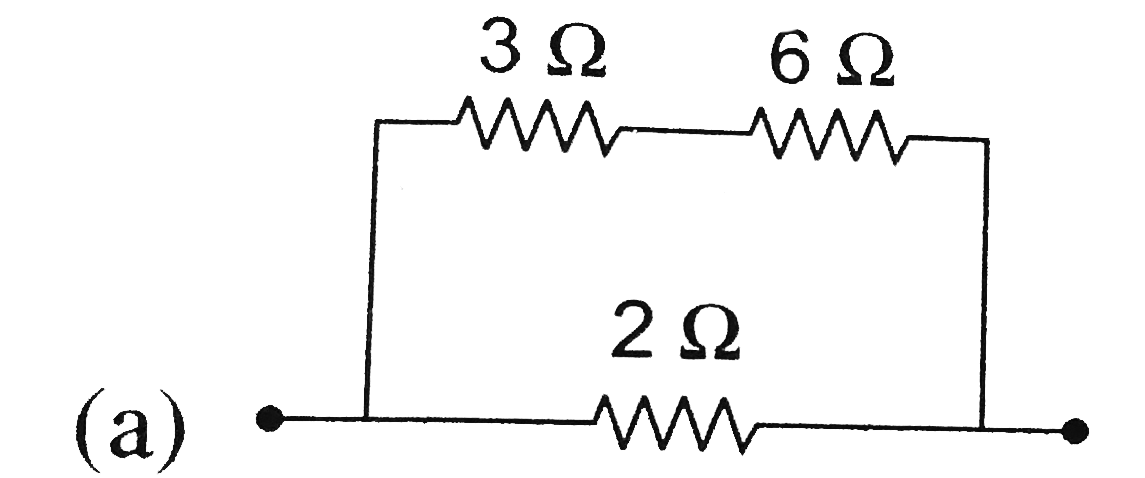
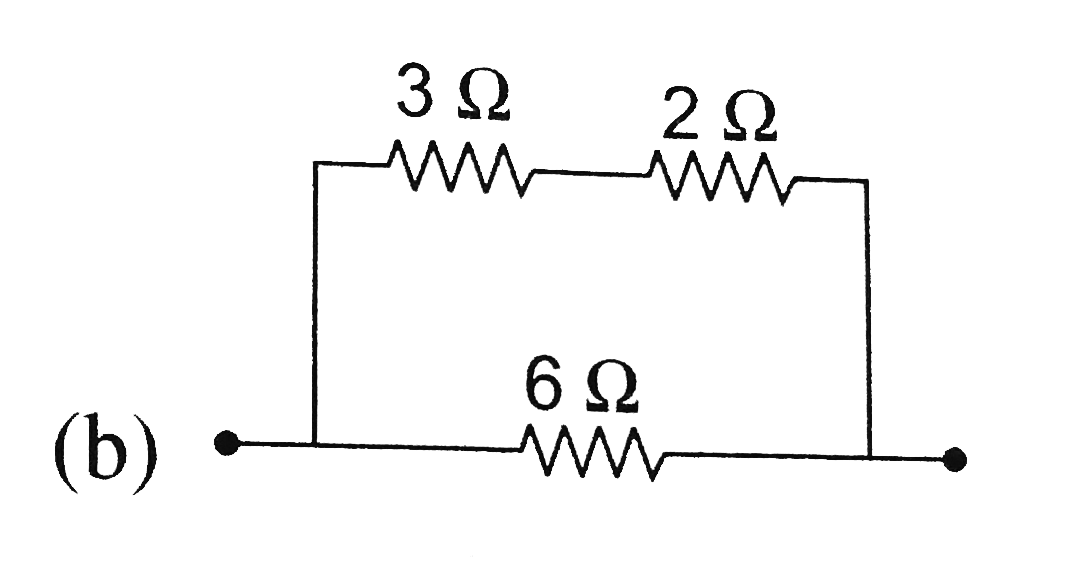
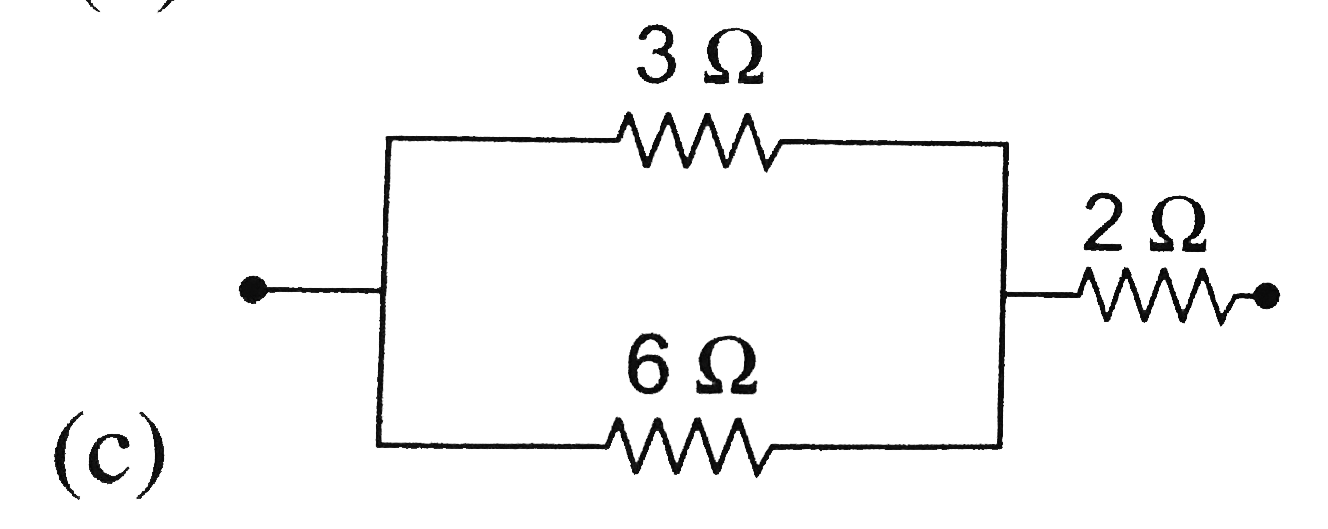
If you are provided three resistance `2 Omega, 3 Omega` and `6 Omega`. How will you connect them so as to obtain the equivalent resistance of `4 Omega`

A

B

C

D

none

Text Solution

AI Generated Solution

The correct Answer is:

To solve the problem of obtaining an equivalent resistance of 4 ohms using the resistances of 2 ohms, 3 ohms, and 6 ohms, we can analyze the possible configurations of these resistors. ### Step-by-Step Solution: 1. **Understanding Series and Parallel Connections**: - In a series connection, the equivalent resistance (R_eq) is the sum of the individual resistances: \[ R_{eq} = R_1 + R_2 + R_3 + \ldots \] - In a parallel connection, the equivalent resistance is given by: \[ \frac{1}{R_{eq}} = \frac{1}{R_1} + \frac{1}{R_2} + \frac{1}{R_3} + \ldots \] 2. **Testing Different Configurations**: - We will check various combinations of the given resistances to find one that results in an equivalent resistance of 4 ohms. 3. **Option A**: Connect 3 ohms and 6 ohms in series, then in parallel with 2 ohms. - Series combination: \[ R_{series} = 3 + 6 = 9 \, \Omega \] - Now, calculate the equivalent resistance with 2 ohms in parallel: \[ \frac{1}{R_{eq}} = \frac{1}{9} + \frac{1}{2} = \frac{2 + 9}{18} = \frac{11}{18} \] \[ R_{eq} = \frac{18}{11} \approx 1.64 \, \Omega \quad \text{(not equal to 4 ohms)} \] 4. **Option B**: Connect 3 ohms and 2 ohms in series, then in parallel with 6 ohms. - Series combination: \[ R_{series} = 3 + 2 = 5 \, \Omega \] - Now, calculate the equivalent resistance with 6 ohms in parallel: \[ \frac{1}{R_{eq}} = \frac{1}{5} + \frac{1}{6} = \frac{6 + 5}{30} = \frac{11}{30} \] \[ R_{eq} = \frac{30}{11} \approx 2.73 \, \Omega \quad \text{(not equal to 4 ohms)} \] 5. **Option C**: Connect 3 ohms and 6 ohms in parallel, then add 2 ohms in series. - Parallel combination: \[ \frac{1}{R_{parallel}} = \frac{1}{3} + \frac{1}{6} = \frac{2 + 1}{6} = \frac{3}{6} = \frac{1}{2} \] \[ R_{parallel} = 2 \, \Omega \] - Now, add the 2 ohms in series: \[ R_{eq} = 2 + 2 = 4 \, \Omega \quad \text{(this is equal to 4 ohms)} \] 6. **Conclusion**: - The configuration that gives an equivalent resistance of 4 ohms is to connect the 3-ohm and 6-ohm resistors in parallel and then connect the resulting 2-ohm resistance in series with the 2-ohm resistor. ### Final Answer: The equivalent resistance of 4 ohms can be obtained by connecting the 3-ohm and 6-ohm resistors in parallel, and then connecting the resulting 2-ohm resistance in series with the 2-ohm resistor.

To solve the problem of obtaining an equivalent resistance of 4 ohms using the resistances of 2 ohms, 3 ohms, and 6 ohms, we can analyze the possible configurations of these resistors. ### Step-by-Step Solution: 1. **Understanding Series and Parallel Connections**: - In a series connection, the equivalent resistance (R_eq) is the sum of the individual resistances: \[ R_{eq} = R_1 + R_2 + R_3 + \ldots ...
Promotional Banner

Topper's Solved these Questions

  • CURRENT ELECTRICITY

    A2Z|Exercise Kircoff'S Laws And Simple Circuits|64 Videos
  • CURRENT ELECTRICITY

    A2Z|Exercise R-C Circuits|17 Videos
  • CURRENT ELECTRICITY

    A2Z|Exercise Section D - Chapter End Test|29 Videos
  • ATOMIC PHYSICS

    A2Z|Exercise Section D - Chapter End Test|30 Videos
  • DUAL NATURE OF RADIATION AND MATTER

    A2Z|Exercise Section D - Chapter End Test|30 Videos

Similar Questions

Explore conceptually related problems

Given three resistors of resistances 1 Omega, 2Omega and 3Omega . How will you combine them to get an equivalent resistance of (11)/(5) Omega ?

If you are provided a set of resistances 2Omega,4Omega,6Omega and 8Omega . Connect these resistances so as to obtain an equivalent resistance of 46/3Omega

Which of the circuit has an equivalent resistance of 4 Omega ?

Given the resistances of 1 Omega, 2 Omega and 3 Omega . How will you combine them to get an equivalent resistance of (i) (11)/3 Omega ? (ii) (11)/5 Omega ?

(a) Given n resistors each of resistance R . How will you combine them to get the (i) maximum (ii) minimum effective resistance ? What is the ratio of the maximum to minimum resistance ? (b) Given the resistances of 1 Omega, 2 Omega, 3 Omega , how will you combine them to get an equivalent resistance of (i) (11//3)Omega (ii) (11//5)Omega (iii) 6 Omega (iv) (6//11) Omega ? (c) Determine the equivalent resistance of networks shown in Figure.

Three resistors of 2 Omega, 3 Omega and 4 Omega are connected in (a) series (b) parallel. Find the equivalent resistance in each case.

The resistors of resistances 2 Omega, 4 Omega and 8 Omega are connected in parallel, then the equivalent resistance of the combination will be

Given the resistance of 1 Omega, 2 Omega, 3 Omega , how will you combine them to get an e3quivalent resistance of : (11)/(3) Omega " " (ii) (11)/(5) Omega " " (iii) 6 Omega " " (6)/(11) Omega ?

A2Z-CURRENT ELECTRICITY-Combination And Resistivity
  1. A prism is made of wire mesh with each side having equal resistance R....

    Text Solution

    |

  2. Find the equivalent resistance across AB :

    Text Solution

    |

  3. If you are provided three resistance 2 Omega, 3 Omega and 6 Omega. How...

    Text Solution

    |

  4. In the circuit given E = 6.0 V, R(1) = 100 ohms, R(2) = R(3) = 50 ohms...

    Text Solution

    |

  5. In the diagram resistance across terminals A and B is

    Text Solution

    |

  6. The effecitve resistance between A and B of the shown network, where r...

    Text Solution

    |

  7. In the arrangement shown, the magnitude of each resistance is 2 Omega....

    Text Solution

    |

  8. Seven resistances are connected as shown in the figure. The equivalent...

    Text Solution

    |

  9. The equivalent resistance between the point A and B is

    Text Solution

    |

  10. Four resistances 10 Omega, 5 Omega, 7 Omega and 3 Omega are connected ...

    Text Solution

    |

  11. Thirteen resistances each of resistance R ohm are connected in the cir...

    Text Solution

    |

  12. The resistance of all the wires between any two adjacent dots is R. Th...

    Text Solution

    |

  13. An infinite sequence of resistance is shown in the figure. The resulta...

    Text Solution

    |

  14. The equivalent resistance of the following infinite network of resista...

    Text Solution

    |

  15. In the figure, the value of resistors to be connected between C and D ...

    Text Solution

    |

  16. What is the equivalent resistance between the point A and B of the net...

    Text Solution

    |

  17. The effective resistance between points P and Q of the electrical ci...

    Text Solution

    |

  18. The equivalent resistance between the point P and Q in the network giv...

    Text Solution

    |

  19. Kirchhoff's first law i.e., sum I = 0 at a junction is based on the la...

    Text Solution

    |

  20. Kirchoff's second law is based on the law of conservation of

    Text Solution

    |
