Home
Class 12
PHYSICS
Refraction takes place at a concave sphe...

Refraction takes place at a concave spherical boundary separating glass air medium. For the image to be real, the object distance `(mu_(g)=3//2)`

A

should be greater than three times the radius of curvature of refracting surface

B

should be greater than two times the radius of curvature of the refracting surface

C

should be greater than the radius of curvature of refracting surface

D

is independent of the radius of curvature of the refracting surface

Text Solution

Verified by Experts

The correct Answer is:
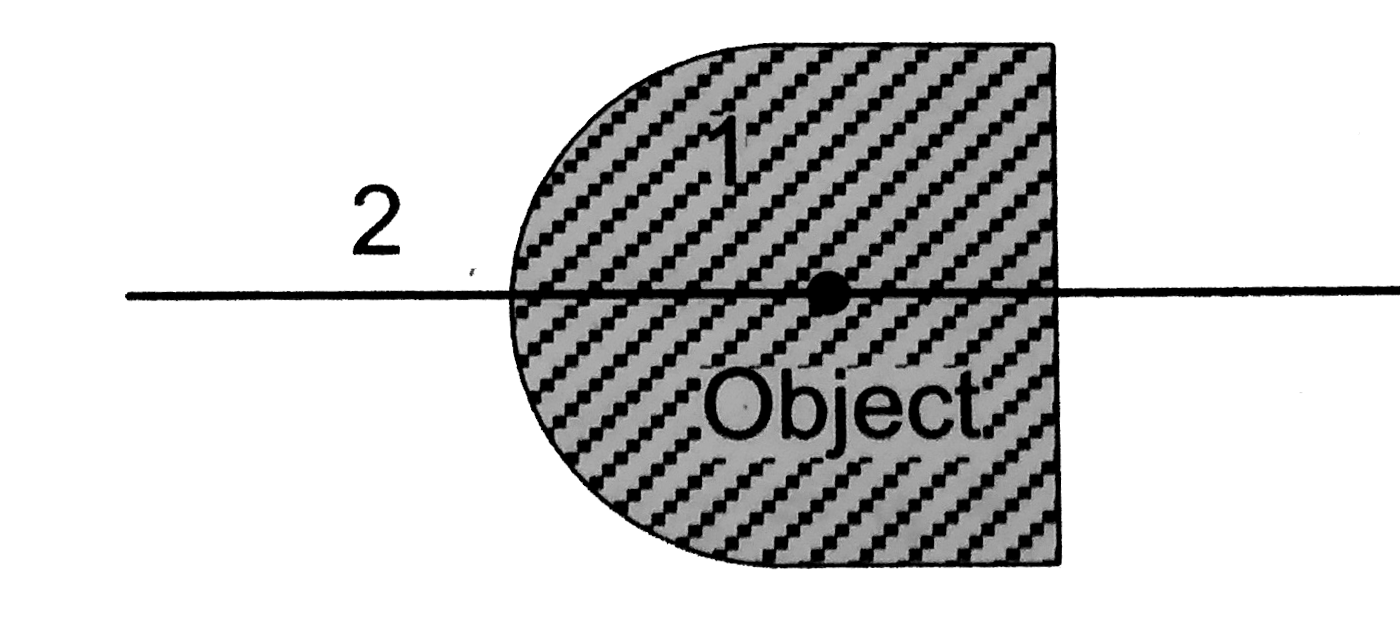
A

Applying `(mu_(2))/(v)-(mu_(1))/(u)=(mu_(2)-mu_(1))/(R)`
`(1)/(v)-(1.5)/((-u))=(1-(1.5))/(-R)` or `(1)/(v)+(3)/(2u)=(1)/(2R)`
for `v` to be positive `(1)/(2R)gt(3)/(2u)`
or` ugt3R`
Promotional Banner

Topper's Solved these Questions

  • GEOMETRICAL OPTICS

    A2Z|Exercise Prism Theory And Dispersion Of Light|45 Videos
  • GEOMETRICAL OPTICS

    A2Z|Exercise Optical Instruments|55 Videos
  • GEOMETRICAL OPTICS

    A2Z|Exercise Section D - Chapter End Test|30 Videos
  • ELECTROMAGNETIC WAVES AND COMMUNICATION SYSTEM

    A2Z|Exercise Section D - Chapter End Test|30 Videos
  • MAGNETISM AND MATTER

    A2Z|Exercise Section D - Chapter End Test|30 Videos

Similar Questions

Explore conceptually related problems

Refraction takes place at a convex spherical boundary separating glass-air medium. For the image to be real, the object distance (mu_(g)=3//2) should be // is

Refraction takes place at a convex spherical boundary separating air-glass medium. For the image to be real, the object distance (mu_(g) = 3//2) Note Object lying in the glass.

A real object is kept in air and refraction occurs at the convex boundry of a spherical glass surface. For the image to be real, the real object distance (n_(g)=3//2)

Show that for refraction at a concave spherical surface (separating glass-air medium), the distance of the object should be greater than three times the radius of curvature of the refracting surface for the image to be real.

A point object is above the principal axis in the concave side of a spherical interface separating medium 1 from medium 2. I f the object is in medium 1 and mu_(1) gt mu_(2) , determine the position of the image by ray tracing.

A convex spherical refracting surfaces separates two media glass and air (mu_g=1.5). If the image is to be real, at what minimum distance u should the object be placed in air if R is the radius of curvature

Radius of curvature of a concave spherical surface separating air-glass medium is R. A point object is placed on the principal axis in the glass (m_(g) = 1.5) . For the image to be real seen by observer in air, distance of the object from P should be

In Figure, a point object O is placed in air. A spherical boundary separates two media. Ab is the principall axis. The refractive index above AB is 1.6 and below AB is 2.0. The separation between the images formed due to refraction at a the spherical surface is (assume the radius of curvature (R) to be 1 unit)

An object is placed at a distance of 10 cm (in a medium of μ = 1) from the pole of a spherical refracting surface bounding a medium of μ = 1.5. If the image formed is virtual and at a distance of 40 cm, then the spherical surface is –

A2Z-GEOMETRICAL OPTICS-Refraction At Curved Surface
  1. A point object O is placed in front of a glass rod having spherical en...

    Text Solution

    |

  2. Refraction takes place at a concave spherical boundary separating glas...

    Text Solution

    |

  3. A plastic hemisphere has a radius of curvature of 8 cm and an index of...

    Text Solution

    |

  4. A point object is placed at the centre of a glass sphere of radius 6cm...

    Text Solution

    |

  5. A spherical surface of radius of curvature R separates air (refractive...

    Text Solution

    |

  6. A ray of light falls on a transparent sphere with center at C as shown...

    Text Solution

    |

  7. A ray of light in incident on a glass sphere of refractive index 3//2....

    Text Solution

    |

  8. A convex lens of focal length f is placed somewhere in between an obje...

    Text Solution

    |

  9. A thin lens focal length f(1) and its aperture has diameter d. It form...

    Text Solution

    |

  10. A lens of power +2 dioptres is placed in contact with a lens of powe...

    Text Solution

    |

  11. A convex lens of focal length 40 cm is in contact with a concave lens ...

    Text Solution

    |

  12. Two lenses are placed in contact with each other and the focal length ...

    Text Solution

    |

  13. Two similar planoconvex lenses are combined together in three differen...

    Text Solution

    |

  14. Two convex lenses of powers 4D and 6D are separated by a distance of (...

    Text Solution

    |

  15. The slit of a collimator is illuminated by a source as shown in the a...

    Text Solution

    |

  16. A converging lens is used to form an image on a screen. When the upper...

    Text Solution

    |

  17. The ray diagram could be correct

    Text Solution

    |

  18. The relation between n(1) and n(2) , if behavior of light rays is as s...

    Text Solution

    |

  19. The minimum distance between an object and its real image formed by a ...

    Text Solution

    |

  20. An object is placed at a distance of f//2 from a convex lens. The imag...

    Text Solution

    |

