Home
Class 12
PHYSICS
An optical fiber consists of core of mu(...

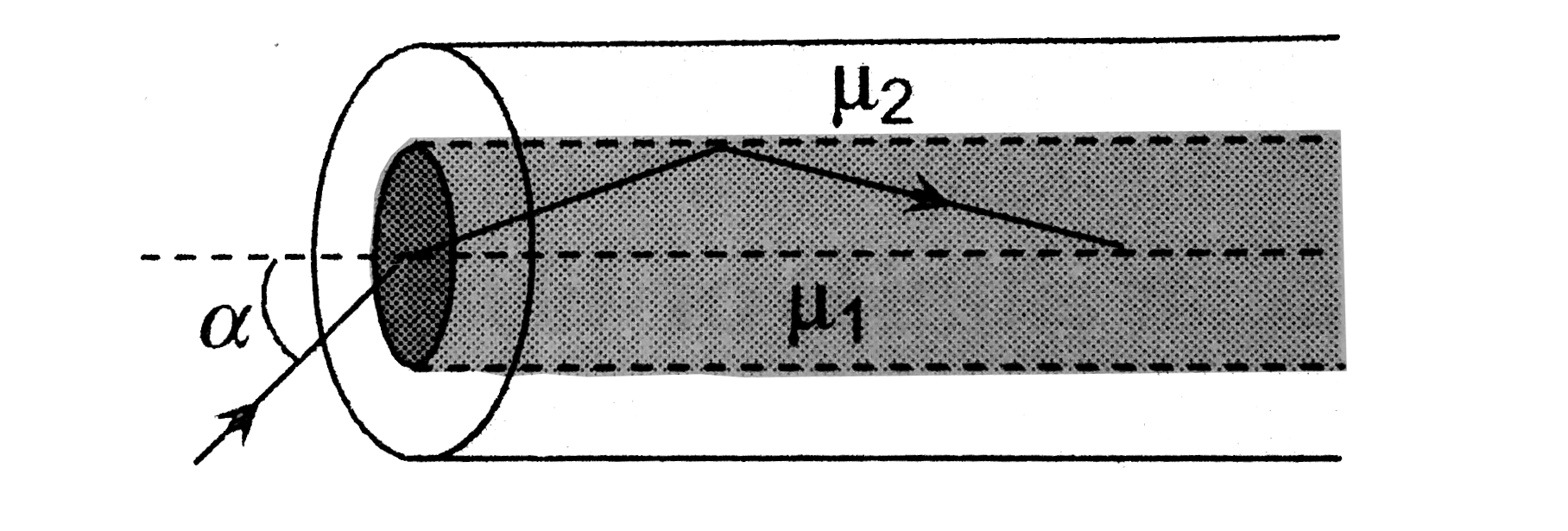
An optical fiber consists of core of `mu_(1)` surrounded by a cladding of `mu_(2) lt mu_(1)`. A beam of light enters from air at an angle `alpha` with axis of fiber. The highest `alpha` for which ray can be travelled through fiber is

A

`cos^(-1)sqrt(mu_(2)^(2)-mu_(1)^(2))`

B

`sin^(-1)sqrt(mu_(1)^(2)-mu_(2)^(2))`

C

`tan^(-1)sqrt(mu_(1)^(2)-mu_(2)^(2))`

D

`sec^(-1)sqrt(mu_(1)^(2)-mu_(2)^(2))`

Text Solution

Verified by Experts

The correct Answer is:
B

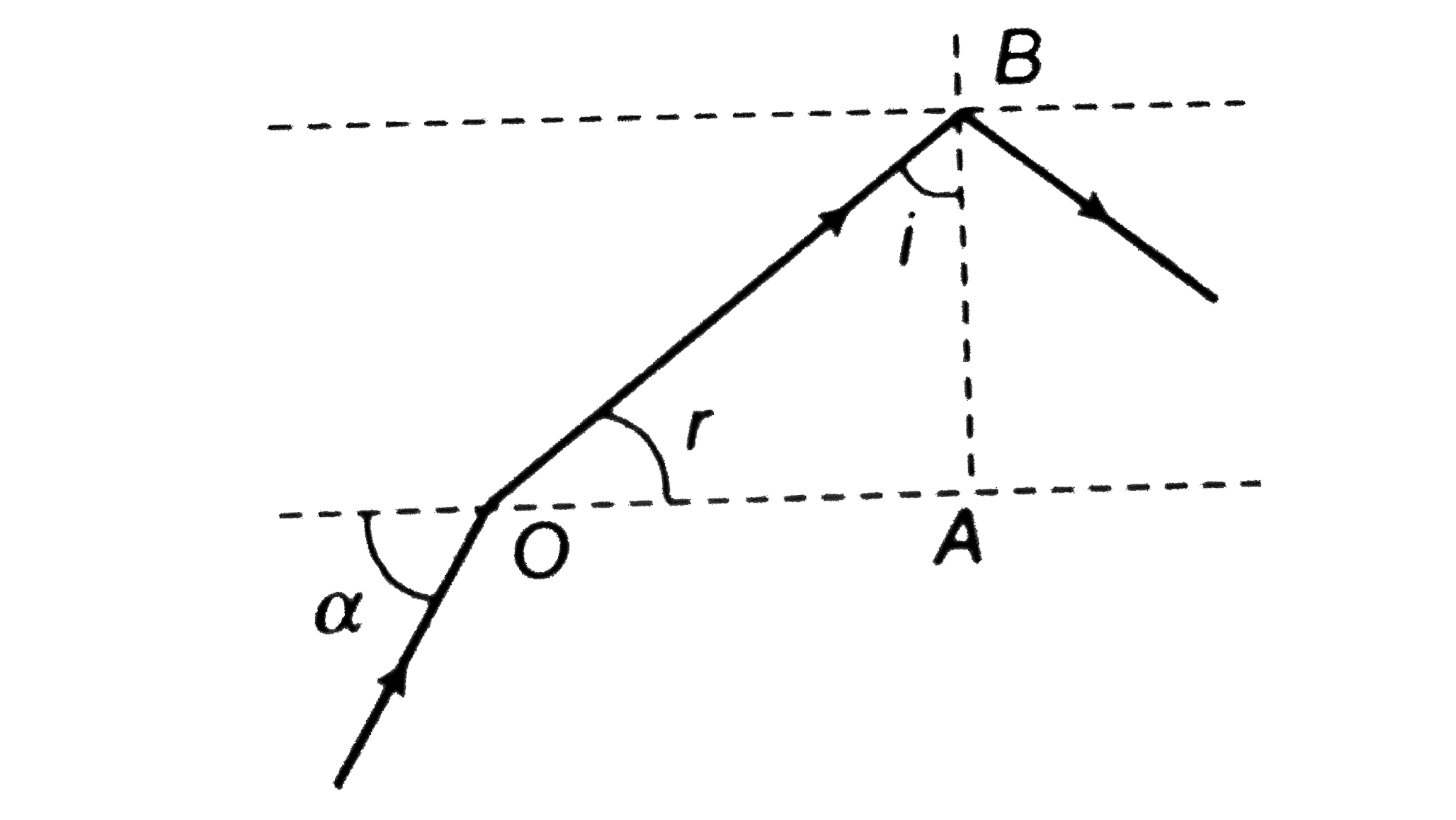
Here the requirement is that `igtc`
`impliessinigtsincimpliessinigt(mu_(2))/(mu_(1))` ...`(i)`
From Snell's law `mu_(1)=(sin alpha)/(sin r)` ...`(ii)`
Also in `DeltaOBA`
`r+i=90^(@)impliesr=(90-i)`
Hence from equation `(ii)`
`sin alpha=mu_(1)sin (90-i)`
`impliescosi=(sin alpha)/(mu_(1))`
`sin i =sqrt(1-cos^(2)i)=sqrt(1((sinalpha)/(mu_(1)))^(2))`
From equations (i) and (iii) `sqrt(1-((sin alpha)/(mu_(1)))^(2)) gt (mu_(2))/(mu_(1))`
`rArr sin^(2)alpha lt (mu_(1)^(2)-mu_(2)^(2)) rArr sin alpha lt sqrt(mu_(1)^(2)-mu_(2)^(2))`
`alpha_(max)=sin^(-1)sqrt(mu_(1)^(2)-mu_(2)^(2))`
Promotional Banner

Topper's Solved these Questions

  • GEOMETRICAL OPTICS

    A2Z|Exercise Assertion Reason|15 Videos
  • GEOMETRICAL OPTICS

    A2Z|Exercise Section D - Chapter End Test|30 Videos
  • GEOMETRICAL OPTICS

    A2Z|Exercise Section B - Assertion Reasoning|19 Videos
  • ELECTROMAGNETIC WAVES AND COMMUNICATION SYSTEM

    A2Z|Exercise Section D - Chapter End Test|30 Videos
  • MAGNETISM AND MATTER

    A2Z|Exercise Section D - Chapter End Test|30 Videos

Similar Questions

Explore conceptually related problems

An optical fibre consists of core of mu_(1) surrounded by a cladding of mu_(2) lt mu_(1) . A beam of light enters from air at an angle alpha with axis of fibre. The highest alpha for which ray can be travelled through fibre is

A concave lens having a material of refractive index mu_(1) is kept in a medium of R.I. mu_(2) , where mu_(1) lt mu_(2) . A parallel beam of light is incident on the lens. The concave lens will act as

In figure, the optical fiber is l = 2 m long and has a diameter of d = 20 mum. If a ray of light is incident on one end of the fiber at angle theta_1=40^@ , the number of reflections it makes before emerging form the other end is close to : (refractive index of fiber is 1.31 and sin40^@=0.64 )

An optical fibre has diameter d and is made of material of refractive indeed mu . It is surrounded by air. Light is made to enter through one end of the fibre as shown. The fiber is in the shape of a circular bend of outer radius r. (a) Find least value of r (= r_(o)) for which no light can escape out of the fibre. Calculate r_(o) for d = 200 mum and mu = 1.4 . (b) How is value of r_(o) affected as d is made smaller? (c) For sharper bends, shall we have higher mu or smaller mu ?

Optical Fibre: Optical fibre works on the principle of total internal reflection. Light rays can be used to transmit a huge amount of data, but there is a problem here - the light rays travel in straight lines. So unless we have a long straight wire without any bends at all, harnessing this advantage will be very tedious. Instead, the optical cables are designed such that they bend all the light rays' inwards (using TIR). Light rays travel continuously, bouncing off the optical fibre walls and transmitting end to end data. It is usually made of plastic or glass. Modes of transmission: Single-mode fibre is used for long-distance transmission, while multi mode fiber is used for shorter distances. The outer cladding of these fibres needs better protection than metal wires. Although light signals do degrade over progressing distances due to absorption and scattering. Then, optical Regenerator system is necessary to boost the signal. Types of Optical Fibres: The types of optical fibers depend on the refractive index, materials used, and mode of propagation of light. The classification based on the refractive index is as follows: • Step Index Fibres: It consists of a core surrounded by the cladding, which has a single uniform index of refraction. • Graded Index Fibres: The refractive index of the optical fibre decreases as the radial distance from the fibre axis increases. Light signal through optical fibre may degrade due to:

There are two blocks of masses m_(1) and m_(2) , m_(1) is placed on m_(2) on a table which is rotating with an angular velocity omega about the vertical axis . The coefficent of friction between the block is mu_(1) and between m_(2) and table is mu_(2) (mu_(1) lt mu_(2)) if block are placed at distance R from the axis of ratation , for relative sliding between the surface in contact , find the a. friction force at the contacting surface b. maximum angular speed omega

Optical Fibre: Optical fibre works on the principle of total internal reflection. Light rays can be used to transmit a huge amount of data, but there is a problem here - the light rays travel in straight lines. So unless we have a long straight wire without any bends at all, harnessing this advantage will be very tedious. Instead, the optical cables are designed such that they bend all the light rays' inwards (using TIR). Light rays travel continuously, bouncing off the optical fibre walls and transmitting end to end data. It is usually made of plastic or glass. Modes of transmission: Single-mode fibre is used for long-distance transmission, while multi mode fiber is used for shorter distances. The outer cladding of these fibres needs better protection than metal wires. Although light signals do degrade over progressing distances due to absorption and scattering. Then, optical Regenerator system is necessary to boost the signal. Types of Optical Fibres: The types of optical fibers depend on the refractive index, materials used, and mode of propagation of light. The classification based on the refractive index is as follows: • Step Index Fibres: It consists of a core surrounded by the cladding, which has a single uniform index of refraction. • Graded Index Fibres: The refractive index of the optical fibre decreases as the radial distance from the fibre axis increases. Optical fibre is made of:

Optical Fibre: Optical fibre works on the principle of total internal reflection. Light rays can be used to transmit a huge amount of data, but there is a problem here - the light rays travel in straight lines. So unless we have a long straight wire without any bends at all, harnessing this advantage will be very tedious. Instead, the optical cables are designed such that they bend all the light rays' inwards (using TIR). Light rays travel continuously, bouncing off the optical fibre walls and transmitting end to end data. It is usually made of plastic or glass. Modes of transmission: Single-mode fibre is used for long-distance transmission, while multi mode fiber is used for shorter distances. The outer cladding of these fibres needs better protection than metal wires. Although light signals do degrade over progressing distances due to absorption and scattering. Then, optical Regenerator system is necessary to boost the signal. Types of Optical Fibres: The types of optical fibers depend on the refractive index, materials used, and mode of propagation of light. The classification based on the refractive index is as follows: • Step Index Fibres: It consists of a core surrounded by the cladding, which has a single uniform index of refraction. • Graded Index Fibres: The refractive index of the optical fibre decreases as the radial distance from the fibre axis increases. Optical fibre works on the principle of:

Optical Fibre: Optical fibre works on the principle of total internal reflection. Light rays can be used to transmit a huge amount of data, but there is a problem here - the light rays travel in straight lines. So unless we have a long straight wire without any bends at all, harnessing this advantage will be very tedious. Instead, the optical cables are designed such that they bend all the light rays' inwards (using TIR). Light rays travel continuously, bouncing off the optical fibre walls and transmitting end to end data. It is usually made of plastic or glass. Modes of transmission: Single-mode fibre is used for long-distance transmission, while multi mode fiber is used for shorter distances. The outer cladding of these fibres needs better protection than metal wires. Although light signals do degrade over progressing distances due to absorption and scattering. Then, optical Regenerator system is necessary to boost the signal. Types of Optical Fibres: The types of optical fibers depend on the refractive index, materials used, and mode of propagation of light. The classification based on the refractive index is as follows: • Step Index Fibres: It consists of a core surrounded by the cladding, which has a single uniform index of refraction. • Graded Index Fibres: The refractive index of the optical fibre decreases as the radial distance from the fibre axis increases. In graded index optical fibre:

A2Z-GEOMETRICAL OPTICS-AIPMT/NEET Questions
  1. A telescope has an objective lens of focal length 200cm and an eye pie...

    Text Solution

    |

  2. The apparent depth of water in cylindrical water tank of diameter 2R c...

    Text Solution

    |

  3. An optical fiber consists of core of mu(1) surrounded by a cladding of...

    Text Solution

    |

  4. In refraction, light waves are bent on passing from one medium to the ...

    Text Solution

    |

  5. A wire mesh consisting of very small squares is viewed at a distance o...

    Text Solution

    |

  6. A lens is made of flint glass (refractive index =1.5). When the lens i...

    Text Solution

    |

  7. In a compound microscope, the focal length of the objective and the ey...

    Text Solution

    |

  8. A thin glass (refractive index 1.5) lens has optical power of -5D in a...

    Text Solution

    |

  9. A fish looking up through the water sees the outside world contained i...

    Text Solution

    |

  10. A beam of light propagating in medium A with index of refraction n(A) ...

    Text Solution

    |

  11. A microscope is focused on a coin lying at the bottom of a beaker. The...

    Text Solution

    |

  12. A diver in a swimming poole wants to signal his distress to a person l...

    Text Solution

    |

  13. A ray of monochromatic light is incident on one refracting face of a p...

    Text Solution

    |

  14. A combination of two thin lenses with focal lengths f(1) and f(2) resp...

    Text Solution

    |

  15. A thin made of glass of refractive index 1.5 has a front surface +11 D...

    Text Solution

    |

  16. A thin prism P(1) with angle 4degree and made from glass of refractive...

    Text Solution

    |

  17. Figure given below shows a beam of light converging at point P. When a...

    Text Solution

    |

  18. An equilateral prism is placed on a horizontal surface. A ray PQ is in...

    Text Solution

    |

  19. In a laboratory four convex lenses L(1), L(2), L(3) and L(4) of focal ...

    Text Solution

    |

  20. The average distance between the earth and moon is 3.86xx10^(4)km. The...

    Text Solution

    |

