Home
Class 12
PHYSICS
According to Einstein's photoelectric eq...

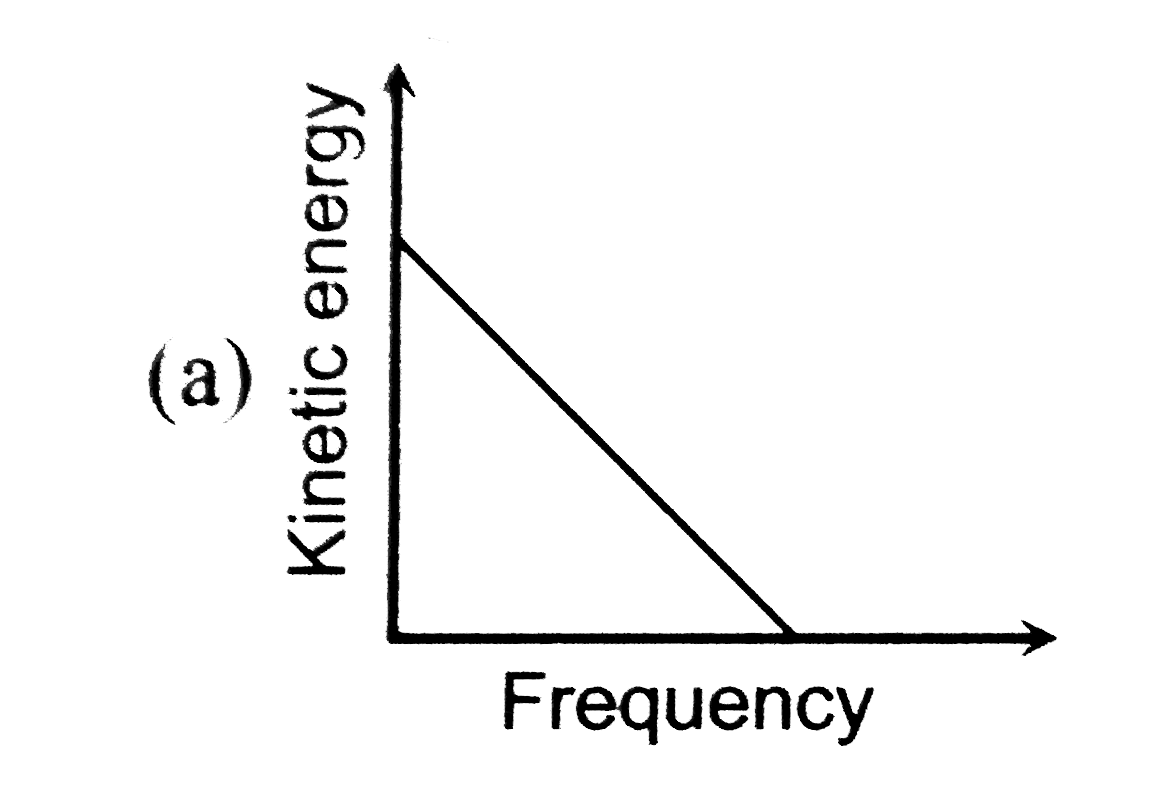
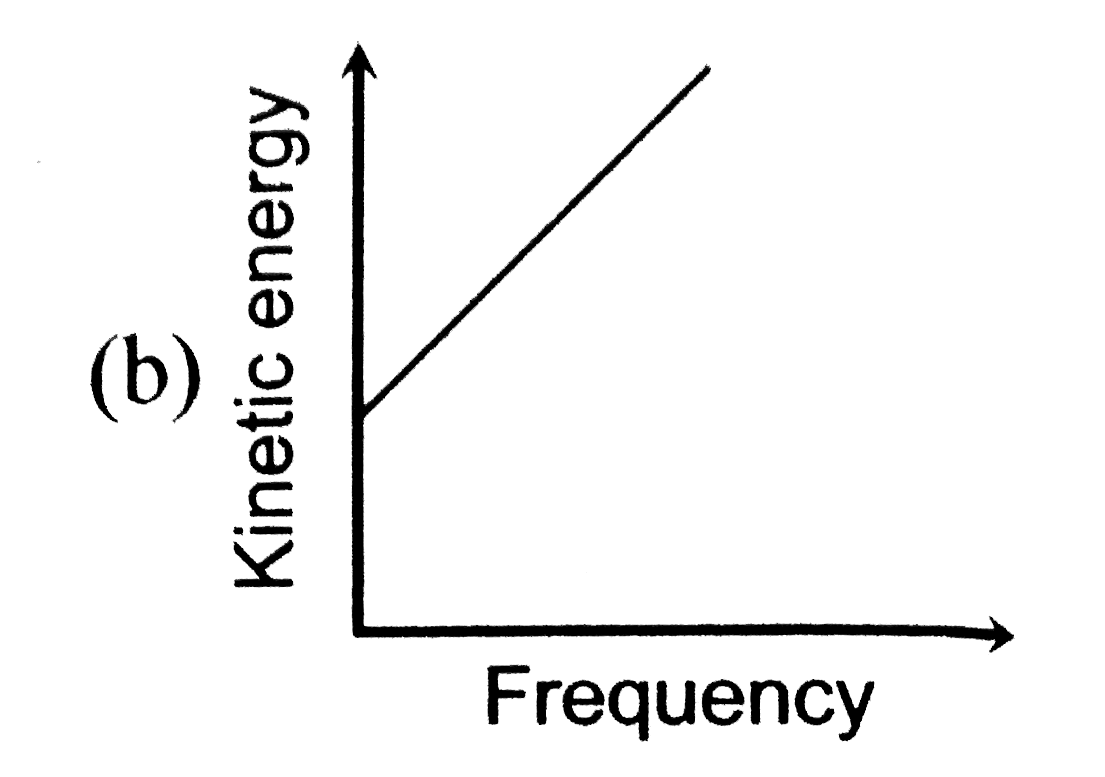
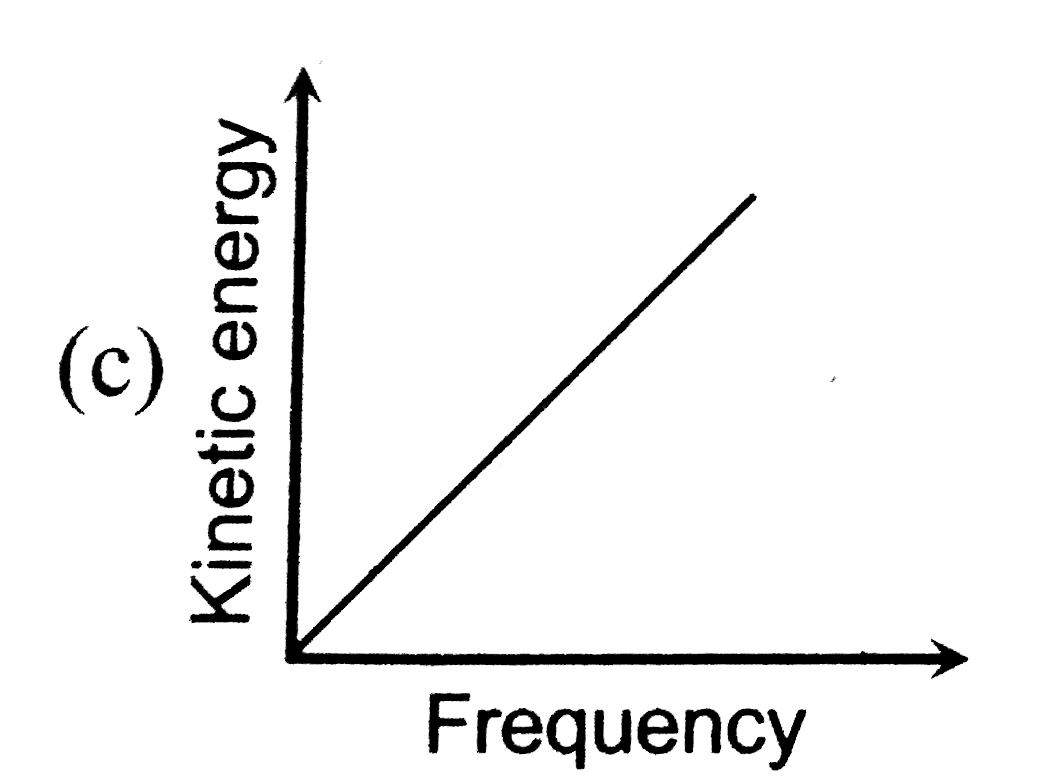
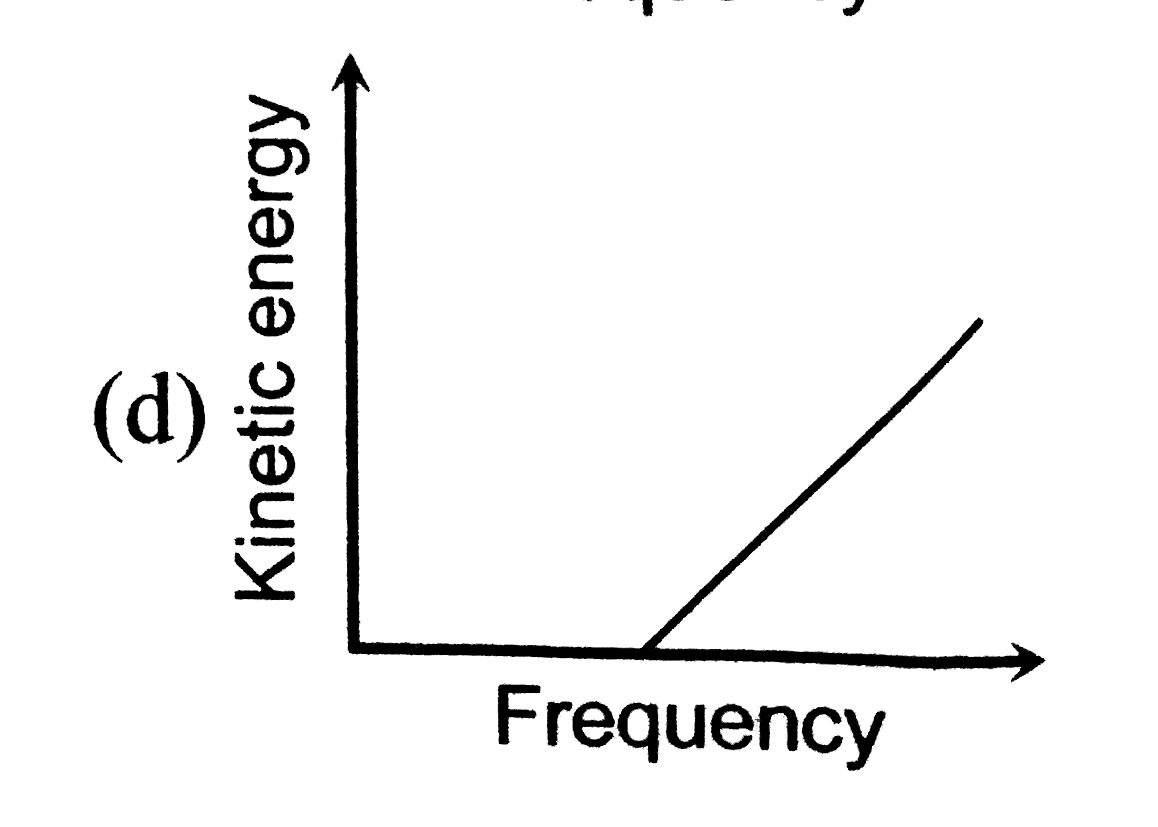
According to Einstein's photoelectric equation, the graph between the kinetic energy of photoelectrons ejected and the frequency of incident radiation is

A

B

C

D

Text Solution

AI Generated Solution

The correct Answer is:

To solve the problem regarding the graph between the kinetic energy of photoelectrons ejected and the frequency of incident radiation according to Einstein's photoelectric equation, we can follow these steps: ### Step-by-Step Solution: 1. **Understand Einstein's Photoelectric Equation**: The equation is given by: \[ K_{\text{max}} = h\nu - \phi \] where \( K_{\text{max}} \) is the maximum kinetic energy of the emitted photoelectrons, \( h \) is Planck's constant, \( \nu \) is the frequency of the incident radiation, and \( \phi \) is the work function of the material. 2. **Rearranging the Equation**: We can rearrange the equation to express \( K_{\text{max}} \) in terms of frequency: \[ K_{\text{max}} = h\nu - \phi \] This shows that \( K_{\text{max}} \) is directly proportional to the frequency of the incident radiation. 3. **Identifying the Graph**: In the equation \( K_{\text{max}} = h\nu - \phi \), we can interpret it as a linear equation of the form \( y = mx + c \), where: - \( y \) is \( K_{\text{max}} \) - \( x \) is \( \nu \) - \( m \) (the slope) is \( h \) - \( c \) (the y-intercept) is \(-\phi\) 4. **Slope and Intercept**: - The slope \( m = h \) is positive since Planck's constant is a positive value. - The y-intercept \( c = -\phi \) is negative because the work function \( \phi \) is a positive value representing the energy required to eject an electron. 5. **Graph Characteristics**: - Since the slope is positive, the graph will be a straight line that rises as frequency increases. - The line will intersect the y-axis below the origin due to the negative intercept. 6. **Conclusion**: The graph of \( K_{\text{max}} \) versus \( \nu \) will be a straight line with a positive slope and a negative y-intercept. This indicates that as the frequency of the incident radiation increases, the kinetic energy of the emitted photoelectrons also increases linearly. ### Final Answer: The graph between the kinetic energy of photoelectrons ejected and the frequency of incident radiation is a straight line with a positive slope and a negative y-intercept. ---

To solve the problem regarding the graph between the kinetic energy of photoelectrons ejected and the frequency of incident radiation according to Einstein's photoelectric equation, we can follow these steps: ### Step-by-Step Solution: 1. **Understand Einstein's Photoelectric Equation**: The equation is given by: \[ K_{\text{max}} = h\nu - \phi ...
Promotional Banner

Topper's Solved these Questions

  • DUAL NATURE OF RADIATION AND MATTER

    A2Z|Exercise X-Rays|45 Videos
  • DUAL NATURE OF RADIATION AND MATTER

    A2Z|Exercise Problems Based On Mixed Concepts|42 Videos
  • DUAL NATURE OF RADIATION AND MATTER

    A2Z|Exercise Photo Momentum Energy|30 Videos
  • CURRENT ELECTRICITY

    A2Z|Exercise Section D - Chapter End Test|29 Videos
  • ELECTRIC CHARGE, FIELD & FLUX

    A2Z|Exercise Section D - Chapter End Test|29 Videos

Similar Questions

Explore conceptually related problems

According to Einstein's photoelectric equation, the graph between kinetic energy of photoelectrons ejected and the frequency of the incident radiation is :

Write Einstein's photoelectric equation.

Does the kinetic energy of photoelectrons depend on the intensity of incident radiations?

How does kinetic energy of ejected photoelectrons depend upon the frequency of incident radiation?

The graph between the energy of photoelectrons E and the wavelength of incident light (lamda ) is

According to Einstein's photoelectric equation, the plot of the maximum kinetic energy of the emitted photoelectrons from a metal versus frequency of the incident radiation gives a straight line whose slope

According to Einstein's photoelectric equation (symbols have their usual meaning)

Maximum kinetic energy (E_(k)) of a photoelectron varies with the frequency (v) of the incident radiation as

According to Einstein's photoelectric equjation , the plot of the kinetic energy of the incident radaiation given as straight the whose used slope

A graph regarding photoelectric effect is shown between the maximum kinetic energy of electrons and the frequency of the incident light. On the basis of data as shown in the graph, calculate (a) threshold frequency , (b) work- function, (c ) planck constant

A2Z-DUAL NATURE OF RADIATION AND MATTER-Photo Electric Effect
  1. If in a photoelectric experiment , the wavelength of incident radiatio...

    Text Solution

    |

  2. The photoelectric work function for a metal surface is 4.125 eV. The c...

    Text Solution

    |

  3. According to Einstein's photoelectric equation, the graph between the ...

    Text Solution

    |

  4. The stopping potential V for photoelectric emission from a metal surfa...

    Text Solution

    |

  5. In an experiment on photoelectric effect the frequency f of the incide...

    Text Solution

    |

  6. The work function of a metal is 1.6 xx 10^(-19) J. When the metal surf...

    Text Solution

    |

  7. Ultraviolet radiation of 6.2 eV falls on an aluminium surface (work -...

    Text Solution

    |

  8. The work function for tungsten and sodium are 4.5 eV and 2.3 eV respec...

    Text Solution

    |

  9. The work function of a metallic surface is 5.01 eV. The photo - electr...

    Text Solution

    |

  10. Light of wavelength 4000 Å falls on a photosensitive metal and a negat...

    Text Solution

    |

  11. When yellow light is incident on a surface , no electrons are emitted ...

    Text Solution

    |

  12. The photoelectric threshold of a certain metal is 3000A. If the radiat...

    Text Solution

    |

  13. A photocell stoops emission if it is maintained at 2 V negative potent...

    Text Solution

    |

  14. Assuming photoemission to take place , the factor by which the maximum...

    Text Solution

    |

  15. When a point source of light is at a distance of one metre from a phot...

    Text Solution

    |

  16. If the work function of a metal is 'phi' and the frequency of the inci...

    Text Solution

    |

  17. Light of wavelength lambda strikes a photo - sensitive surface and ele...

    Text Solution

    |

  18. Light of wavelength 5000 Å falls on a sensitive plate with photoelectr...

    Text Solution

    |

  19. If the work function of a photo - metal is 6.825 eV. Its threshold wav...

    Text Solution

    |

  20. Work function of a metal is 2.1 eV. Which of the waves of the followin...

    Text Solution

    |
