Home
Class 12
PHYSICS
If m is mass of electron, v its velocity...

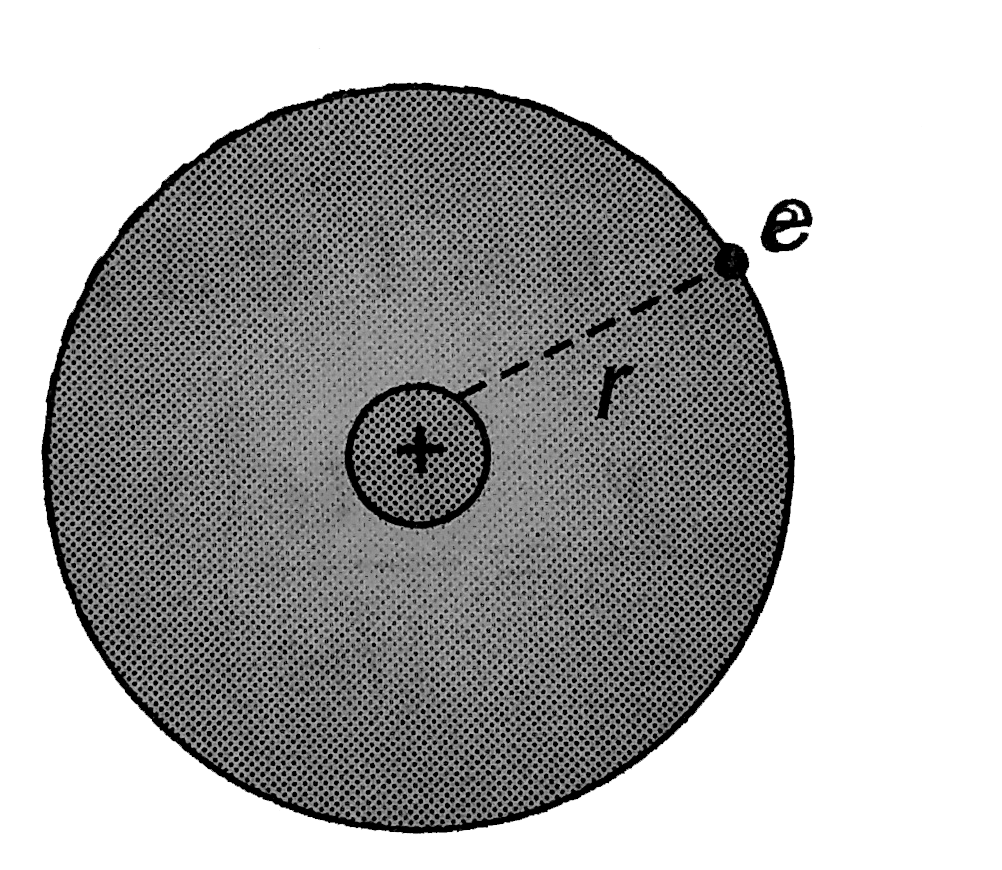
If `m` is mass of electron, `v` its velocity, `r` the radius of stationary circular orbit around a nucleus with charge `Ze`, then from Bohr's first postulate, the kinetic energy `k = (1)/(2)mv^(2)` of the electron is

A

`(1)/(2)(Ze^(2))/(r )`

B

`(1)/(2)(Ze^(2))/(r^(2))`

C

`(Ze^(2))/(r )`

D

`(Ze)/(r^(2))`

Text Solution

Verified by Experts

The correct Answer is:
A

In the revolution of electron, coulomb force provides the necessary centripetal force
`rArr (ze^(2))/(r^(2)) = (mv^(2))/(r ) rArr mv^(2) = (ze^(2))/(r )`
`:. K.E. (1)/(2)mv^(2) = (ze^(2))/(2r)`
Promotional Banner

Topper's Solved these Questions

  • ATOMIC PHYSICS

    A2Z|Exercise Atomic Spectrum|53 Videos
  • ATOMIC PHYSICS

    A2Z|Exercise Problems Based On Mixed Concepts|43 Videos
  • ATOMIC PHYSICS

    A2Z|Exercise Section D - Chapter End Test|30 Videos
  • ALTERNATING CURRENT

    A2Z|Exercise Section D - Chapter End Test|30 Videos
  • CURRENT ELECTRICITY

    A2Z|Exercise Section D - Chapter End Test|29 Videos

Similar Questions

Explore conceptually related problems

The time of revolution of an electron around a nucleus of charge Ze in n th Bohr orbit is directly proportional to

An electron of charge 'e' is revolving in a circular orbit of radius r around a nucleus with speed v. The equivalent current is

An electron of mass m and charge -e moves in circular orbit of radius r round the nucleus of charge +Ze in unielectron system. In CGS system the potential energy of electron is

An electron revolve round the nucleous with the radius of the circular orbit is 'r' . To double the kinetic energy of the electron its orbital radius will be

An electron rotates in a circle around a nucleus with positive charge Ze . How is the electrons'velocity realted to the radius of its orbit?

An electron of charge e is moving in a circular orbit of radius r around a nucleus, at a frequency v. The magnetic moment associated with the orbital motion of the electron is

A particle of charge equal to that of electron and mass 208 times the mass of the electron moves in a circular orbit around a nucleus of charge +3e. Assuming that the Bohr model of the atom is applicable to this system find the value of n for which the radius of the orbit is approximately the same as that of the first Bohr orbit of the hydrogen atom.

An electron of charge e moves in a circular orbit of radius r round a nucleus the magnetic field due to orbit motion off the electron at the site of the nucleus is B . The angular velocity omega of the electron is

When an electron of charge , e and mass , m moves with velocity v around the nuclear charge 'Ze' describing the circular orbit, the potential energy of the electron is

A particle known as mu mean has a charge equal to that of no electron and mass 208 times the mass of the electron B moves in a circular orbit around a nucleus of charge +3e Take the mass of the nucles to be infinite Assuming that the bohr's model is applicable to this system (a)drive an eqression for the radius of the nth Bohr orbit (b) find the value of a for which the redius of the orbit it approninately the same as that at the first bohr for a hydrogen atom (c) find the wavelength of the radiation emitted when the u - mean jump from the orbit to the first orbit

A2Z-ATOMIC PHYSICS-Bohr'S Hydrogen Model
  1. According to Bohr's theory the radius of electron in an orbit describe...

    Text Solution

    |

  2. The radius of electron's second stationary orbit in Bohr's atom is R. ...

    Text Solution

    |

  3. If m is mass of electron, v its velocity, r the radius of stationary c...

    Text Solution

    |

  4. Consider an electron in the nth orbit of a hydrogen atom in the Bohr m...

    Text Solution

    |

  5. In any Bohr orbit of the hydrogen atom, the ratio of kinetic energy to...

    Text Solution

    |

  6. when a hydrogen atom is raised from the ground state to an excited sta...

    Text Solution

    |

  7. In Bohr model of the hydrogen atom, the lowest orbit corresponds to

    Text Solution

    |

  8. The ratio of the kinetic energy to the total energy of an electron in ...

    Text Solution

    |

  9. An electron in the n = 1 orbit of hydrogen atom is bound by 13.6 eV. I...

    Text Solution

    |

  10. Which of the following statements about the Bohr model of the hydrogen...

    Text Solution

    |

  11. If an electron jumps from 1st orbital to 3rd orbital, than it will.

    Text Solution

    |

  12. According to Bohr's theory, the expression for the kinetic and potenti...

    Text Solution

    |

  13. In the lowest energy level of hydrogen atom, the electron has the angu...

    Text Solution

    |

  14. The Rydberg constant R for hydrogen is

    Text Solution

    |

  15. According to Bohr's theory the moment of momentum of an electron revol...

    Text Solution

    |

  16. The velocity of an electron in the second orbit of sodium atom (atomic...

    Text Solution

    |

  17. The absorption transitions between the first and the fourth energy sta...

    Text Solution

    |

  18. In the Bohr model of a hydrogen atom, the centripetal force is furnish...

    Text Solution

    |

  19. The electron in a hydrogen atom make a transition n(1) rarr n(2) wher...

    Text Solution

    |

  20. As par Bohr model, the minimum energy (in eV) required to remove an el...

    Text Solution

    |

