Home
Class 12
PHYSICS
In the figure, a proton moves a distance...

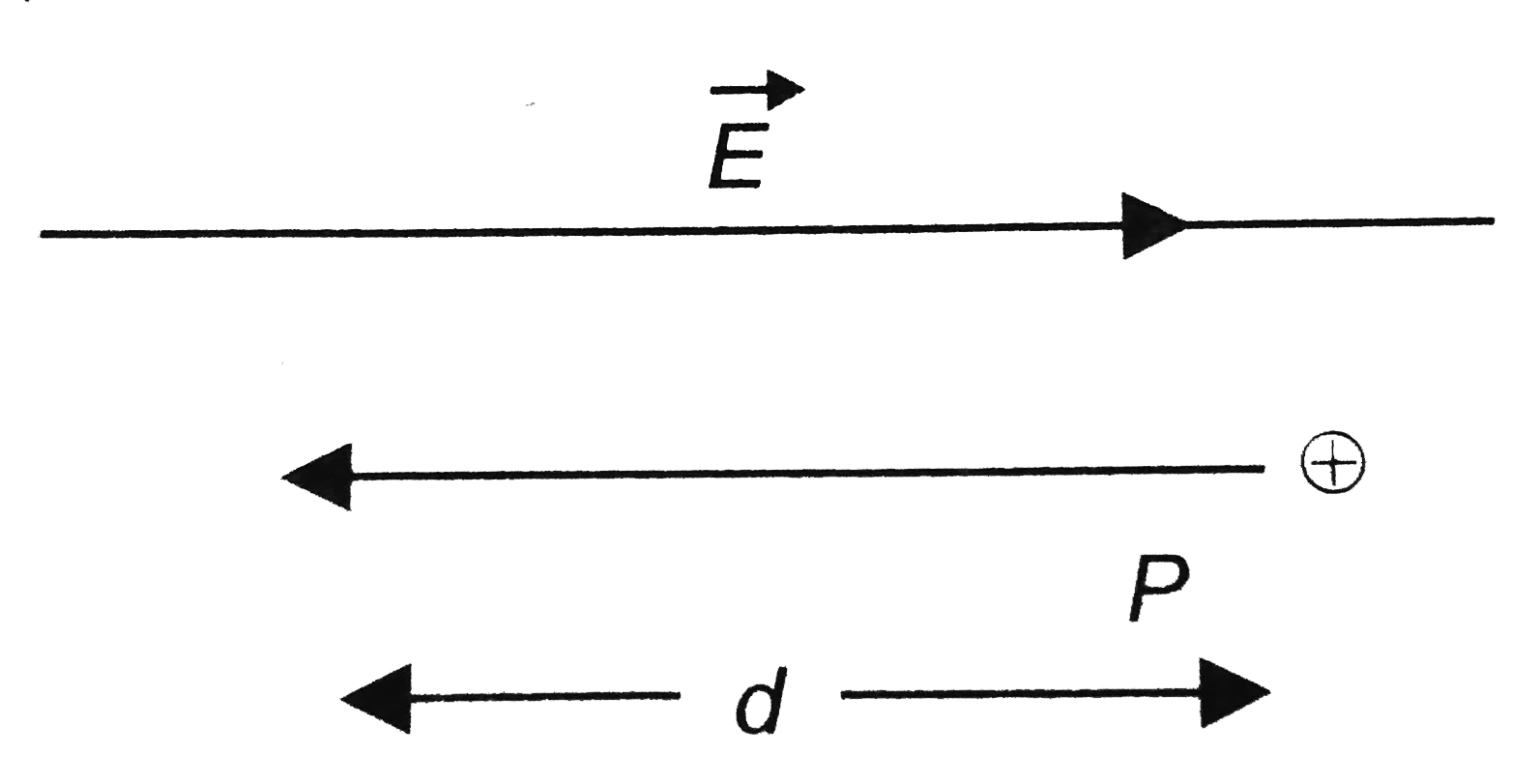
In the figure, a proton moves a distance `d` in a unform electric `vecE` as shown in the figure. Does the electric field do a positive or negative work on the proton? Does the electric potential energy of the proton increase or decrease?

A

Negative, increase

B

Positive, decrease

C

Negative, decrease

D

Positive, increase

Text Solution

Verified by Experts

The correct Answer is:

A

Since, the proton is moving against the direction of eelctric field, so work is done by the proton against electric field. Implies that eleectric field does negative work on the proton.
Again, proton is moving in electric field from low potential region to high potential region hence, its potential eenrgy increases.
Promotional Banner

Topper's Solved these Questions

  • MOCK TEST

    A2Z|Exercise Mock Test 3|44 Videos
  • MOCK TEST

    A2Z|Exercise Mock Test 3|44 Videos
  • MAGNETISM AND MATTER

    A2Z|Exercise Section D - Chapter End Test|30 Videos
  • NUCLEAR PHYSICS

    A2Z|Exercise Section D - Chapter End Test|29 Videos

Similar Questions

Explore conceptually related problems

A proton moves a distance d in a uniform electric field E ®as shown in the figure. Then which of the following statements are correct ? (1) Electric field do a negative work on the proton (2) Electric potential energy of the proton increases (3) Electric field do a positive work on the proton (4) Electric potential energy of the proton decreases

An electron and proton are placed inside a uniform electric field.

Eluipotential surfcaces are shown in figure. Then the electric field strength will be

A proton and an electron are placed in a uniform electric field.

Electric field lines are shown inf figure. State whether the electric potential is greater at A or B.

If work done by electric field is positive, then the potential energy

The variation of potential with distance R from a fixed point is shown in figure. The electric field at R = 5 m is -

A2Z-MOCK TEST-Mock Test 2
  1. A ray of light is incident on the surface of a glass plate of thicknes...

    Text Solution

    |

  2. The figure shows three situations when an electron moves with velocity...

    Text Solution

    |

  3. In the figure, a proton moves a distance d in a unform electric vecE a...

    Text Solution

    |

  4. The figure shows theree cirrcuit with idential batteries, inductors, a...

    Text Solution

    |

  5. The figure shows the path of a positively charged particle 1 through a...

    Text Solution

    |

  6. The energy spectrum of beta - particle [number N€ as a function of bet...

    Text Solution

    |

  7. In a detector, output circuit consists of R = 10kOmega and C = 100 p F...

    Text Solution

    |

  8. The graph showing the dependence of intensity transmitted light on the...

    Text Solution

    |

  9. Energy from the sun is recived on earth at the rate of 2 cal per cm^(2...

    Text Solution

    |

  10. A beam of 35.0 keV electrons strikes a molybdenum target, generating t...

    Text Solution

    |

  11. We have seen that a gamma-ray does of 3 Gy is lethal to half the peopl...

    Text Solution

    |

  12. Mass spectrometic analysis of potassium and argon atoms in a Moon rock...

    Text Solution

    |

  13. The current - voltage graphs for a given metallic wire at two differen...

    Text Solution

    |

  14. An electric bulb, marked 40 W and 200 V, is used in a circuit of suppl...

    Text Solution

    |

  15. There are four point charges +q, -q, +q and -q are placed at the corne...

    Text Solution

    |

  16. The potential difference across the 3 resistor shown in figure is

    Text Solution

    |

  17. There are N cells in the circuit of figure. The emf and internal resis...

    Text Solution

    |

  18. The earth's magnetic field at a certain place has a horizontal compone...

    Text Solution

    |

  19. Two spherical conductors A and B of radii a and b (b gt a) ar placed c...

    Text Solution

    |

  20. The magnetic flux linked with a coil, in webers, is given by the equat...

    Text Solution

    |
