Home
Class 11
PHYSICS
If light passes near a massive object, t...

If light passes near a massive object, the gravitational interaction causes a bending of the ray. This can be thought of as happening due to a change in the effective refractive index of the medium given by `n( r) = 1+ 2 GM//rc^2`
where `r` is the distance of the point consideration from the centre of the mass of the massive body, `G` is the universal gravitational constant, `M` the mass of the body and `c` the speed of light in vacuum. Considering a spherical object, find the deviation of the ray from the original path as it grazes the object.

Text Solution

Verified by Experts
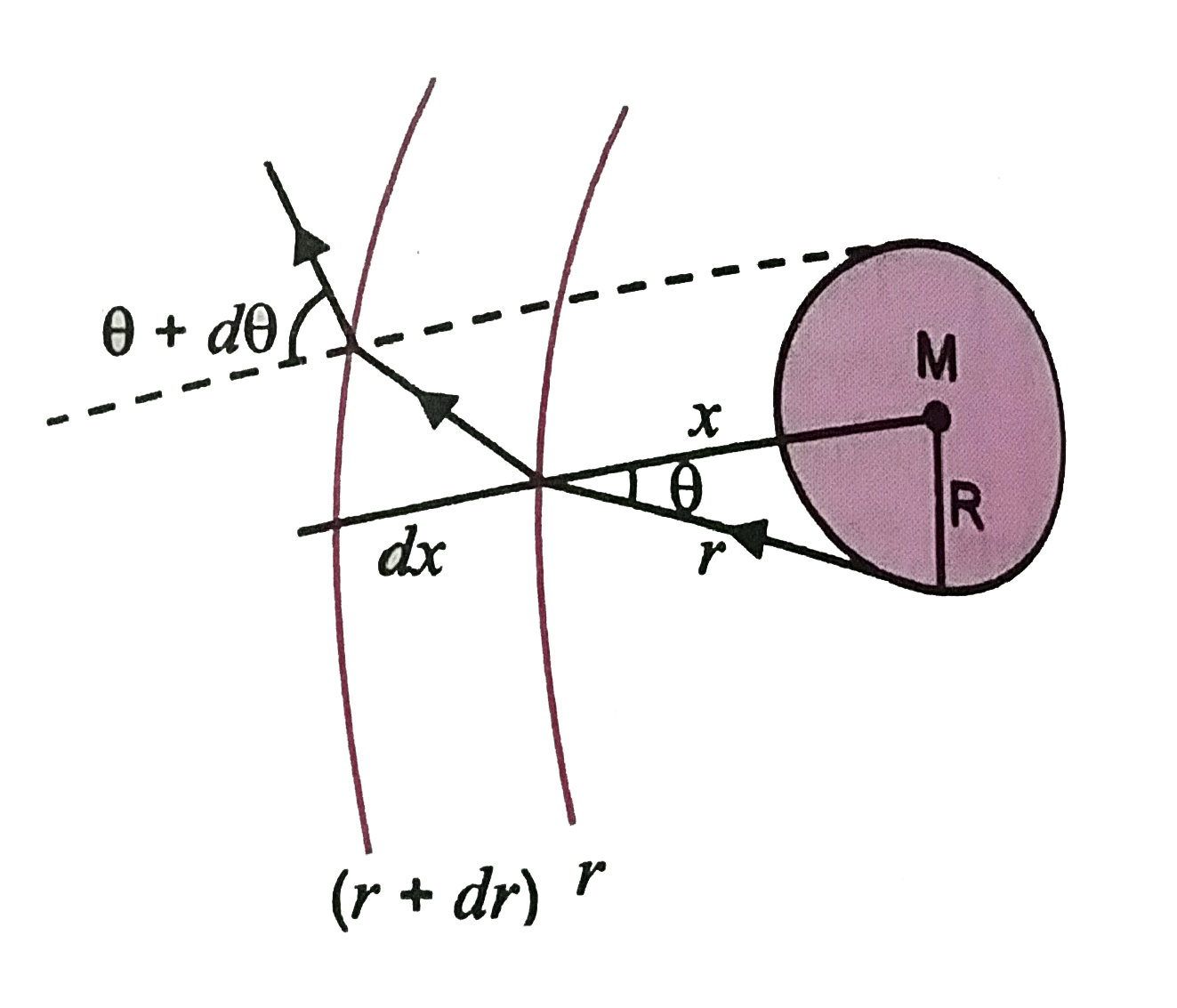
In Fig., we have shown a spherical massive body of mass `M` and radius `R`. Consider two planes one at `r` and other at `(r + dr)` from the centre of massive body. Let the light rays be incident at an angle `theta` on the plane at `r` and leave the plane at `(r + dr)` at an angle `(theta + d theta)`.
According to Snell's law,
`n(r)sin theta = n (r + dr) sin (theta + d theta) = [n(r) + (dn)/(dr) dr] (sin theta cos d theta + cos theta sin d theta)`
As `d theta` is small, `cos d theta ~= 1 and sin d theta ~= d theta`
Neglecting products of differentials, we get
`n(r) sin theta = n (r) sin theta + n (r) cos theta d theta + (dn)/(dr) dr sin theta` or `-(dn)/(dr) dr sin theta = n (r) cos theta d theta`
or `- (dn)/(dr) tan theta = n(r)(d theta)/(dr)`
As `n(r) = 1 + (2 GM)/(r c^2) :. (d n)/(dr) = (-2 GM)/(r^2 c^2)`
Put in (i) `(2 GM)/(r^2 c^2) tan theta = (1 + (2 GM)/(rc^2)) (d theta)/(dr) ~= (d theta)/(dr)` `(because (2 GM)/(rc^2)lt lt 1)`
`d theta = (2 GM)/(c^2) (tan theta)/(r^2) dr`
Intergrating both sides, we get
`int_0^(theta 0) d theta = (2GM)/(c^2) int_(-oo)^(+oo) (tan theta dr)/(r^2) = (2 GM)/(c^2) int_(-oo)^(+oo) (tan thetar dr)/(r^3)`
Now, from (Fig. 11(EP).16), `r^2 = x^2 + R^2` and `tan theta = (R )/(x)`
`:. 2 r dr = 2 x dx :. int_0^(theta 0) d theta = (2 GM)/(c^2) int_(-oo)^(+oo) (R x d x)/(x(x^2 + R^2)^(3//2))`
If we put `x = R tan phi` so that `dx = R sec^2 phi d phi`,
then `int_0^(theta 0) d theta = (2 GM)/(c^2) int_(- pi//2)^(pi//2) (R^2 sec^2 phi d phi)/(R^3 sec^3 phi)`
`theta_0 = (2 GM)/(R c^2) int_(-pi//2)^(pi//2) cos phi d phi = (4 GM)/(R c^2)`
This is the deviation for the ray from the original path as it grazes the massive body.
.
Promotional Banner

Topper's Solved these Questions

  • RAY OPTICS

    PRADEEP|Exercise (NCERT)Exercise With Solution|38 Videos
  • RAY OPTICS

    PRADEEP|Exercise Higher Thinking Order|5 Videos
  • RAY OPTICS

    PRADEEP|Exercise Long Answer (d)|6 Videos
  • PROPERTIES OF BULK MATTER

    PRADEEP|Exercise Multiple choice questions|7 Videos
  • SYSTEMS OF PARTICLES AND ROTATIONAL MOTION

    PRADEEP|Exercise Assertion- Reason Type questions|20 Videos

Similar Questions

Explore conceptually related problems

Define G (universal gravitational constant).

The acceleration due to gravity'g' for objects on or near the surface of earth is related to the universal gravitational constant 'G' as ('M' is the mass of the earth and 'R' is its radius):

When a ray of light passes from air medium to denser medium then the refractive index is

If E is energy M is mass, J is angular momentum and G is universal gravitational constant ,then dimensions of x=EJ^2/G^2M^5 can be that of

P is a point at a distance r from the centre of a spherical shell of mass M and radius a, where r lt a . The gravitational potential at P is

If the energy, E = G^p h^q c^r, where G is the universal gravitational constant, h is the Planck's constant and c is the velocity of light, then the values of p are q and r are, respectively

