Home
Class 12
PHYSICS
Two bars connected by a weightless sprin...

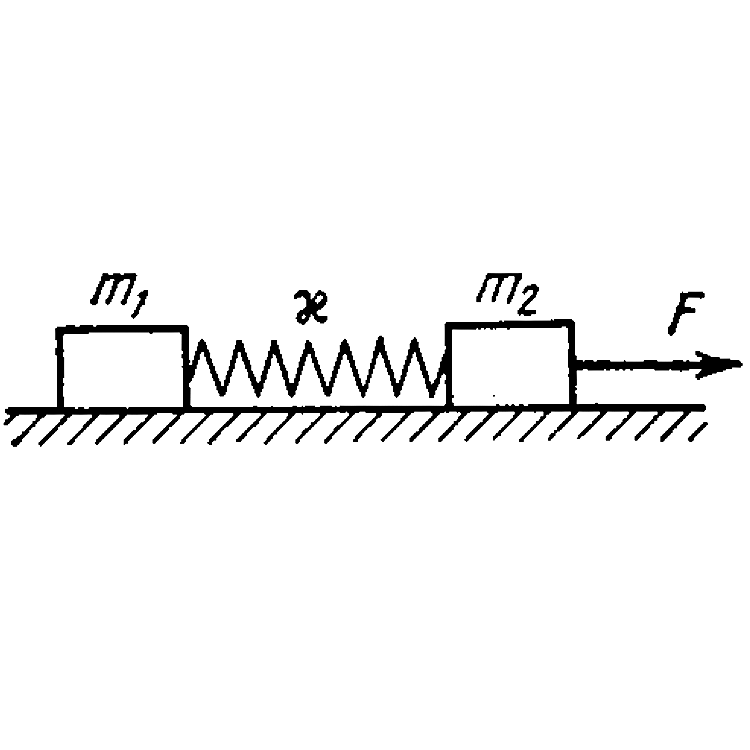
Two bars connected by a weightless spring of stiffness `ϰ` and length (in the non-deformed state) `l_0` rest on a horizontal plane. A constant horizontal force F starts acting on one of the bars as shown in figure. Find the maximum and minimum distances between the bars during the subsequent motion of the system, if the masses of the bars are:
(a) equal:
(b) equal to `m_1` and `m_2`, and the force F is applied to the bar of mass `m_2`.

Text Solution

Verified by Experts

Let us consider both blocks and spring as the physical system. The centre of mass of the system moves with acceleration `a=(F)/(m_1+m_2)` towards right. Let us work in the frame of centre of mass. As this frame is a non-inertial frame (accelerated with respect to the ground) we have to apply a pseudo force `m_1a` towards left on the block `m_1` and `m_2a` towards left on the block `m_2`
As the centre of mass is at rest in this frame, the blocks move in opposite directions and come to instantaneous rest at some instant. The elongation of the spring will be maximum or minimum at this instant. Assume that the block `m_1` is displaced by the distance `x_1` and the block `m_2` through a distance `x_2` from the initial positions.
From the energy equation in the frame of C.M.
`Deltaoverset~T+U=A_(ext)`,
(where `A_(ext)` also includes the work done by the pseudo forces)
Here,
`Deltaoverset~T=0`, `U=1/2k(x_1+x_2)^2` and
`W_(ext)=((F-m_2F)/(m_1+m_2))x_2+(m_1F)/(m_1+m_2)x_1=(m_1F(x_1+x_2))/(m_1+m_2)`
or, `1/2k(x_1+x_2)^2=(m_1(x_1+x_2)F)/(m_1+m_2)`
So, `x_1+x_2=0` or, `x_1+x_2=(2m_1F)/(k(m_1+m_2))`
Hence the maximum separation between the blocks equals: `l_0+(2m_1F)/(k(m_1+m_2))`
Obviously the minimum sepation corresponds to zero elongation and is equal to `l_0`
Promotional Banner

Topper's Solved these Questions

  • PHYSICAL FUNDAMENTALS OF MECHANICS

    IE IRODOV, LA SENA & SS KROTOV|Exercise Universal Gravitation|34 Videos
  • PHYSICAL FUNDAMENTALS OF MECHANICS

    IE IRODOV, LA SENA & SS KROTOV|Exercise Dynamics Of A Solid Body|56 Videos
  • PHYSICAL FUNDAMENTALS OF MECHANICS

    IE IRODOV, LA SENA & SS KROTOV|Exercise The Fundamental Equation Of Dynamics|59 Videos
  • OSCILLATIONS AND WAVES

    IE IRODOV, LA SENA & SS KROTOV|Exercise Electromagnetic Waves, Radiation|36 Videos
  • THERMODYNAMICS AND MOLECULAR PHYSICS

    IE IRODOV, LA SENA & SS KROTOV|Exercise Transport Phenomena|38 Videos

Similar Questions

Explore conceptually related problems

Two blocks connected by a spring rest on a smooth horizontal plane as shown in Fig. A constant force F start acting on block m_2 as shown in the figure. Which of the following statements are not correct?

Two bars of masses m_1 and m_2 connected by a weightless spring of stiffness ϰ (figure) rest on a smooth horizontal plane. Bar 2 is shifted a small distance x to the left and then released. Find the velocity of the centre of inertia of the system after bar 1 breaks off the wall.

Two bars of masses m_1 and m_2 connected by a non-deformed light spring rest on a horizontal plane. The coefficient of friction between the bars and the surface is equal to k. What minimum constant force has to be applied in the horizontal direction to the bar of mass m_1 in order to shift the other bar?

Two bars of masses m_(1) and m_(2) connected by a non - deformed light spring rest on a horizontal plane. The coefficient of friction between the bars and the surface is equal to mu . What minimum constant force has to be appled in the horizontal direction to the bar of mass m_(1) in order to shift the other bar?

Two bars of masses m_1 and m_2 connected by a weightless spring of stiffness k , rest on a smooth horizontal plane. Bar 2 is shifted by a small distance x_0 to the left and released. The veloicyt of the centre of mass of the system when bar 1 breaks off the wall is

A block of mass m is connected to another block of mass M by a massless spring of spring constant k . the blocks are kept of a smooth horizontal plane and are at rest. The spring is unstretched when a constant force F starts acting on the block of mass M of pull it. Find the maximum extension of the spring

In the Boolean algebra bar((bar(A).bar(B))). A equal to

IE IRODOV, LA SENA & SS KROTOV-PHYSICAL FUNDAMENTALS OF MECHANICS-Laws Of Conservation Of Energy, Momentum And Angular Momentum
  1. A system consists of two small spheres of masses m1 and m2 interconnec...

    Text Solution

    |

  2. Two bars of masses m1 and m2 connected by a weightless spring of stiff...

    Text Solution

    |

  3. Two bars connected by a weightless spring of stiffness ϰ and length (i...

    Text Solution

    |

  4. A system consists of two identical cubes, each of mass m, linked toget...

    Text Solution

    |

  5. Two identical buggies 1 and 2 with one man in each move without fricti...

    Text Solution

    |

  6. Two identical buggies move one after the other due to inertia (without...

    Text Solution

    |

  7. Two men, each of mass m, stand on the edge of a stationary buggy of ma...

    Text Solution

    |

  8. A chain hangs on a thread and touches the surface of a table by its lo...

    Text Solution

    |

  9. A steel ball of mass m=50g falls from the height h=1.0m on the horizon...

    Text Solution

    |

  10. A raft of mass M with a man of mass m aboard stays motionless on the s...

    Text Solution

    |

  11. A stationary pulley carries a rope whose one end supports a ladder wit...

    Text Solution

    |

  12. A cannon of mass M starts sliding freely down a smooth inclined plane ...

    Text Solution

    |

  13. A horizontally flying bullet of mass m gets stuck in a body of mass M ...

    Text Solution

    |

  14. A body of mass M (figure) with a small disc of mass m placed on it res...

    Text Solution

    |

  15. A small disc of mass m slides down a smooth hill of height h without i...

    Text Solution

    |

  16. A stone falls down without initial velocity from a height h onto the E...

    Text Solution

    |

  17. A particle of mass 1.0g moving with velocity v1=3.0i-2.0j experiences ...

    Text Solution

    |

  18. Find the increment of the kinetic energy of the closed system comprisi...

    Text Solution

    |

  19. A particle of mass m1 experienced a perfectly elastic collision with a...

    Text Solution

    |

  20. Particle 1 experiences a perfectly elastic collision with a stationary...

    Text Solution

    |

