Home
Class 12
PHYSICS
A body of mass M (figure) with a small d...

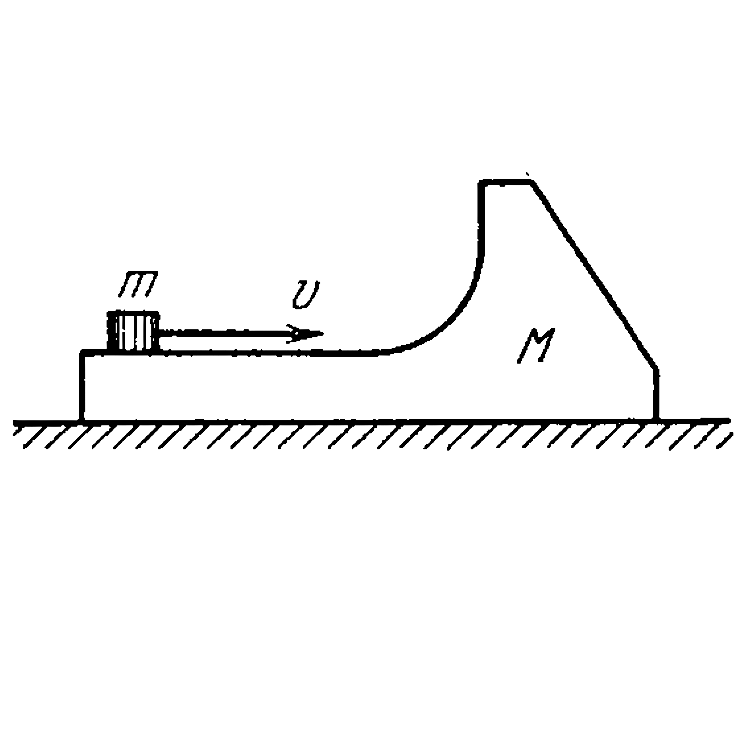
A body of mass M (figure) with a small disc of mass m placed on it rests on a smooth horizontal plane. The disc is set in motion in the horizontal direction with velocity v. To what height (relative to the initial level) will the disc rise after breaking off the body M? The friction is assumed to be absent.

Text Solution

Verified by Experts

When the disc breaks off the body M, its velocity towards right (along x-axis) equals the velocity of the body M, and let the disc's velocity in upward direction (along y-axis) at that moment be `v_y^'`
From conservation of momentum, along x-axis for the system (disc+body)
`mv=(m+M)v_x^'` or `v_x^'=(mv)/(m+M)`
And from energy conservation, for the same system in the field of gravity:
`1/2mv^2=1/2(m+M)v'_x^2+1/2mv'_y^2+mgh^'`,
where `h^'` is the height of break off point from initial level. So,
`1/2mv^2=1/2(m+M)(m^2v^2)/((M+m))+1/2mv'_y^2+mgh^'`, using (1)
or, `v'_y^2=v^2-(mv^2)/((m+M))-2gh^'`
Also, if `h^('')` is the height of the disc, from the break-off point,
then, `v'_y^2=2gh^(' ')`
So, `2g(h^(' ')+h^')=v^2-(mv^2)/((M+m))`
Hence, the total height, raised from the intital level
`=h^'+h^('')=(Mv^2)/(2g(M+m))`
Promotional Banner

Topper's Solved these Questions

  • PHYSICAL FUNDAMENTALS OF MECHANICS

    IE IRODOV, LA SENA & SS KROTOV|Exercise Universal Gravitation|34 Videos
  • PHYSICAL FUNDAMENTALS OF MECHANICS

    IE IRODOV, LA SENA & SS KROTOV|Exercise Dynamics Of A Solid Body|56 Videos
  • PHYSICAL FUNDAMENTALS OF MECHANICS

    IE IRODOV, LA SENA & SS KROTOV|Exercise The Fundamental Equation Of Dynamics|59 Videos
  • OSCILLATIONS AND WAVES

    IE IRODOV, LA SENA & SS KROTOV|Exercise Electromagnetic Waves, Radiation|36 Videos
  • THERMODYNAMICS AND MOLECULAR PHYSICS

    IE IRODOV, LA SENA & SS KROTOV|Exercise Transport Phenomena|38 Videos

Similar Questions

Explore conceptually related problems

A body of mass M with a small block m placed on it rests on a smooth horizontal surface. The block is set in motion in the horizontal direction with a velocity v . To what height relative to the initial level will the block rise after breaking off from the body M . Friction can be assumed to be absent.

A body of mass M with a small box of mass m placed on it rests on a smooth horizontal surface. The box is set in motion in the horizontal direction with a velocity u as shown in figure. To what height relative to the initial level will the box rise after breaking off from the body M? Assume all surfaces are frictionless.

A block of mass m is placed at rest on a smooth wedge of mass M placed at rest on a smooth horizontal surface. As the system is released

A small disc and a thin uniform rod of length l, whose mass is eta times greater than the mass of the disc, lie on a smooth horizontal plane. The disc is set in motion, in horiozontal direction and perpendicular to the rod, with velocity v, after which it elastically collides with the end of the rod. Find the velocity of the disc and the angular velocity of the rod after the collision. At what value of eta will the velocity of the disc after the collision be equal to zero? reverse its direction?

At the moment t=0 the force F=at is applied to a small body of mass m resting on a smooth horizontal plane (a is constant). The permanent direction of this force forms an angle alpha with the horizontal (figure). Find: (a) the velocity of the body at the moment of its breaking off the plane, (b) the distance traversed by the body up to this moment.

A disc of mass M and radius R rolls on a horizontal surface and then rolls up an inclined plane as shown in the figure. If the velocity of the disc is v, the height to which the disc will rise will be:

A disc of mass M and radius R rolls on a horizontal surface and then rolls up an inclined plane as shown in the figure. If the velocity of the disc is v, the height to which the disc will rise will be :-

Disc is rolling on the horizontal with constant If mass of the disc is velocity 2 m/s. 400 g, then total kinetic energy of disc is

IE IRODOV, LA SENA & SS KROTOV-PHYSICAL FUNDAMENTALS OF MECHANICS-Laws Of Conservation Of Energy, Momentum And Angular Momentum
  1. A cannon of mass M starts sliding freely down a smooth inclined plane ...

    Text Solution

    |

  2. A horizontally flying bullet of mass m gets stuck in a body of mass M ...

    Text Solution

    |

  3. A body of mass M (figure) with a small disc of mass m placed on it res...

    Text Solution

    |

  4. A small disc of mass m slides down a smooth hill of height h without i...

    Text Solution

    |

  5. A stone falls down without initial velocity from a height h onto the E...

    Text Solution

    |

  6. A particle of mass 1.0g moving with velocity v1=3.0i-2.0j experiences ...

    Text Solution

    |

  7. Find the increment of the kinetic energy of the closed system comprisi...

    Text Solution

    |

  8. A particle of mass m1 experienced a perfectly elastic collision with a...

    Text Solution

    |

  9. Particle 1 experiences a perfectly elastic collision with a stationary...

    Text Solution

    |

  10. A ball moving translationally collides elastically with another, stati...

    Text Solution

    |

  11. A shell flying with velocity v=500m//s burts into three identical frag...

    Text Solution

    |

  12. Particle 1 moving with velocity v=10m//s experienced a head-on collisi...

    Text Solution

    |

  13. A particle of mass m having collided with a stationary particle of mas...

    Text Solution

    |

  14. A closed system consists of two particles of masses m1 and m2 which mo...

    Text Solution

    |

  15. A particle of mass m1 collides elastically with a stationary particle ...

    Text Solution

    |

  16. Three identical discs A, B, and C (figure) rest on a smooth horizontal...

    Text Solution

    |

  17. A molecule collides with another, stationary, molecule of the same mas...

    Text Solution

    |

  18. A rocket ejects a steady jet whose velocity is equal to u relative to ...

    Text Solution

    |

  19. A rocket moves in the absence of external forces by ejecting a steady ...

    Text Solution

    |

  20. Find the law according to which the mass of the rocket varies with tim...

    Text Solution

    |
