Home
Class 12
PHYSICS
A system goes from A and B via two proce...

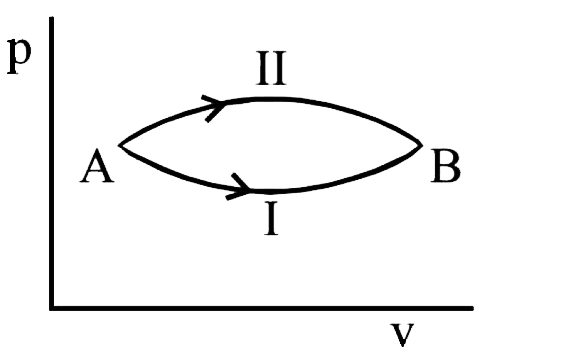
A system goes from A and B via two processes. I and II as shown in figure. If `DeltaU_1 and DeltaU_2` are the changes in internal energies in the processes I and II respectively, then

A

`DeltaU_(2)ltDeltaU_(1)`

B

`DeltaU_(2)gtDeltaU_(1)`

C

relation between `DeltaU_(1)andDeltaU_(2)` cannot be determined

D

`DeltaU_(1)=DeltaU_(2)`

Text Solution

Verified by Experts

The correct Answer is:

D

`DeltaU_(1)=DeltaU_(2)`
Because the change in internal energy does not depend upon the path.
Promotional Banner

Topper's Solved these Questions

  • KINETIC THEORY OF GASES ,THERMODYNAMICS AND RADIATION

    MARVEL PUBLICATION|Exercise TEST YOUR GRASP - 9|30 Videos
  • INTERFERENCE AND DIFFRACTION

    MARVEL PUBLICATION|Exercise TEST YOUR GRASP|20 Videos
  • MAGNETIC EFFECTS OF ELECTRIC CURRENT

    MARVEL PUBLICATION|Exercise MCQ|195 Videos

Similar Questions

Explore conceptually related problems

A system goes from A and B via two processes. I and II as shown in figure. If DeltaU_1 and DeltaU_2 are the changes in internal enregies in the processes I and II respectively, then

A system goes from A to B via two processes I and II as shown in the figure. If DeltaU_(1) and DeltaU_(2) are the changes in the internal energies in the processes I and II respectively, then -

A system goes from state A to B via two processes I and II, as shown in Fig. 12.25, How are delta mu_1 and delta mu_2 (the changes in internal energies in the processes I and II) related to each other ?

Refer to let DeltaU_(1) and DeltaU_(2) be the changes in internal energy of the system in the processes A and B. then

Two path 1 and 2 are shown in figure. If the change in internal energies are U_1 , and U_2 for path 1 and 2 respectively, then

An ideal gas goes from State A to state B via three different process as indicate in the P-V diagram. If Q_(2), Q_(3) indicates the heat absorbed by the gas along the three processes and DeltaU_(1), DeltaU_(2), DeltaU_(3) indicates the change in internal energy along the three processes respectively, then

shows two processes A and B on a system.Let DeltaQ_(1) and DeltaQ_(2) be the heat given to the system in processes A and B respectively. Then

What will be nature of change in internal energy in case of processes shown below ?

Observe the given figure and identify the process (I) and (II)

MARVEL PUBLICATION-KINETIC THEORY OF GASES ,THERMODYNAMICS AND RADIATION-TEST YOUR GRASP - 9
  1. A system goes from A and B via two processes. I and II as shown in fig...

    Text Solution

    |

  2. The velocities of 4 molecules are 4m/s, 5m/s, 6m/s and 2m/s respective...

    Text Solution

    |

  3. Oxygen and hydrogen gas are at same temperature and pressure. And the ...

    Text Solution

    |

  4. The mean free path of nitrogen molecules at 27^(@)C is 3xx10^(-7)m//s....

    Text Solution

    |

  5. The equation of state for 15 gram of oxygen at pressure P, volume V an...

    Text Solution

    |

  6. The rms velocity of the molecules of a gas at temperature T is 1200 m/...

    Text Solution

    |

  7. If atmospheric pressure P=1xx10^(5)N//m^(2)andR=8J//"mole"//""^(@)K, t...

    Text Solution

    |

  8. At what temperature is the K.E. Of a gas molecules half that of its va...

    Text Solution

    |

  9. Each molecule of a gas has F degrees of freedom . The ratio (C(p))/(C(...

    Text Solution

    |

  10. Argon gas is heated at constant volume through 1^(@)C. The heat suppli...

    Text Solution

    |

  11. C(v) denotes the molar specific heat of a gas at constant volume and g...

    Text Solution

    |

  12. One mole of a monoatomic ideal gas is mixed with one mole of a diato...

    Text Solution

    |

  13. Which one of the following is not true about the following thermodynam...

    Text Solution

    |

  14. During an adiabatic process, the pressure of gas is found to be propor...

    Text Solution

    |

  15. The difference between the principal specific heats of a gas is 300J/k...

    Text Solution

    |

  16. When the temperature of 4 moles of a gas was increased from 80^(@)C to...

    Text Solution

    |

  17. 100g of water is heated from 30^@C to 50^@C. Ignoring the slight expan...

    Text Solution

    |

  18. The temperature of sink of Carnot engine is 27^(@)C. Efficiency of eng...

    Text Solution

    |

  19. In an ideal refrigerator, heat from inside at 280 K is transferred to ...

    Text Solution

    |

  20. Which one of the following statements is true in the case of radiation...

    Text Solution

    |

  21. A perfectly black sphere of diameter 0.2 m is in thermal equilibrium w...

    Text Solution

    |
