Home
Class 12
PHYSICS
In the P - V diagram, I is the initial s...

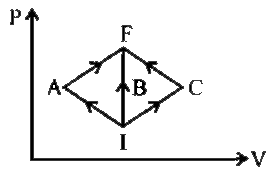
In the P - V diagram, I is the initial state and F is the final state. The gas goes from I to F by
(i) IAF, (ii) IBF and (iii) ICF.

The heat absorbed by the gas is

A

the same in all the three processes

B

the same in (i) and (ii)

C

more in (i) than in (ii)

D

the same in (ii) and (iii)

Text Solution

Verified by Experts

The correct Answer is:

C

For a thermodynamic process, dQ = dU + dW
In this case for all three processes initial and final states are the same.
`therefore` dU is the same for all.
`therefore` dQ will depend upon dW.
Let `dW_(1),dW_(2)anddW_(3)` be the works done in (i), (ii) and (iii) then `dW_(1)` is +ve.
`thereforedW_(2)` = 0 as it is an isochoric process as volume is constant and `dW_(2)` = PdV = 0.
`dW_(3)` is positive and `dW_(1)=dW_(3)" "thereforedQ_(1)gtdQ_(2)`
Promotional Banner

Topper's Solved these Questions

  • KINETIC THEORY OF GASES ,THERMODYNAMICS AND RADIATION

    MARVEL PUBLICATION|Exercise TEST YOUR GRASP - 9|30 Videos
  • INTERFERENCE AND DIFFRACTION

    MARVEL PUBLICATION|Exercise TEST YOUR GRASP|20 Videos
  • MAGNETIC EFFECTS OF ELECTRIC CURRENT

    MARVEL PUBLICATION|Exercise MCQ|195 Videos

Similar Questions

Explore conceptually related problems

When a thermodynamic system is taken from an initial state I to a final state F along the path IAF, as shown in Fig. the heat energy absorbed by the system is Q = 55 J and work done by the system is W = 25 J . If the same system is taken along the path IBF, the value of Q = 35 J . (a) If W = - 15 J for the curved path FI, how much heat energy is lost by the system along this path ? (b) If U_(1) = 10 J , what is U_(F) ? (d) If U_(B) = 20 J , what is Q for the process BF and IB ?

One mole of an ideal gas is taken from state A to state B by three different processes (a) ACB , (b) ADB and (c ) AEB as shown in the P - V diagram. The heat absorbed by the gas is

An ideal gas of mass m in a state A goes to another state B via three different processes as shown in Fig. If Q_(1), Q_(2) and Q_(3) denote the heat absorbed by the gas along the three paths, then

Six grams of hydrogen gas at a temperature of 273 K isothoermally expanded to five times its initial volume and then isochorically heated so that the pressure in the final state becomes equal to that in the initial state. Find the total amount of heat absorbed by the gas during the entire process.

An ideal gas goes from State A to state B via three different process as indicate in the P-V diagram. If Q_(2), Q_(3) indicates the heat absorbed by the gas along the three processes and DeltaU_(1), DeltaU_(2), DeltaU_(3) indicates the change in internal energy along the three processes respectively, then

An ideal gas undergoes a four step cycle as shown in the P-V diagram below. During this cycle heat is absorbed by the gas in

Figure shows the p-V diagram of an ideal gas undergoing a change of state from A to B. Four different parts I, II, III and IV as shown in the figure may lead to the same change of state. ltBrgt

A thermodynamic system goes from states (i) P_(1) V to 2P_(1) , V (ii) P , V to P , 2 V . Then work done in the two cases is

An ideal gas goes from the state i to the state int as shown in .the work done by the gas during the process

MARVEL PUBLICATION-KINETIC THEORY OF GASES ,THERMODYNAMICS AND RADIATION-TEST YOUR GRASP - 9
  1. In the P - V diagram, I is the initial state and F is the final state....

    Text Solution

    |

  2. The velocities of 4 molecules are 4m/s, 5m/s, 6m/s and 2m/s respective...

    Text Solution

    |

  3. Oxygen and hydrogen gas are at same temperature and pressure. And the ...

    Text Solution

    |

  4. The mean free path of nitrogen molecules at 27^(@)C is 3xx10^(-7)m//s....

    Text Solution

    |

  5. The equation of state for 15 gram of oxygen at pressure P, volume V an...

    Text Solution

    |

  6. The rms velocity of the molecules of a gas at temperature T is 1200 m/...

    Text Solution

    |

  7. If atmospheric pressure P=1xx10^(5)N//m^(2)andR=8J//"mole"//""^(@)K, t...

    Text Solution

    |

  8. At what temperature is the K.E. Of a gas molecules half that of its va...

    Text Solution

    |

  9. Each molecule of a gas has F degrees of freedom . The ratio (C(p))/(C(...

    Text Solution

    |

  10. Argon gas is heated at constant volume through 1^(@)C. The heat suppli...

    Text Solution

    |

  11. C(v) denotes the molar specific heat of a gas at constant volume and g...

    Text Solution

    |

  12. One mole of a monoatomic ideal gas is mixed with one mole of a diato...

    Text Solution

    |

  13. Which one of the following is not true about the following thermodynam...

    Text Solution

    |

  14. During an adiabatic process, the pressure of gas is found to be propor...

    Text Solution

    |

  15. The difference between the principal specific heats of a gas is 300J/k...

    Text Solution

    |

  16. When the temperature of 4 moles of a gas was increased from 80^(@)C to...

    Text Solution

    |

  17. 100g of water is heated from 30^@C to 50^@C. Ignoring the slight expan...

    Text Solution

    |

  18. The temperature of sink of Carnot engine is 27^(@)C. Efficiency of eng...

    Text Solution

    |

  19. In an ideal refrigerator, heat from inside at 280 K is transferred to ...

    Text Solution

    |

  20. Which one of the following statements is true in the case of radiation...

    Text Solution

    |

  21. A perfectly black sphere of diameter 0.2 m is in thermal equilibrium w...

    Text Solution

    |
