Home
Class 12
PHYSICS
The graph shows the change 'Delta l' in ...

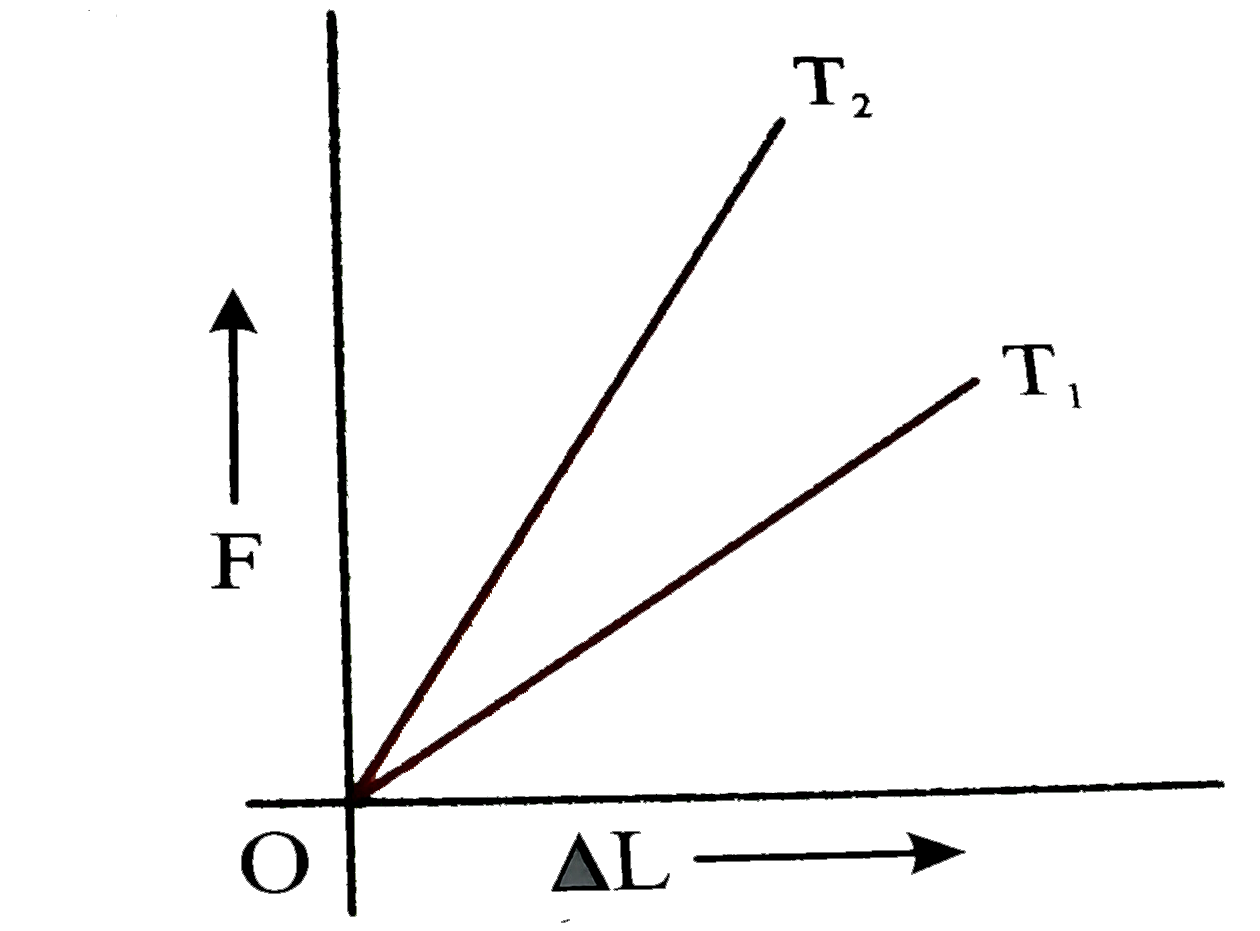
The graph shows the change `'Delta l'` in the length of a thin uniform wire used by the application of force `F` at different temperatures `T_(1)` and `T_(2)`. The variation suggests that

A

`T_(1)=T_(2)`

B

`T_(1)gtT_(2)`

C

`T_(1) lt T_(2)`

D

`T_(1) leT_(2)`

Text Solution

Verified by Experts

The correct Answer is:

B
Promotional Banner

Topper's Solved these Questions

  • EXPERIMENTAL PHYSICS

    NARAYNA|Exercise Level-v(Single answer)|23 Videos
  • EXPERIMENTAL PHYSICS

    NARAYNA|Exercise Multiple answer|6 Videos
  • ELECTROSTATICS AND GAUSS LAW

    NARAYNA|Exercise Intergers type question|11 Videos
  • MAGNETISM

    NARAYNA|Exercise LEVEL-II (H.W)|24 Videos

Similar Questions

Explore conceptually related problems

The diagram shows the change x in the length of the uniform wire caused by the application of stres F at two different temperatures T and T. The variations shown suggest that

The figure shows the variation of V with i at temperatures T_(1) and T_(2) . Then T_(1)-T_(2) is proportional to

The graph of (x/m) vs P at two different temperature T_1 and T_2 is [where T_1gtT_2 ]

The current (I) and voltage (V) graphs for a given metallic wire at two different temperature (T_(1)) and (T_(2)) are shown in fig. It is concluded that

The isothermal diagram of a gas at three different temperatures T_(1),T_(2) and ^_(3) , is show in the given figure .Then

The stress-strain graph for a metallic wire is shown at two different temperature, T_(1) and T_(2) which temperature is high T_(1) or T_(2) ?

The current - voltage graphs for a given metallic wire at two different temperatures T_1 and T_2 are shown in the figure. The temperature T_2 is greater than T_1 .

Figure shows graphs of pressure vs density for an ideal gas at two temperatures T_(t) and T_(2)
