Home
Class 11
PHYSICS
In the shown arrangement, both the sprin...

In the shown arrangement, both the spring are in their natural lengths. The coefficient of friction between `m_(2)` and `m_(1)` is `mu`. There is no friction between `m_(1)` and the surface. If the blocks are displaced slightly, they together perform simple harmonic motion. Obtain
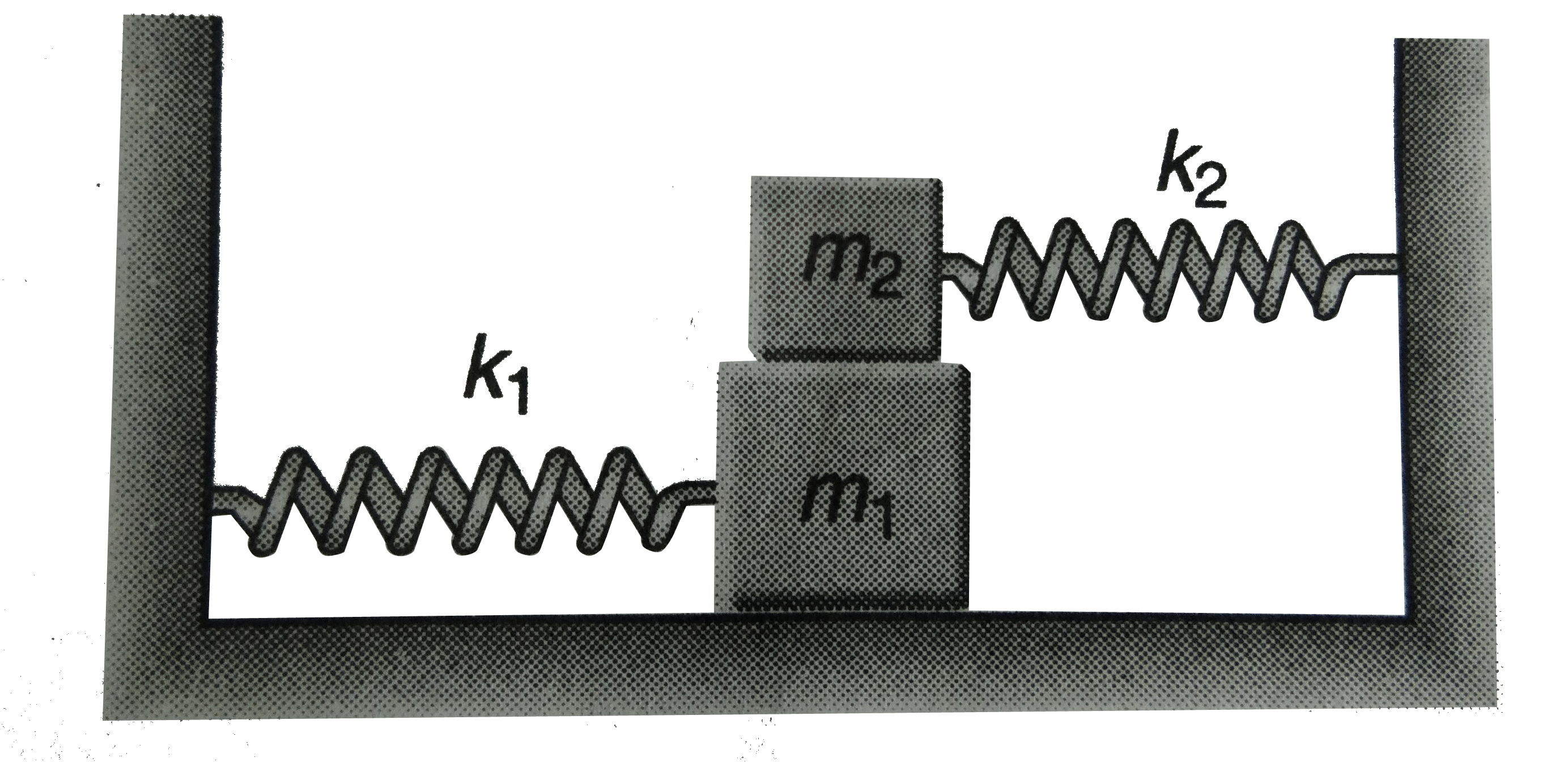
(a) Frequency of such oscillations.
(b) The condition if the friction force on clock `m_(2)` is to act in the direction of its displacement from mean position.
( c) If the condition obtained in (b) is met, what can be maximum of their oscillations ?


A

`(1)/(2pi) sqrt(((k_(1)+k_(2)))/((m_(1)+m_(2))))`

B

`(1)/(2pi)sqrt((k_(1)k_(2))/((m_(1)+m_(2))(k_(1)+k_(2))))`

C

`(1)/(2pi) sqrt(((k_(1)+k_(2))(m_(1)+m_(2)))/(m_(1)m_(2)))`

D

`(1)/(2pi)sqrt(((m_(1)+m_(2)))/((k_(1)+k_(2))))`

Text Solution

Verified by Experts

The correct Answer is:
A

Oscillate together i.e. `m_(eff) = m_(1) +m_(2)`
`k_(eff) = k_(1) +k_(2) :. T = 2pi sqrt((m_(eff))/(k_(eff)))`
Promotional Banner

Topper's Solved these Questions

  • OSCILLATIONS

    NARAYNA|Exercise Passage|33 Videos
  • OSCILLATIONS

    NARAYNA|Exercise Passage-II|2 Videos
  • OSCILLATIONS

    NARAYNA|Exercise SINGLE ANSWER QUESTIONS|65 Videos
  • NEWTONS LAWS OF MOTION

    NARAYNA|Exercise PASSAGE TYPE QUESTION|6 Videos
  • PHYSICAL WORLD

    NARAYNA|Exercise C.U.Q|10 Videos