Home
Class 11
PHYSICS
Water of density p flows with a linear s...

Water of density `p` flows with a linear speed `v` through a horizontal rubber tube having the form of a ring of radius `R`. If the diameter of the tube is `d(ltlt R)`, find the tension in the rubber tube.

A

`(pid^(2)rhov^(2))/4`

B

`(pid^(2)rhov^(2))/8`

C

`(pid^(2)rhov^(2))/6`

D

None

Text Solution

Verified by Experts

The correct Answer is:
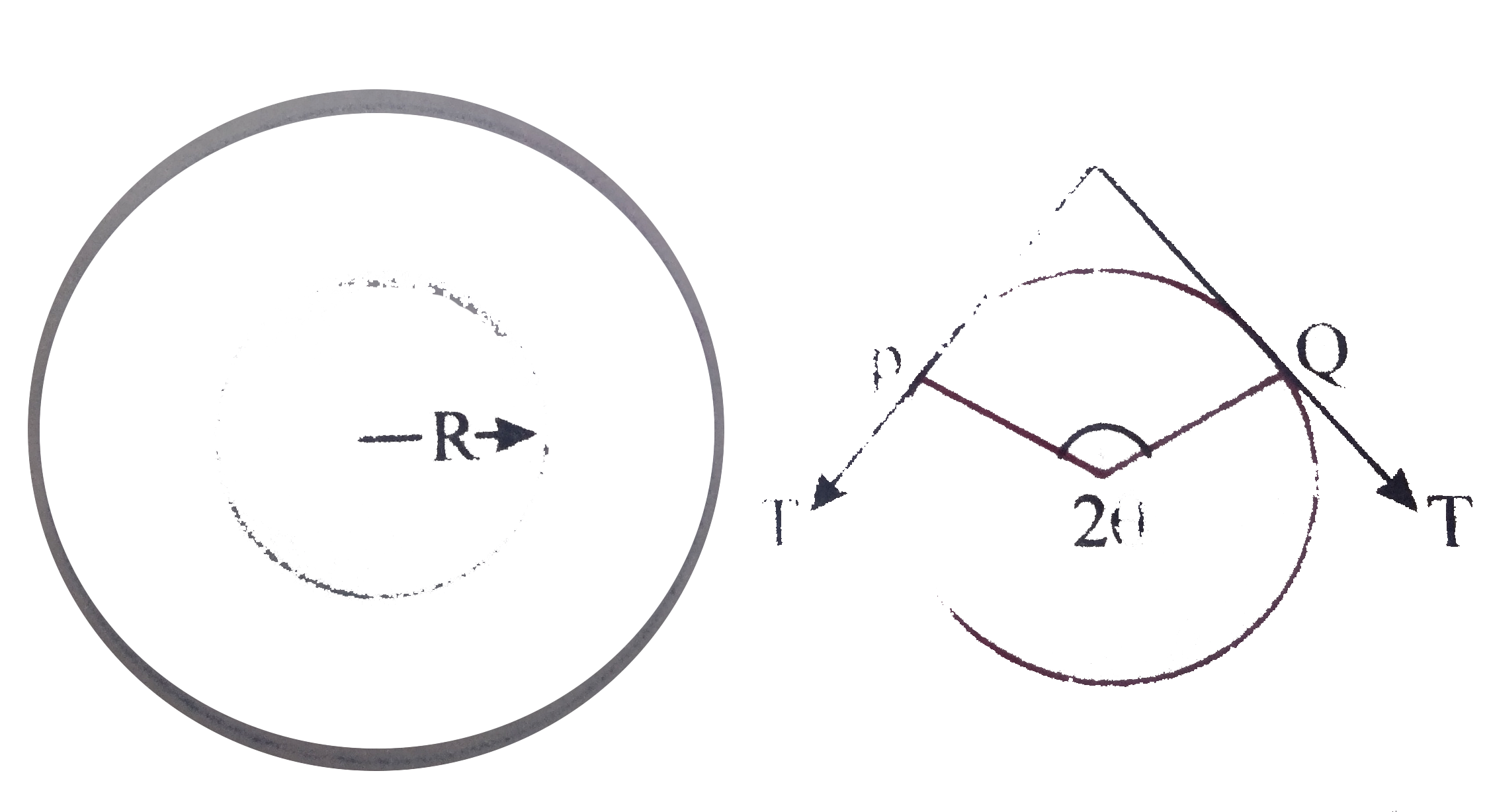
B, D

In equilibrium, `2T sin theta=(dmv^(2))/R`
`2Txxtheta=(piu^(2))/4xxRxx(20xxv^(2))/Rxxrho`
`:.T=(pid^(2)rhov^(2))/4`
Promotional Banner

Topper's Solved these Questions

  • CIRCULAR MOTION

    NARAYNA|Exercise LEVEL-VI|14 Videos
  • CIRCULAR MOTION

    NARAYNA|Exercise LEVEL-VI PASSAGE|3 Videos
  • CALORIMETRY

    NARAYNA|Exercise Level- II (H.W)|11 Videos
  • COLLISION

    NARAYNA|Exercise Level-II (H.W)|54 Videos

Similar Questions

Explore conceptually related problems

When a liquid moves steadily under some pressure through a horizontal tube, it moves in the form of cylindrical layers coaxial to the ends of the tube. The velocity of different layers is different. The velocity of the layer is maximum along the axis of the tube and it decreases as one moves towards the walls of the tube. According to Poiseuille, the rate of flow of liquid through a horizontal capillary tube varies as the relation V alpha (pr^(4))/(eta l) where l and r are the length and radius of the tube and p is the pressure different between the ends of the tube and is the constant of proportionality. When two capillary tubes through which the liquid is flowing are joined in series then the equivalent liquid resistance is

When a liquid moves steadily under some pressure through a horizontal tube, it moves in the form of cylindrical layers coaxial to the ends of the tube. The velocity of different layers is different. The velocity of the layer is maximum along the axis of the tube and it decreases as one moves towards the walls of the tube. According to Poiseuille, the rate of flow of liquid through a horizontal capillary tube varies as the relation V alpha (pr^(4))/(eta l) where l and r are the length and radius of the tube and p is the pressure different between the ends of the tube and is the constant of proportionality. (pi pr^(4))/(8 etal) is dimensionally equivalent to (R is the resistance)

When a liquid moves steadily under some pressure through a horizontal tube, it moves in the form of cylindrical layers coaxial to the ends of the tube. The velocity of different layers is different. The velocity of the layer is maximum along the axis of the tube and it decreases as one moves towards the walls of the tube. According to Poiseuille, the rate of flow of liquid through a horizontal capillary tube varies as the relation V alpha (pr^(4))/(eta l) where l and r are the length and radius of the tube and p is the pressure different between the ends of the tube and is the constant of proportionality. The dimensional formula for rate of flow

Water is flowing through a long horizontal tube. Let P_A and P_B be the pressures at two points A and B of the tube

Under a constant pressure head, the rate of streamlined volume flow of a liquid through a capillary tube is V. if the length of the capillary tube is double and diameter of the bore is halved, find the rate of flow of the liquid through the capillary tube.

The value of end correction for the pipe open at both the ends is a (If the d is the inner diameter of the tube and r is the radius of the tube .)

(i) Air (density= rho ) flows through a horizontal venturi tube that discharges to the atmosphere. The area of cross section of the tube is A_(1) and at the constriction it is A_(2) . The constriction is connected to a water (density =rho_(0) ) tank through a vertical pipe of lenght H. Find the volume flow rate (Q) of the air through tube that is needed to just draw the water into the tube. (ii) A non viscous liquid of constant density rho flows in a stremline motion along a tube of variable cross section. The tube is kept inclined in the vertical plane as shown in the figure. The area of cross section of the tube at two points P and Q at heights of h_(1) and h_(2) are respectively A_(1) and A_(2) . The velocity of the liquid at point P is v. Find the work done on a small volume DeltaV of fluid by the neighbouring fluid as the small volume moves from P to Q.

An incompressible liquid flows through a horizontal tube LMN as shown in the figure. Then the velocity V of the liquid throught he tube N is:

A capillary tube is dipped in water and the water rises in it to a height h . If r be the radius of the bore of the tube , then

Find the nature of flow of water flowing at a speed of 8 cms"^(-1) through a horizontal tube of radius 2 cm. The viscosity of water at room temperature is 0.01 Poise.

NARAYNA-CIRCULAR MOTION-LEVEL II(H.W)
  1. Water of density p flows with a linear speed v through a horizontal ru...

    Text Solution

    |

  2. A ball of mass 0.2 kg is thrown vertically upwards by applying a force...

    Text Solution

    |

  3. A body of mass 3 kg is moving alone a straight line with a velocity of...

    Text Solution

    |

  4. A rubber ball of mass 50 g falls from a height of 5m and rebounds to a...

    Text Solution

    |

  5. A stream of water flowing horizontally with a speed of 15 ms^(-1) push...

    Text Solution

    |

  6. What is the magnitude of the total force on a driver by the racing car...

    Text Solution

    |

  7. A base ball of mass 150 gm travelling at speed of 20 m//s is caught by...

    Text Solution

    |

  8. A dynamometer D is attached to two blocks of masses 6 kg and 4 kg.Forc...

    Text Solution

    |

  9. A particle of mass m moving with velocity u makes an elastic one-dimen...

    Text Solution

    |

  10. Figure shows the position-time graph of a particle of mass 0.04kg. Sug...

    Text Solution

    |

  11. The elevator shown in fig. is descending with an acceleration of 2ms^(...

    Text Solution

    |

  12. A block of mass m is pulled by a uniform chain of mass m tied to it by...

    Text Solution

    |

  13. Two masses of 8 kg and 4 kg are connected by a string as shown in figu...

    Text Solution

    |

  14. Consider the system as shown in the figure. The pulley and the string ...

    Text Solution

    |

  15. Two masses of 1kg and 5kg are attached to the ends of a massless strin...

    Text Solution

    |

  16. A chain consisting of 5 links each of mass d 0.1 kg is lifted vertical...

    Text Solution

    |

  17. Three blocks of equal masses (each 3kg) are suspended by weightless st...

    Text Solution

    |

  18. Pulleys and strings are massless.The horizontal surface is smooth.What...

    Text Solution

    |

  19. When a train starting from rest is uniformly accelerating, a plumb bob...

    Text Solution

    |

  20. The pulleys and strings shown in the figure are smooth and of negligib...

    Text Solution

    |

  21. Two bodies of mass 4kg and 6kg are attached to the ends of a string pa...

    Text Solution

    |

