Home
Class 11
PHYSICS
A solid body starts rotating about a sta...

A solid body starts rotating about a stationary axis with an angular acceleration `alpha=(2.0xx10^(-2))trad//s^(2)` here `t` is in seconds. How soon after the beginning of rotation will the total acceleration vector of an arbitrary point of the body form an angle `theta=60^(@)` with its velocity vector?

Text Solution

Verified by Experts
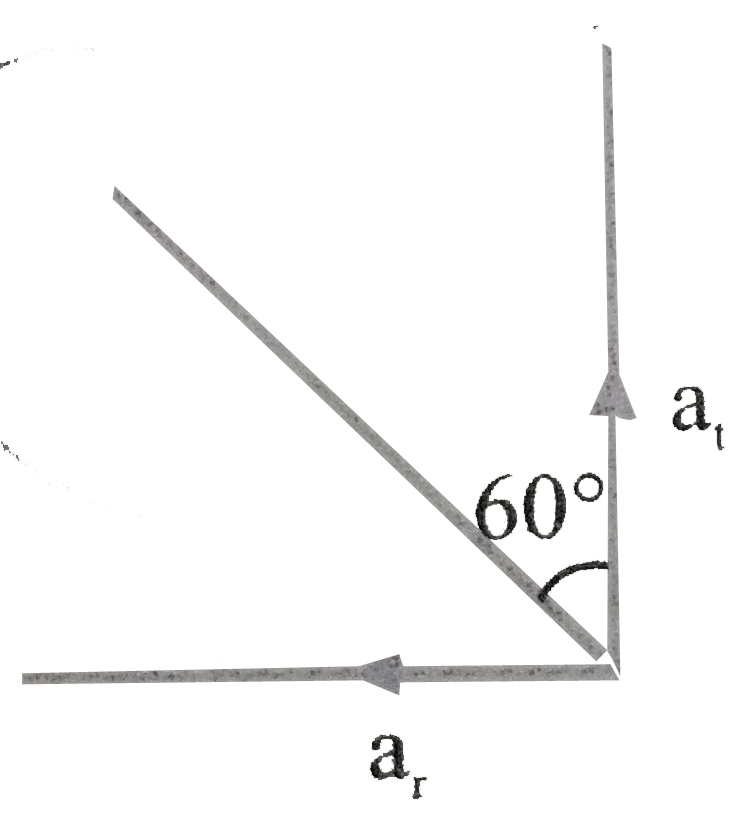

`beta=at, (domega)/(dt)=at rArr domega=at dt`
`intdw=intatdt,omega=(at^(2))/2`
`a_(N)=Romega^(2)=Rxx(a^(2)t^(2))/4,a_(T)=R beta=Rat`
`tan 60=a_(N)/a_(T),a_(N)=sqrt3a_(T)`
`Rxx(a^(2)t^(4))/4=sqrt3xxRat, (at^(3))/4=sqrt3`
`:.t^(3)=(4xxsqrt3)/a rArrt=7sec`
Promotional Banner

Topper's Solved these Questions

  • CIRCULAR MOTION

    NARAYNA|Exercise IIT QUES.|4 Videos
  • CIRCULAR MOTION

    NARAYNA|Exercise LEVEL I(H.W)|43 Videos
  • CIRCULAR MOTION

    NARAYNA|Exercise LEVEL-VI PASSAGE|3 Videos
  • CALORIMETRY

    NARAYNA|Exercise Level- II (H.W)|11 Videos
  • COLLISION

    NARAYNA|Exercise Level-II (H.W)|54 Videos

Similar Questions

Explore conceptually related problems

A solid body starts rotating about a stationary axis with an angular acceleration alpha=kt , where k is a constant. How soon after the beginning of motion will the total acceleration vector of an arbitrary point of the body form an angle 60^(@) with its velocity vector?

A solid body starts rotating about a stationary axis with an angular acceleration beta = at. How soon after the beginning of rotation will the total acceleration vector of a general point on the body form an angle alpha with its velocity vector ?

A solid body starts rotating about a stationary axis with an angular acceleration alpha=alpha_(0) cos theta , where alpha_(0) is a constant and theta is an angle of rotation from the initial position. Find the angular velocity of the body as a function of theta .

A solid body starts rotating about a stationary axis with an angular acceleration beta=beta_0cos varphi , where beta_0 is a constant vector and varphi is an angle of rotation from the initial position. Find the angular velocity of the body as a function of the angle varphi . Draw the plot of this dependence.

A body starts rotating from rest and completes 10 revolutions in 4 s .Find its angular acceleration

A stationary wheel starts rotating about its own axis at uniform rate amgular acceleration 8rad//s^(2) .The time taken by its to complete 77 rotation is

A stationary wheel starts rotating about its own axis at an angular acceleration 5.5 rad//s^(2) . To acquire an angular velocity 420 revolutions per minute , the number of rotations made by the wheel is

A stationary wheel starts rotating about its own axis at constant angular acceleration. If the wheel completes 50 rotations in first 2 seconds, then the number of rotations mades by it in next two seconds is

A disc, initially at rest, starts rotating about its own axis/ with a constant angular acceleration of 0*2 rad/s2. The time taken by the disc to rotate by 10 rad (in seconds) is

A ball starts moving in a circular slot with angular acceleration alpha = 2 rad //s^2 at t=0 The angle between its velocity and acceleration varies with time as

