Home
Class 12
CHEMISTRY
Predict the end product of the following...

Predict the end product of the following sequence of reactions
`C_(6)h_(5)NH_(2) underset(Delta)overset(CH_(3)I(2mo1))rarrA overset(HNO_(2))rarrB underset(Delta)overset(NaOH)rarrC` .

A

`(C_(6)H_(5))_(2)NH`

B

`C_(6)H_(5)NHCH_(3)`

C

`(CH_(3))_(2)NH_(2)`

D

`(CH_(3))_(2)NH`

Text Solution

Verified by Experts

The correct Answer is:
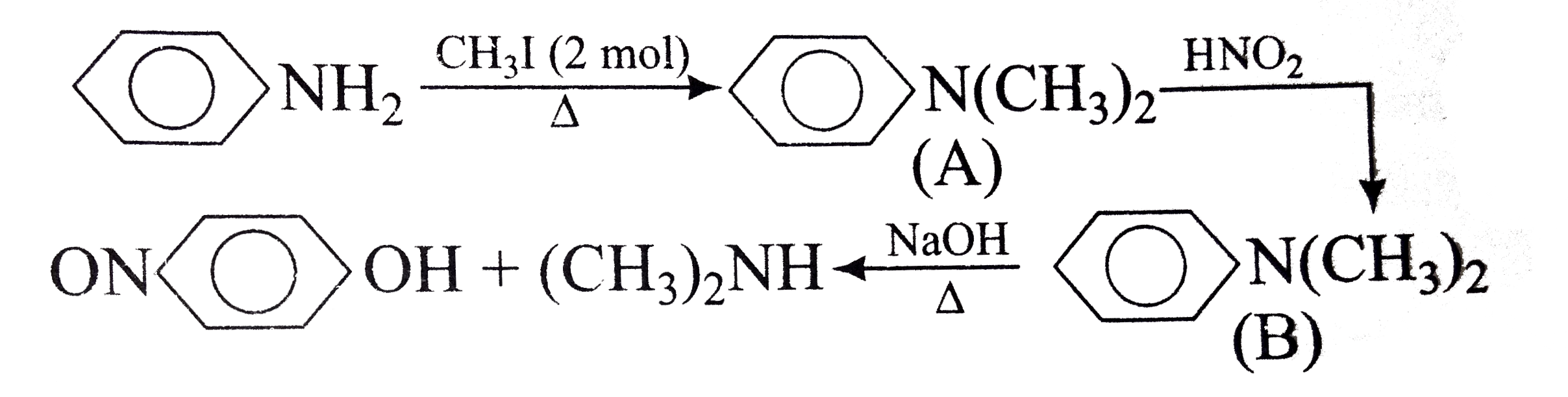
D

The following reaction are
Promotional Banner

Topper's Solved these Questions

  • AMINES

    R SHARMA|Exercise Follow -up Test 3|1 Videos
  • AMINES

    R SHARMA|Exercise Follow -up Test 4|1 Videos
  • AMINES

    R SHARMA|Exercise Follow -up Test 2|1 Videos
  • ALCOHOL, PHENOL AND ETHERS

    R SHARMA|Exercise ETHERS level IV|7 Videos
  • BIOMOLECULES

    R SHARMA|Exercise Archives|47 Videos

Similar Questions

Explore conceptually related problems

Predict the end product of the following sequence of reactions C_(6)H_(5)NH_(2)overset(CH_(3)CI)rarrA overset(CH_(3)CI)rarrB .

The end product (B) of the following sequence of reactions (CH_(3)CH_(2))NH+CS_(2)rarrA underset(Delta)overset(HgCI_(2))rarrB is .

The end product of the following sequence of reactions CH_(3)NH_(2)overset(NaOCI)rarrA overset(C_(6)H_(5)MgI)rarrB is .

Identify the end product of the following sequence of reactions C_(6)H_(5)NH_(2)overset(180^(@)C)rarrA underset(H_(2)O)overset(180^(@)C)rarrB underset(3hours)overset(180^(@)C)rarrC .

The structure of C in the following sequence of reactions CH_(3)CH_(2)CH_(2)NH_(2)underset(excess)overset(CH_(3)I)rarrA overset(AgOH)rarrBoverset(heat)rarrC is .

Predict the product of the following reaction C_(6)H_(5)CH_(2)I underset(2.H_(2),Ni)overset(1.CH_(3)NH_(2),heat)rarr .

What is the end product 'B' of following sequence of reaction? C_(6)H_(5)NH_(2)underset(H_(@)SO_(4)//O^(@)C)overset(HNO_(2))to'A'underset(Delta)overset(H_(2)O)to'B'

Consider the following sequence of reactions CH_(3)CH_(2)Brunderset(Delta)overset(AgCN)rarrA overset(H_(2)Ni)rarrB The final product (B) is .

In the following sequence of reactions (CH_(3))_(2)CO underset(H_(2)SO_(4))overset(HN_(3))rarrA overset(H_(2)O)rarrB The end product 'B' is .

R SHARMA-AMINES-Follow -up Test
  1. Consider the following sequence of reactions underset(base)overset(C...

    Text Solution

    |

  2. The end product C in the following sequence of reactions CaNCN ove...

    Text Solution

    |

  3. Predict the end product of the following sequence of reactions C(6)...

    Text Solution

    |

  4. The end product of the following sequence of reactions CH(3)NH(2)ove...

    Text Solution

    |

  5. The major product (X) of the reaction CH(3)CH(2)NH(2)+HCHO+HCOOHover...

    Text Solution

    |

  6. Which of the following compounds gives a tertiary amine on reduction ?...

    Text Solution

    |

  7. When tetramethylammonium hydroxide is heated in aqueous solution under...

    Text Solution

    |

  8. The major product (X) of the reaction (CH(3))(3)CNH(2)+underset(exce...

    Text Solution

    |

  9. The end product of the following of reactions is C(6)H(5)underset(Fe...

    Text Solution

    |

  10. An amine (X) on being heated with an excess of methy1 bromide produces...

    Text Solution

    |

  11. Which of the following reagents is used for the Hinsberg method to sep...

    Text Solution

    |

  12. A mixture of ethano1 vapour and ammonia is heated under pressure in th...

    Text Solution

    |

  13. A compound (X) having the molecular formula C(3)H(9)N is insoluble in ...

    Text Solution

    |

  14. Which of the following reagents is employed in the Hofmann s method to...

    Text Solution

    |

  15. In Which of the following compound are intermolecular hydrogen bonds n...

    Text Solution

    |

  16. Among the following isomeric amines which one is expected to have the ...

    Text Solution

    |

  17. Which of the following are soluble in water ? .

    Text Solution

    |

  18. Which of the following is incorrect about amines

    Text Solution

    |

  19. If pK(b) for the reaction of MeNH(2) in water is 3.4 the pK(a) for the...

    Text Solution

    |

  20. Which of the following statements is incorrect .

    Text Solution

    |

