Home
Class 11
PHYSICS
A rectangular plank of mass m(1) and hei...

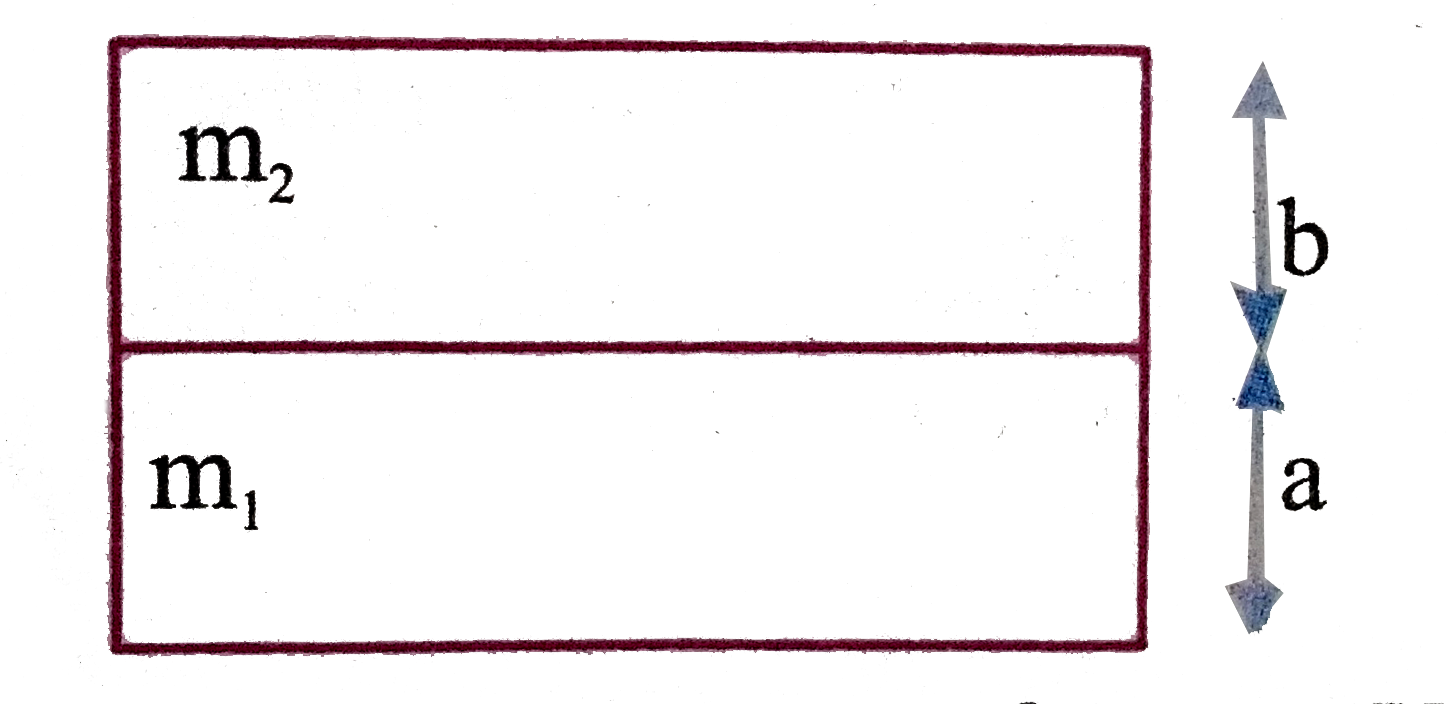
A rectangular plank of mass `m_(1)` and height 'a' is on a horizontal surface. On the top of it another rectangular plank of mass `m_(2)` and height 'b' is placed. Find the potential energy of the system ?
.

Text Solution

Verified by Experts

Total potential energy of system `U = U_(1) + U_(2)`
=`m_(1)g (a)/(2) + m_(2) g(a + (b)/(2)) = [((m_(1))/(2) + m_(2)) a + m_(2) ((b)/(2))] g`.
Promotional Banner

Topper's Solved these Questions

  • WORK POWER AND ENERGY

    NARAYNA|Exercise C.U.Q-Key|75 Videos
  • WORK POWER AND ENERGY

    NARAYNA|Exercise Level- I (C.W)|60 Videos
  • WORK , ENERGY & POWER

    NARAYNA|Exercise EXERCISE IV|43 Videos

Similar Questions

Explore conceptually related problems

A horizontal plank having mass m lies on a smooth horizontal surface. A sphere of same mass and radius r is spined to angular frequency omega_(0) and gently placed on the plank as shown in the figure. If coefficient of friction between the plank and the sphere is mu . Find the distance moved by the plank till sphere starts pure rolling on the plank. the plank is long enough.

A sphere of mass m and radius r is placed on a rough plank of mass M . The system is placed on a smooth horizontal surface. A constant force F is applied on the plank such that the sphere rolls purely on the plank. Find the acceleration of the sphere.

A plank of mass M is placed on a rough horizontal surface and a contant horizontal force F is applied on it . A man of mass m runs on the plank find the range of acceleration of the man that the plank does not move on the surface is mu .Assume that the does not slip on the plank

A block of mass m=2kg of shown dimensions is placed on a plank of mass M = 6Kg which is placed on smooth horizontal plane. The coefficient of friction between the block and the plank is mu=1/3 . If a horizontal froce F is applied on the plank, then find the maximum value of F (in N) for which the block and the plank move together

Block m_(1) is projected on a long plank of mass m_(2) plank is placed on a smooth horizontal surface. There is friction between block and plank, coefficient of friction is mu. Block m_(1) has initial velocity v_(01) and plank has initial velocity v_(02) with (v_(01) gt v_(02)) . Which of following graphs is correct.

A bar of mass m_(1) is placed on a plank of mass m_(2) which rests on a smooth horizontal plane . The coefficient of friction between the surfaces of bar and plank is k . The plank is subjected to a horizontal force F depending on time t as F = at , where a is a constant . The moment of time t_(0) at which the plank starts sliding is :

A plank of mass 10kg rests on a smooth horizontal surface. Two blocks A and B of masses m_(A)=2kg and m_(B)=1kg lies at a distance of 3m on the plank as shown in the distance of 3m on the plank as shown in the figure. The friction coefficient between the blocks and plank are mu_(A)=0.3 and mu_(B)=0.1 . Now a force F = 15 N is applied to the plank in horizontal direction. Find the time after which block A collides with B.

A plank of mass m_(1) with a sphere of mass m_(2) on it rests on a smooth horizontal surface. A canstant horizontal force F is applied to the plank. With what sliding between the plank and the sphere? [hint: Rel vel. Of the lowest point v-(2) + epsilonR -v_(1) =0 for no sliding)

A man of mass m is standing on a plank of equal mass m resting on a smooth horizontal surface. The man starts moving on the plank with speed u relative to the plank. The speed of the man relative to the ground is

