Home
Class 11
PHYSICS
Two blocks having masses 8kg and 16kg ar...

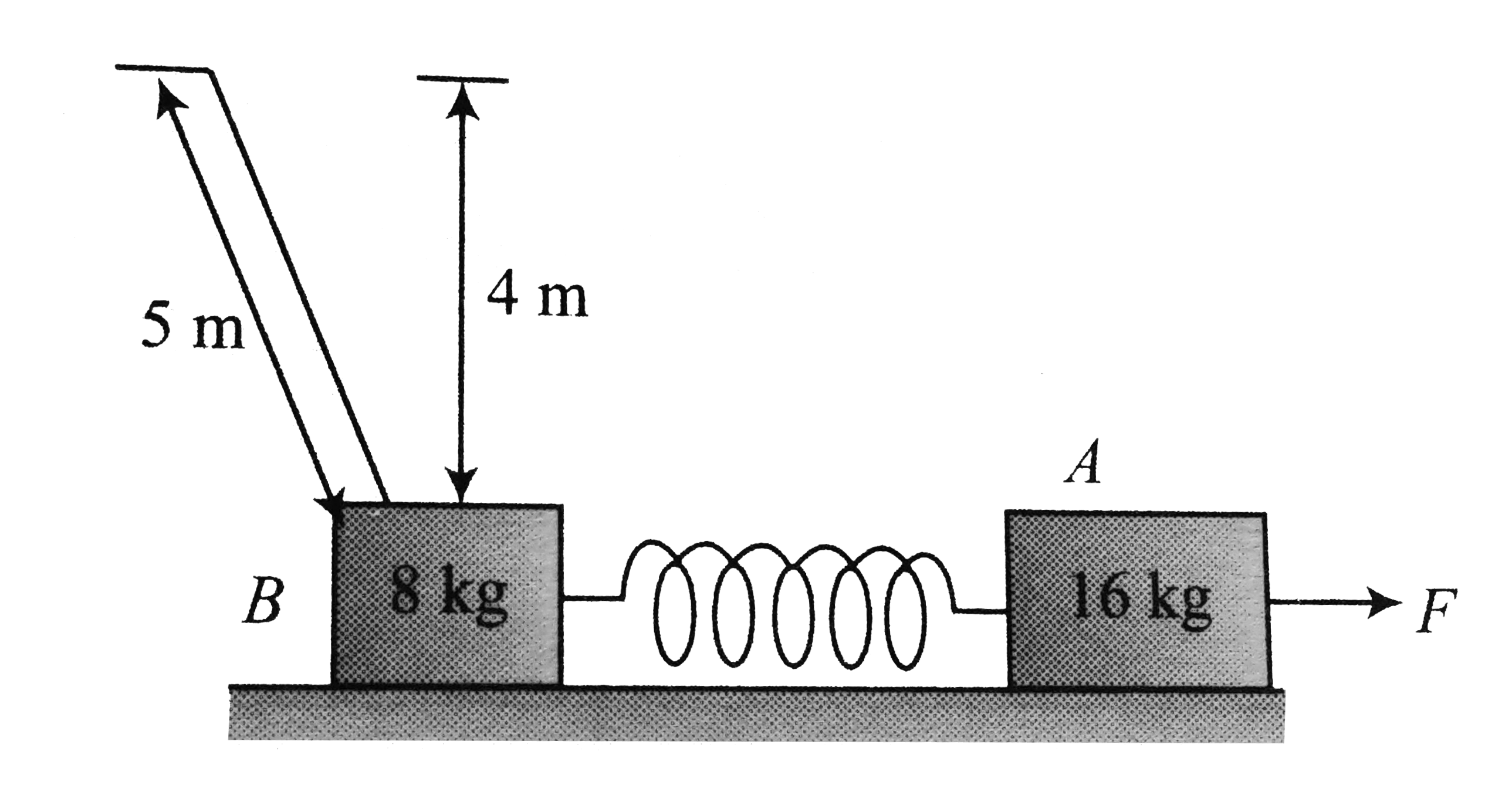
Two blocks having masses `8kg` and `16kg` are connected to the two ends of a light spring. The system is placed on a smooth horizontal floor. An inextensible string also connects B with ceiling as shown in the figure at the initial moment. Initially the spring has its natural length. A constant horizontal force F is applied to the heavier block as shown. What is the maximum possible value of F so the lighter block doesn't loose contact with ground?

Text Solution

Verified by Experts
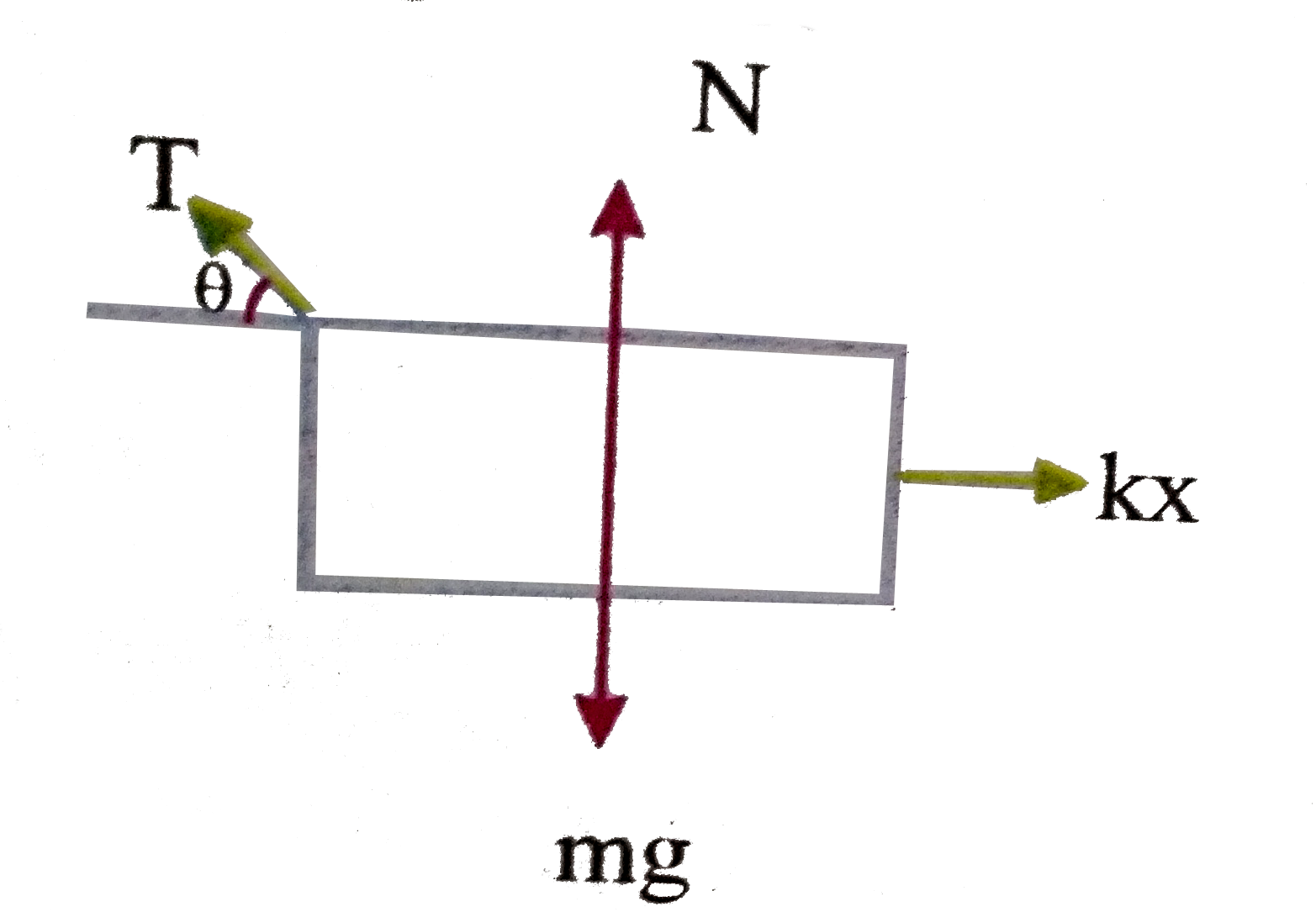
Draw `FBD` of `B` to get extension in spring. When block `B` just looses contact with ground resultant force on it is zero.

`Kx - T cos theta = 0 rArr T = (Kx)/(cos theta) , T sin theta + N - mg = 0`
When `N = 0` then `T sin theta = mg rArr (Kx)/(cos theta) sin theta = mg`
`x = (mg)/(K tan theta) = (80)/(K xx (4//3)) = (60)/(K)`
If spring has to just to just extend till this value then form work energy theorem we get
`Fx = (1)/(2) Kx^(2) rArr F = 30 N`.
Promotional Banner

Topper's Solved these Questions

  • WORK POWER AND ENERGY

    NARAYNA|Exercise C.U.Q-Key|75 Videos
  • WORK POWER AND ENERGY

    NARAYNA|Exercise Level- I (C.W)|60 Videos
  • WORK , ENERGY & POWER

    NARAYNA|Exercise EXERCISE IV|43 Videos

Similar Questions

Explore conceptually related problems

Two blocks having masses 8 kg and 16 kg are connected to the two ends of a light spring. The system is placed on a smooth horizontal floor. An inextensible starting also connects B with ceiling as shown in figure at the initial moment. Initially the spring has its natural length. A constant horizontal force F is applied to the heavier block as shown. What is the maximum possible value of F so the lighter block doesn't loose contant with ground

Two blocks of masses m and M are connected by an inextensible light string . When a constant horizontal force acts on the block of mass M. The tension in the string is

Two blocks A and B of mass m and 2m respectively are connected by a light spring of force constant k. They are placed on a smooth horizontal surface. Spring is stretched by a length x and then released. Find the relative velocity of the blocks when the spring comes to its natural length

Three blocks of masses 5 kg, 10 kg and 15 kg are connected to - light inextensible string placed on smooth horizontal table as shown below. (T_(1)) /( T_(2)) will be

Two blocks of masses 10 kg and 20 kg are connected by a massless string and are placed on a smooth horizontal surface as shown in the figure. If a force F=600 N is applied to 10 kg block, then the tension in the string is

Two blocks A and B of the same mass are connected to a light spring and placed on a smooth horizontal surface B is given velocity v_(0) (as shown in the figure) when the spring is in natural length. In the subsequent motion.

Assertion: Two blocks A and B are connected at the two ends of an ideal spring as shwon in figure. Initially, spring was released. Now block B is pressed. Linear momentum of the system will not remain constan till the spring reaches its initial natural length. Reason: An external force will act from the wall on block A.

Two blocks of mass m and 2m are kept on a smooth horizontal surface. Theya are connected by an ideal spring of force constant k. Initially the spring is unstretched. A constant force is applied to the heavier block in the direction shown in figure. Suppose at time t displacement of smaller block is x_(1) then displacement of the heavier block at this moment would be

Two blocks of masses 10 kg and 20 kg are connected by a massless spring and are placed on a smooth horizontal surface. A force of 200 N is applied on 20 kg mass as shown in the diagram. At the instant, the acceleration of 10 kg mass is 12ms^(-2) , the acceleration of 20 kg mass is:

