Home
Class 11
PHYSICS
A body slides without friction from a he...

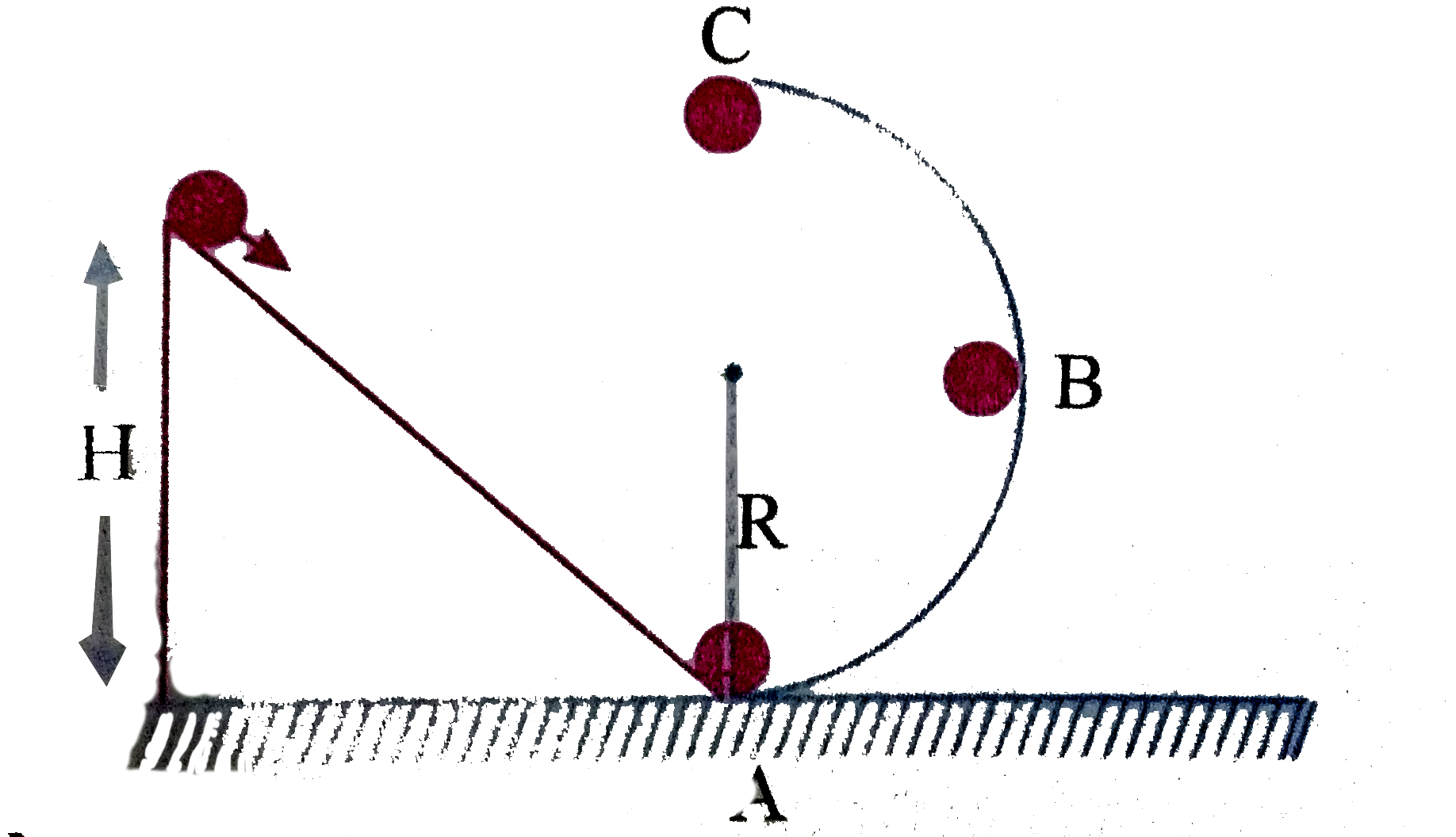
A body slides without friction from a height `H = 60 cm` and then loops the loop of radius `R = 20 cm` at the bottom of an incline. Find the ratio of forces exerted on the body by the track at the positions `A,B` and `C (g = 10 ms^(-2))`.
.

Text Solution

Verified by Experts

From data `H = 3R`
Velocity ar `A, V_(A) = sqrt(2gH) = sqrt(2g(3R)) = sqrt(6 gR)`
Velocity ar `B, V_(B) = sqrt(4 gR)`
Velocity at `C, V_(C) = sqrt(2 gR)`
Reaction force at `A= R_(1) = (mV_(A)^(2))/( R) + mg cos (0^(@))`
=`(m xx 6gR)/( R) + mg = 7 mg`
Reaction force at `B = R_(2) = (mV_(B)^(2))/( R) + mg cos(90^(@))`
=`(mxx 4gR)/( R) + 0 = 4 mg`
Reaction force at `C = R_(3) = (mV_(C)^(2))/( R) + mg cos (180^@)`
=`(m xx 2gR)/( R) -mg = mg`
`:. R_(1) : R_(2): R_(3) = 7 : 4 : 1`.
Promotional Banner

Topper's Solved these Questions

  • WORK POWER AND ENERGY

    NARAYNA|Exercise C.U.Q-Key|75 Videos
  • WORK POWER AND ENERGY

    NARAYNA|Exercise Level- I (C.W)|60 Videos
  • WORK , ENERGY & POWER

    NARAYNA|Exercise EXERCISE IV|43 Videos

Similar Questions

Explore conceptually related problems

A small object slides without friction from the height 5R//2 and then loops of the verticle loop of radius R from which a symmetrical section of angle 2alpha has been removed. Find angle alpha such that after losing contact at A and flying through the air, the object will reach point B .

A small body of mass m slide without friction from the top of a hemispherical cup of radius r as shown in figure. If leaves the surface to the cup at vertial distance h below the highest point then

A body slides down a fixed curved track that is one quadrant of a circle of radius R , as in the figure. If there is no friction and the body starts from rest, its speed at the bottom of the track is

A body slides down an inclined surface which ends into a vertical loop of radius R = 40cm. What must be the height H of the inclined surface for the body so that it does not leave contact with the surface even at the uppermost point of the loop? Assume friction to be absent.

Water is filled in a flask upto a height of 20cm . The bottom of the flask is circular with radius 10 cm . If the atmospheric pressure is 1.013xx10^(5) Pa, find the force exerted by the water on the bottom . Take g=10 "ms"^(-2) and density of water =1000 "kgm"^(-3).

The block on the loop shown slides without friction. At what height from A it starts so that it passes against the track at B with a net upward force equal to its own weight? The radius of the loop is R.

A head slide without friction around a loop the (figure). The bead slide is released is from rest at a height h = 3.50R . How large is the normal force on the bead at point (A) if its mass is 50 g ?

A body of mass 10 kg is dropped from a height of 10 m on a planet, whose mass and radius are double that of the Earth. Find the maximum kinetic energy the body can possess. ("Take" g_(E) = 10 ms^(-2))

A water container has water upto a height of 20 cm, volume 2 litres. Top of container has area 60 cm ""^(2) and bottom has area of 20 cm ""^(2) . The downward force exerted by water at the bottom will be.

A small stone of mass 100 g in rotated I a verticlal circle of radius 40 cm. What is the minimum speed needed at the lowest point for looping the loop? Also find the tension in the string at this point (g=10ms^(-2)).

