Home
Class 11
PHYSICS
In the figure shown upper block is given...

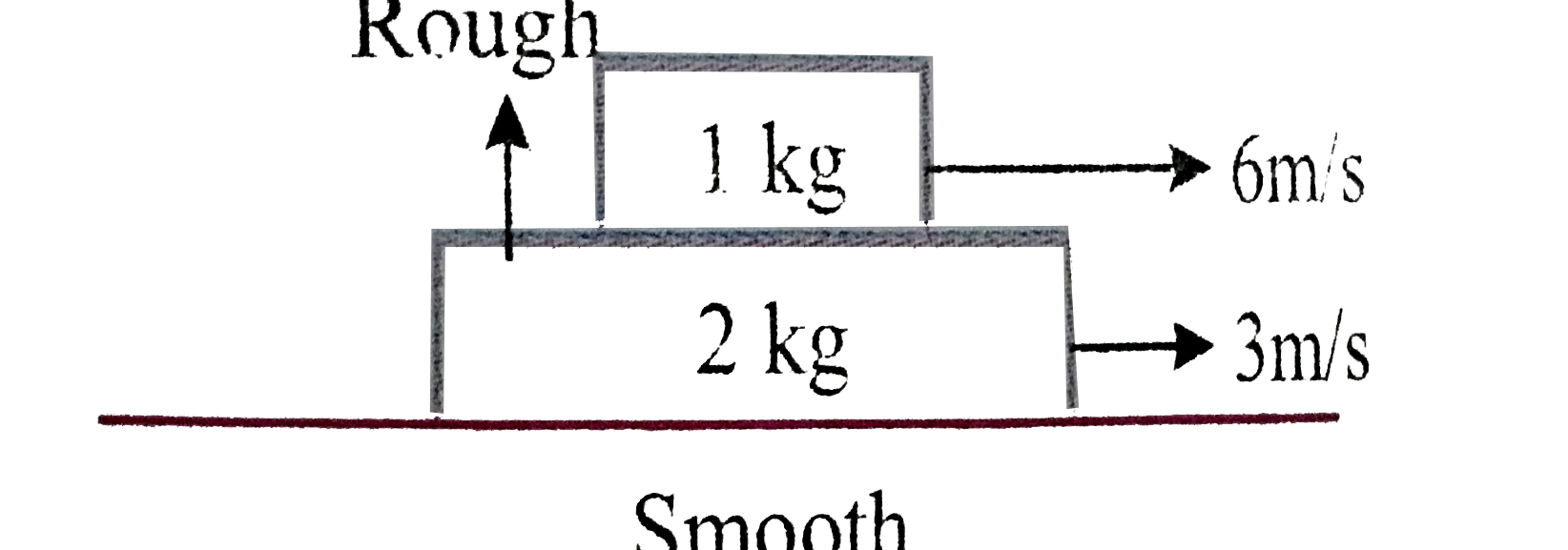
In the figure shown upper block is given a velocity of `6 m//s` and lower block `3 m//s`. When relative motion between them is stopped.
.

A

Work done by friction on upper block is negative

B

Work done by friction on both blocks is positive

C

The magnitude of work done by friction on upper block is `10 J`

D

Net work done by friction is zero.

Text Solution

Verified by Experts

The correct Answer is:

A, C

From conservation of linear momentum `(1+2) v = (6 xx 1)+(2-3)`
`:. v = 4m//s` (of both the blocks)
from work energy theorm
i.e., `W_("total") = Delta KE` on `1 kg` block,
`W_(f) = (1)/(2) xx 1 xx (4^(2) - 6^(2)) = - 10 J`
on `2 kg` block `W_(f) = (1)/(2) xx 2(4^(2) - 3^(2)) = + 7 J`
`:.` Net work done by friction is ` - 3 J`.
Promotional Banner

Topper's Solved these Questions

  • WORK POWER AND ENERGY

    NARAYNA|Exercise Level-V (Comprehension)|22 Videos
  • WORK POWER AND ENERGY

    NARAYNA|Exercise Level-V (Integer)|5 Videos
  • WORK POWER AND ENERGY

    NARAYNA|Exercise Level-V (Single Answer)|24 Videos
  • WORK , ENERGY & POWER

    NARAYNA|Exercise EXERCISE IV|43 Videos

Similar Questions

Explore conceptually related problems

In the figure two blocks are given velocities as shown. The lower block is very long. Find velocities of both the blocks when relative motion between them is ceased

coefficient of friction between two blocks shown in figure is mu =0.6 . The blocks are given velocities in the direction shown in figure. Find (a) the time when relative motion between them is slopped. (b) the common velocity of the two blocks. (c) the displocement of 1kg and 2kg blocks upto that instant. (Take g =10m//s^(2))

Coefficient of friction between two block shown in figure ia mu = 0.4 . The blocks are given velocities of 2 m//s and 8 m//s in the directions figure. Find (a) The time when relative motion between them will stop (b) the common velocities of blocks upto that instant. (c) Displacement of 1 kg and 2 kg block upto that instant (g = 10 m//s^(2)) .

Three blocks of masses m , m and M are kept on a frictionless floor as shown in the figure .The leftmost block is given velocity v towards the right . All the collision between the blocks are perfectly inelastic . The loss in kinetic energy after all the collision is 5//6th of initial kinetic energy. The ratio of M//m will be

Block A of mass 5kg is placed on long block B having a mass of 5kg . The coefficient of friction between two block is 0.4 . There is no friction between the ground and lower block. The upper block is given a sudden velocity of 10m//s . The upper block slides toward right, so friction force acting on it will be toward left. Its reaction wall act on the lower block, which will act forward . The friction force absorbs x mechanical energy from upper block but supply only y mechanical energy to lower block. Due to friction the velocity of upper block reduces and velocity of lower block increases. This will continue till velocity of both the block get equal. Which curve shows the correct variation of velocity of each block v//s time?

Block A of mass 5kg is placed on long block B having a mass of 5kg . The coefficient of friction between two block is 0.4 . There is no friction between the ground and lower block. The upper block is given a sudden velocity of 10m//s . The upper block slides toward right, so friction force acting on it will be toward left. Its reaction wall act on the lower block, which will act forward . The friction force absorbs x mechanical energy from upper block but supply only y mechanical energy to lower block. Due to friction the velocity of upper block reduces and velocity of lower block increases. This will continue till velocity of both the block get equal. The net energy loss due to friction in the entire process is

In the figure shown, a block of weight 10 N resting on a horizontal surface. The coefficent of static friction between the block and the surface mu_(s)=0.4 . A force of 3.5 N will keep the block in uniform motion, once it has been set in motion. A horizontal force force of 3N is applid to the block, then the block will
