Home
Class 11
PHYSICS
A smooth track in the form of a quarter ...

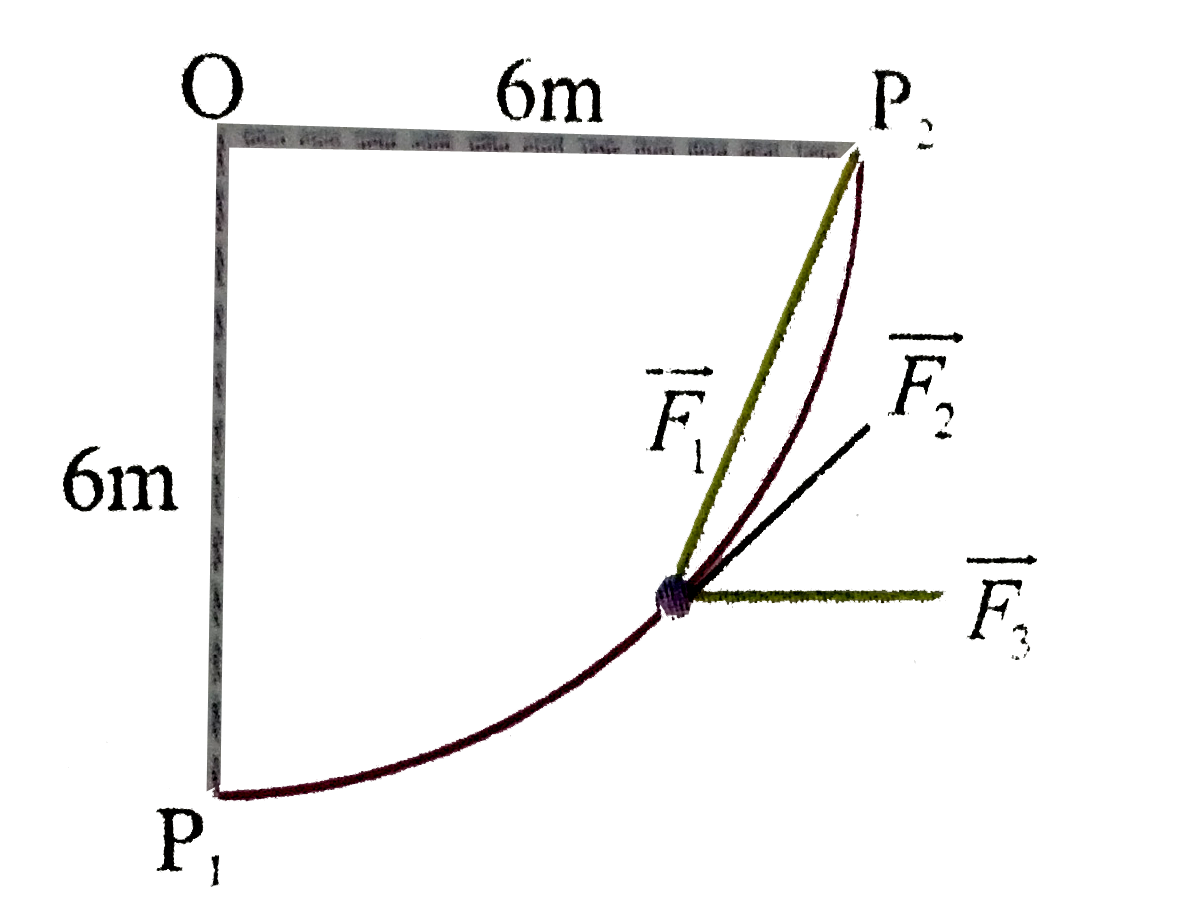
A smooth track in the form of a quarter circle of radius `6 m` lies in the vertical plane. A particle moves from `P_(1)` to `P_(2)` under the action of forces `vec F_(1),vecF_(2)` and `vec F_(3)` Force `vec F_(1)` is 20N, Force `vec F_(2)` is always `30 N` in magnitude. Force `vec F_(3)` always acts tangentiallly to the track and is of magnitude `15 N`. Select the correct alternative (s) :
.

A

Work done by `vec F_(1)` is `120 J`

B

Work done by `vec F_(2)` is `180 J`

C

Work done by `vec F_(3)` is `45 pi J`

D

`vec F_(1)` is conservative in nature.

Text Solution

Verified by Experts

The correct Answer is:

B, C, D

Work done by `vec F_(1)` is
`W_(1)=int_(P_(1))^(P_(2)) F_(1)cos theta ds`
Here, `ds=(6)d(-2 theta)=-12 d theta` and `F_(1)=20 N`
`:. W_(1)=-240 int_(x//4)^(0) cos theta d theta = 240 sin (pi)/(4) = 120 sqrt(2)J`
`vec F_(1)` is conservative because it is always directed towards a fixed point `P_(2)`.
`W_(2)=F_(2)(OP_(2))=(30)(6)=180J` and
`W_(3)=vecF_(1) int_(0)^(6(pi//2))F_(3)ds =int_(0)^(3pi) 15ds =[15x]_(0)^(3pi)= 45 pi`.
Promotional Banner

Topper's Solved these Questions

  • WORK POWER AND ENERGY

    NARAYNA|Exercise Level-V (Comprehension)|22 Videos
  • WORK POWER AND ENERGY

    NARAYNA|Exercise Level-V (Integer)|5 Videos
  • WORK POWER AND ENERGY

    NARAYNA|Exercise Level-V (Single Answer)|24 Videos
  • WORK , ENERGY & POWER

    NARAYNA|Exercise EXERCISE IV|43 Videos

Similar Questions

Explore conceptually related problems

A smooth track is in the form of a quarter circle of radius 10 m lies in the vertical plane. A bead moves from A and B along the circular track under the action of forces vec(F)_(1),vec(F)_(2) and vec(F)_(3) Force vec(F)_(1) acts always towards point B and is always 20 N in magnitude Force vec(F)_(2) always acts horizontally and is always 25 N in magnitude. Force vec(F)_(3) always acts tangentially to the track and is of constant magnitude 10 N. Select the correct answer.

A smooth track in the form of a quarter-circle of radius 6 m lies in the vertical plane. A ring of weight 4(N) moves from P_(1) and P_(2) under the action of forces F_(1) , F_2 and F_3 . is always towards P_(2) under the action of forces F_(1),F_(2) and F_(3) Force F_(1) is always towards P_(2) and is always (20) N in maghitude, force F_(2) always acts hotizontally and is always (30 N) in magnitude, force F_(3) always acts tangentially to the track and is of magnitude (15-10 s) N , where s is in metre. If the particle has speed 4 m//s at P_(1) ,what will its speed be at P_(2) ?

Find magnitude and direction of vec F_(2)-vec F_(1) if vec F_(1)=500N due east and vec F_(2)=250N due north:

A slab is subjected to two forces vec F_(1) and vec F_(2) of same magnitude F as shown in the figure . Force vec F_(2) is in XY-plane while force F_(1) acts along z-axis at the point (2 vec I + 3 vec j) .The moment of these forces about point O will be :

Three forces vec(F)_(1), vec(F)_(2) and vec(F)_(3) are represented as shown. Each of them is equal magnitude. Now match the given columns and select the correct option from the codes given below.

Two forces vec(F_(1)) and vec(F_(2)) are acting at right angles to each other , find their resultant ?

A body is at rest under the action of three forces, two of which are vec(F)_(1)= 4hat(i), vec(F)_(2)= 6hat(j) , the third force is

AB is a quarter of smooth circular track of radius R=6m . A particle P of mass 0.5kg moves along the track from A to B under the action of the following forces. a. A force F_1 directed always towards the point B, its magnitude is constant and is equal to 20N . b. A force F_2 directed along the instantaneous tangent to the circular track, its magnitude is (15-10S)N , where S is the distance travelled in metre. c. A horizontal force of magnitude 30N . Find the work done by forces mentioned in (a), (b) and (c)

Two forces vec(F)_(1) = 3hati +4hatj and vec(F)_(2) = 3hatj +4hatk are acting simultaneously at a point. What is the magnitude of the resultant force ?

When force vec(F_(1)), vec(F_(2)),vec(F_(3))"…..."vec(F_(n)) act on a particle , the particle remains in equilibrium . If vec( F_(1)) is now removed then acceleration of the particle is
