Home
Class 11
PHYSICS
What is the minimum value of the mass M ...

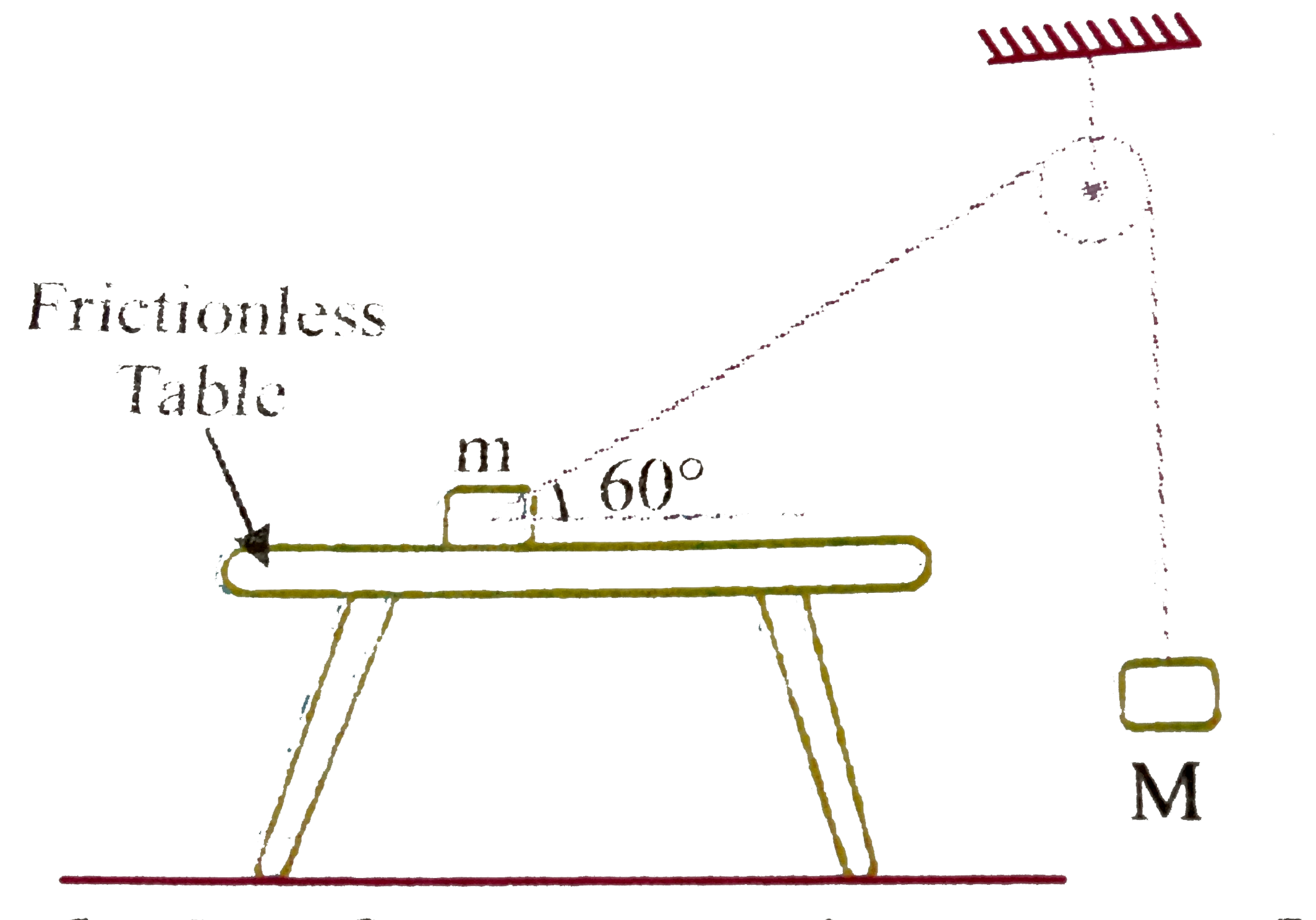
What is the minimum value of the mass `M` so that the block is lifted off the table at the instant shown in the diagram ? Assume that the blocks are initially at rest.
.

A

`(m)/(sin 60^@)`

B

`(m)/(tan 60^@)`

C

`m sin 60^@`

D

none of these

Text Solution

Verified by Experts

The correct Answer is:

D

The accelerations of the blocks along the string are equal , now apply `F = ma` for both the blocks.
Promotional Banner

Topper's Solved these Questions

  • WORK POWER AND ENERGY

    NARAYNA|Exercise Level-VI (Multiple Answer)|11 Videos
  • WORK POWER AND ENERGY

    NARAYNA|Exercise Level-VI (Comprehension)|20 Videos
  • WORK POWER AND ENERGY

    NARAYNA|Exercise Level-V (Integer)|5 Videos
  • WORK , ENERGY & POWER

    NARAYNA|Exercise EXERCISE IV|43 Videos

Similar Questions

Explore conceptually related problems

A block of mass m collides with another block of mass 3m completely inelastically as shown in figure. What is the maximum value of v ( in m//s) for which the block B does not move. Assume that initially spring is in natural length and blocks A and B are at rest. (K//m=100 S.I. unit )

A block of mass m is dropped onto a spring of constant k from a height h . The second end of the spring is attached to a second block of mass M as shown in figure. Find the minimum value of h so that the block M bounces off the ground. If the block of mass m sticks to the spring immediately after it comes into contact with it.

Infinite numbers of bloks are placed on a table on a edge as shown in the diagram. What is the minimum value of L so that the blocks are just going to topple over the table ?

The coefficient of static friction mu_(s) between block A of mass 2kg and the table as shown in is 0.1 What would be the maximum mass value of blocks B so that the two bloks do not move ? The string and the pulley are assumed to be smooth and massless (g = 10m//s^(2)) .

The coefficient of static friction, mu_(s) between block A mass 2kg and the table as shown in the figure, is 0.2. What would be the maximum mass value of block B, so that the two blocks do not move ? The string and the pulley are asseumed to be smooth and massless ( g=10m//s^(2) )

A block of mass m rests on a wedge of mass M which, in trun, rests on a horizontal table, as shown in figure. All surfaces are frictionless. If the system starts at rest with point P of the block a distance h above the table, find the speed of the wedge the instant point P touches the table.

Three blocks are initially placed as shown in the figure. Block A has mass m and initial velocity v to the right. Block B with mass m and block C with mass 4 m are both initially at rest. Neglect friction. All collisions are elastic. The final velocity of block A is

Three blocks are initially placed as shown in the figure. Block A has mass m and initial velocity v to the right. Block B with mass m and block C with mass 4m are both initially at rest. Neglect friction. All collisions are elastic. The final velocity of blocks A is

A small block of mass m is projected on a larger block of mass 10 m and length l with a velocity v as shown in the figure. The coefficient of friction between the two block is mu_(2) while that between the lower block and the ground is mu_(1) . Given that mu_(2) gt 11 mu_(1) . (a) Find the minimum value of v , such that the mass m falls off the block of mass 10 m . (b) If v has minimum value, find the time taken by block m to do so.

A block of mass M has a circular cut with a frictionless surface as shown. The block rests on the horizontal frictionless surface of a fixed table. Initially the right edge of the block is at x = 0, in a co-ordinate system fixed to the table. A point mass m is released from rest at the topmost point of the path as shown and it slides down. When the mass loses contact with the block, its position is x and the velocity is v. At that instant, which of the following options is/are correct?

NARAYNA-WORK POWER AND ENERGY-Level-VI (Single Answer)
  1. A hemispherical vessel of radius R moving with a constant velocity v(0...

    Text Solution

    |

  2. Two ball of same mass are projected as shown. By compressing equally (...

    Text Solution

    |

  3. What is the minimum value of the mass M so that the block is lifted of...

    Text Solution

    |

  4. A bob of mass m is suspended from a fixed support with a light string ...

    Text Solution

    |

  5. A particle moves move on the rough horizontal ground with some initial...

    Text Solution

    |

  6. The total mechanical enegry of a particle is E. The speed of the parti...

    Text Solution

    |

  7. The coefficient of friction between a particle moving with some veloci...

    Text Solution

    |

  8. A block A os mass m slides on a smooth slider in the system as shown. ...

    Text Solution

    |

  9. A ring 'A' of mass 'm' is attached to a stretched spring of force cons...

    Text Solution

    |

  10. A and B are smooth light hinges equidistant from C, which can slides o...

    Text Solution

    |

  11. Three springs A,B and C each of force constant K, are connected at O. ...

    Text Solution

    |

  12. A rope of length l and mass 'm' is connected to a chain of length l an...

    Text Solution

    |

  13. In the figure shown all the surfaces are frictionless and mass of bloc...

    Text Solution

    |

  14. A ring of mass m can slide over a smooth vertical rod as shown in fig...

    Text Solution

    |

  15. A small body A starts sliding from the height h down an inclined groov...

    Text Solution

    |

  16. In the figure (a) and (b) AC and GF are fixed inclined planes BC = EF ...

    Text Solution

    |

  17. A 0.5kg block slides from the point A on a horizontal track with an in...

    Text Solution

    |

  18. A block of mass 1 kg kept over a smooth surface is given velocity 2 m/...

    Text Solution

    |

  19. A body is displaced from (0,0) to (1 m, 1m) along the path x = y by a ...

    Text Solution

    |

  20. Forces acting on a particle moving in a straight line varies with the ...

    Text Solution

    |
