Home
Class 11
PHYSICS
The graph shown the variation of velocit...

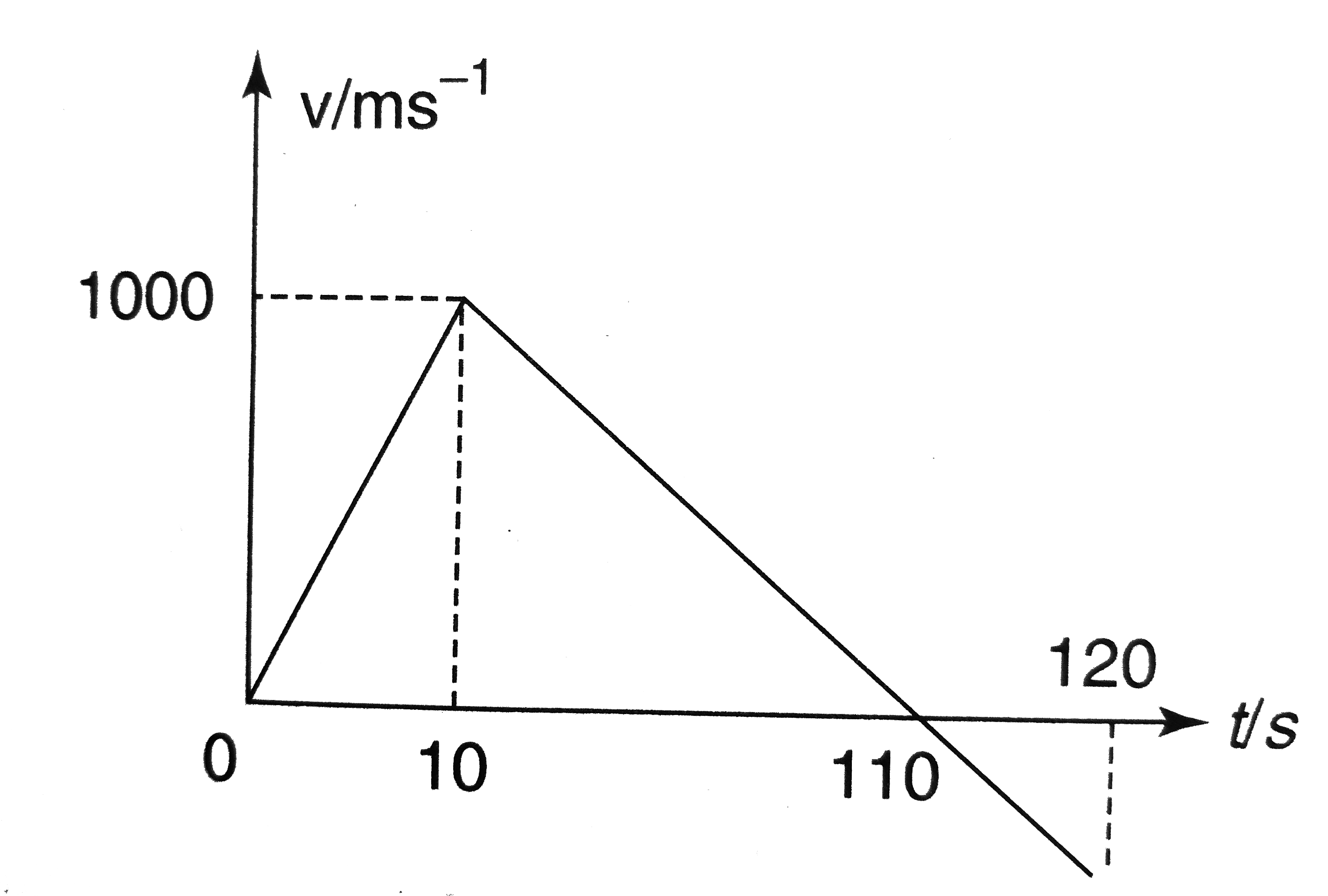
The graph shown the variation of velocity of a rocket with time. Then, the maximum height attained by the rocket is.

A

1.1 km

B

5 km

C

55 km

D

none

Text Solution

Verified by Experts

The correct Answer is:

C

Maximum height will be attained at 110 s because after 110 s velocity becomes negative and roacke3t will start coming down area from 0 to 110 s is `(1)/(2)xx110xx1000=55,000m =55km`
Promotional Banner

Topper's Solved these Questions

  • MOTION IN A STRAIGHT LINE

    NARAYNA|Exercise Comprehension Question|5 Videos
  • MOTION IN A STRAIGHT LINE

    NARAYNA|Exercise Level 1 H.W|23 Videos
  • MOTION IN A STRAIGHT LINE

    NARAYNA|Exercise Integer Type Question|13 Videos
  • MOTION IN A PLANE

    NARAYNA|Exercise Level-II(H.W)|31 Videos
  • NEWTONS LAWS OF MOTION

    NARAYNA|Exercise PASSAGE TYPE QUESTION|6 Videos

Similar Questions

Explore conceptually related problems

The follwing graph shows the variation of velocity of a rocker with time. Then the mximum height attained by the rocket is. .

A rocket is launched upward from the earth surface whose velocity time graph shown in figure. Then maximum height attained by the rocket is :-

In the previous question, the mean velocity of the rocket reaching the maximum height is :

A rocket is projected vertically upwards and its time velocity graph is shown in the figure-1.115. The maximum height attained by the rocket is :

A rocket is fired upwards such that its engine takes 10 s to explods fully. Its velocity- time graph is as shown in the figure. Acceleration due to gravity is 10m//s^(2) . The maximum height attained by the rocket is

A rocket prototype is fired from ground at time t = 0 and it goes straight up. Take the launch point as origin and vertically upward direction as positive x direction. The acceleration of the rocket is given by a = (g)/(2) - kt^(2), 0 lt t le t_(0) =- g, t gt t_(0) Where t_(0) = sqrt((3g)/(2k)) (a) Find maximum velocity of the rocket during the up journey. (b) Find maximum height attained by the rocket. (c) Find total time of flight.

In the previous question, the height attained by the rocket before deceleration is :

A particle starting from rest undergoes a rectilinear motion with acceleration a. The variation of a with time t is shown below. The maximum velocity attained by the particle during its motion is

A rocket of mass M is launched vertically from the surface of the earth with an initial speed V= sqrt((gR)/(2)) . Assuming the radius of the earth to be R and negligible air resistance, the maximum height attained by the rocket above the surface of the earth is (R)/(X) where X is:
