Home
Class 12
CHEMISTRY
It is known fact that gases expand to fi...

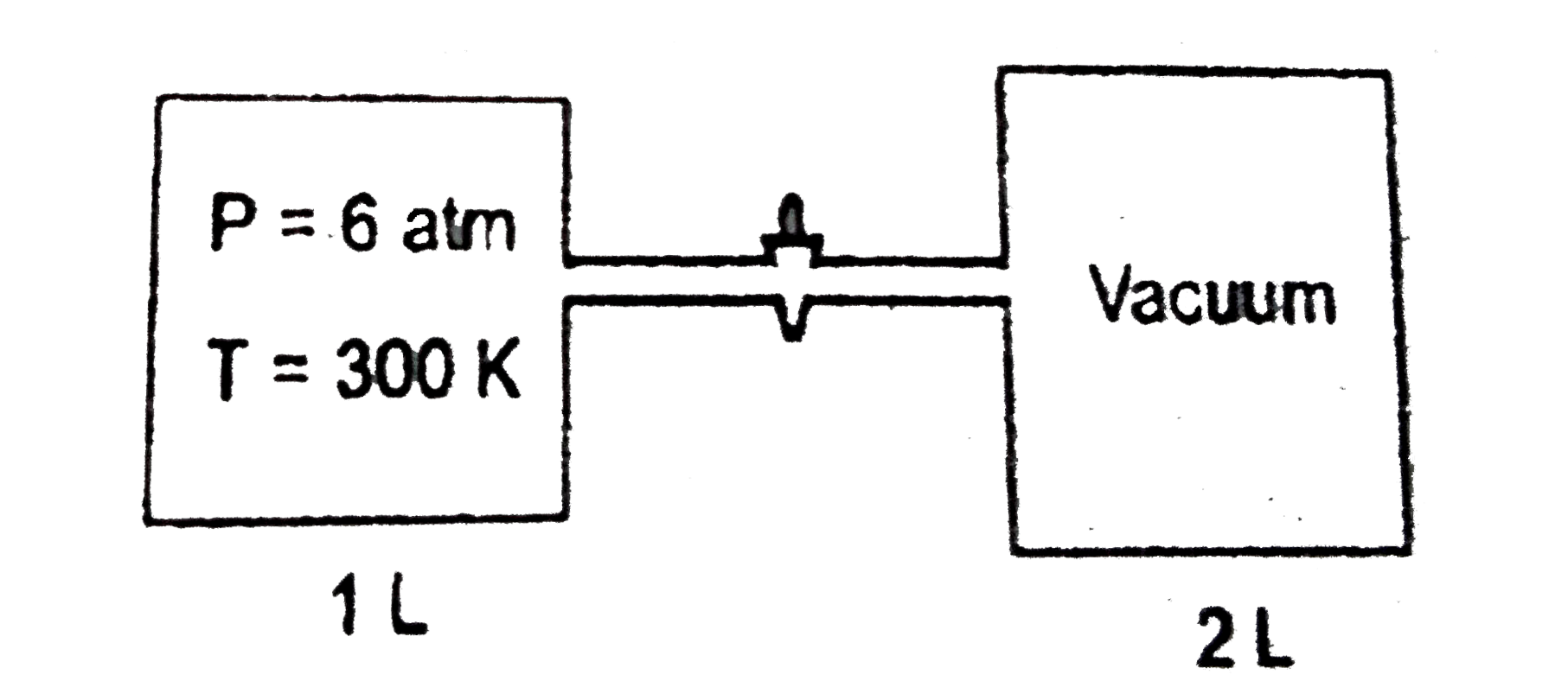
It is known fact that gases expand to fill all available volume and their final pressure becomes equal at every point in connected systeam.

If the gas in the above part weigh `15.36 g`, then select the correct statement(s) :
`(R = (1)/(12) l. atm//mol.K)`

A

The gas may be `SO_(2)`

B

The gas may be `CH_(4)`

C

Moles of gas is `(6)/(25)`

D

Moles of gas is `0.96`

Text Solution

Verified by Experts

The correct Answer is:

A, C

`Pi = 6 cm , P_(f) = ?`
`Vi = 1 L , V_(f) = 3L`
`T = 300 , T = 300 K`
`n_(i) = (6 xx 1)/(R xx 100) , n_(f) = n_(i)`
`rArr P_(f) = (6 xx 1)/(R xx 300) xx (R xx 300)/(3) = 2 "atm"`
`n_(i) = (6)/(1/12xx300) = 6/25`
`rArr MM = ((15.36)/(6))/(25) = 2.56 xx 25`
`= 64 g//mol`
So the gas can be `SO_(2)`
Promotional Banner

Topper's Solved these Questions

  • TEST PAPERS

    RESONANCE|Exercise PART - III CHEMISTRY|20 Videos
  • TEST PAPERS

    RESONANCE|Exercise PT-03|1 Videos
  • TEST PAPERS

    RESONANCE|Exercise PART - III CHEMISTRY SEC - 2|18 Videos
  • SURFACE CHEMISTRY

    RESONANCE|Exercise Section - 5|1 Videos
  • TEST SERIES

    RESONANCE|Exercise CHEMISTRY|50 Videos

Similar Questions

Explore conceptually related problems

It is known fact that gases expand to fill all available volume and their final pressure becomes equal at every point in connected systeam. in the given arrangement, temperature is maintained constant and the knob is opened. After the gas spreads in the second chamber also, the pressure will be:

One mole of an ideal monoatomic gas expands isothermally against constant external pressure of 1 atm from initial volume of 1L to a state where its final pressure becomes equal to external pressure. If initial temperature of gas is 300K then total entropy change of system in the above process is: [R=0.082L atm mol^(-1) K^(-1)-=8.3J mol^(-1) K^(-1)]

One mole of an ideal monoatomic gas expands isothermally against constant external pressure of 1 atm from intial volume of 1L to a state where its final pressure becomes equal to external pressure. If initial temperature of gas in 300 K then total entropy change of system in the above process is: [R=0.0082L atm mol^(-1)K^(-1)=8.3J mol^(-1)K^(-1)]

A vessel of "50L" contains "40g" of an ideal gas "X" at "600K" .The pressure exerted by the gas is 1 atm."20g" of an ideal gas "Y" is added to the same vessel keeping the same temperature.Total pressure becomes "3atm" .If the molar mass of "gas X" is "m (g/mol)" and the molar mass of gas "Y" is "n (g/mol)" then find the value of "(m+n)" .(Use "R=(1)/(12)(atmL)/(molK)" )

When 1 mole of an ideal gas at 20 atm pressure and 15 L volume expands such that the final pressure becomes 10 atm and the final volume becomes 60 L. Calculate entropy change for the process (C_(p.m)=30.96 J "mole"^(-1) K^(-1))

The figure given below shows three glass chambers that are connected by valves of negligible volume. At the outset of an experiment, the valves are closed and the chambers contain the gases as detailed in the diagram. All the chambers are at the temperature of 300 K and external pressure of 1.0 atm . Which of the following represents the total kinetic energy of all the gas molecules after both valves are opened? ( R=0.082 atm L K^(-1) mol^(-1)=8.314 JK^(_1)mol^(-1) )

In a closed container of volume 10^(-3)m^(3),O_(2) gas is filled at temperature 400 K and pressure 1.5 atm. A small hole is made in the container from which gas leaks out to pen atmosphere. After some time the temperature and pressure of container become equals to that of surrounding. Find the mass of gas that leaks out from the container. (Atmospheric temperature = 300 K)

The second law of thermodynamics is a fundamental law of science. In this problem, we consider the thermodynamics of an ideal gas, phase transition, and chemical equilibrium. Three moles of CO_(2) gas expands isothermally (in thermal contact with the surroundings, temperature = 15.0^(@)C ) against a fixed external pressure of 1.00 bar . The initial and final volumes of the gas are 10.0 L and 30.0L , respectively. Select the correct order of the entropy change.

(a) A certain mass of gas initially at (1L, 5 atm, 300 K) is expanded reversible and isothermally to final volume of 5L , calculate the work done by the gas and heat supplied in this process to the gas. (b) Now, if the gas is released to initial position by compressing it using an external constant pressure of 5 atm. Fins work done on the gas in this process and heat rejected by gas (c ) In the above two processes, what is the net gained by surroundings ? [Note: From above question see that surrounding has done extra work on the system but system has returned that work in the form of heat to surrounding and work is considered on organized form of energy while heat as an unorganised form hence in the above process, there must be net increment in randomness of universe which be called Entropy, soon]

RESONANCE-TEST PAPERS-PART - III CHEMISTRY
  1. When a sample of N(2) gas is passed through a liquid (N(2) is insolubl...

    Text Solution

    |

  2. It is known fact that gases expand to fill all available volume and th...

    Text Solution

    |

  3. It is known fact that gases expand to fill all available volume and th...

    Text Solution

    |

  4. Adenine is a substituted form of a heterocyclic nitrogenous base Purin...

    Text Solution

    |

  5. Adenine is a substituted form of a heterocyclic nitrogenous base Purin...

    Text Solution

    |

  6. Valence shell electron pair repusin theory (VSEPR) can be used to perd...

    Text Solution

    |

  7. Valence shell electron pair repusin theory (VSEPR) can be used to perd...

    Text Solution

    |

  8. HCN and HNC molcules are formed by the same atoms. Which of the foll...

    Text Solution

    |

  9. HCN and HNC molcules are formed by the same atoms. What is correct a...

    Text Solution

    |

  10. The energy levels in a certain single electron species are all 800% hi...

    Text Solution

    |

  11. The slope of 'P' v/s "T" plot at constant volume for a fixed amount of...

    Text Solution

    |

  12. Consider the reaction C(6)H(12)O(6) + 12H(2)SO(4) rarr 6CO(2) + 12SO...

    Text Solution

    |

  13. Calculate the molecular weight of a gas X which diffuses four times as...

    Text Solution

    |

  14. Total number of electrons having n + l = 4 in V(23) atom in its ground...

    Text Solution

    |

  15. How many of the following elements show +2 as their most stable oxidat...

    Text Solution

    |

  16. How many of following anions have 1.5 bond order ? IO(4^(-)), CH(3)C...

    Text Solution

    |

  17. How many of the following have sp^(3) hydridisation around the central...

    Text Solution

    |

  18. Cl-O band order in perchlorate ion is M and number of resonating struc...

    Text Solution

    |

  19. Write the sum of lone pairs of electron on central atom of SF(4), CF(4...

    Text Solution

    |

  20. A hydrogen like atom in ground state absorbs n photon having the sa...

    Text Solution

    |
