Home
Class 11
PHYSICS
A cylindrical tube with adiabatic walls ...

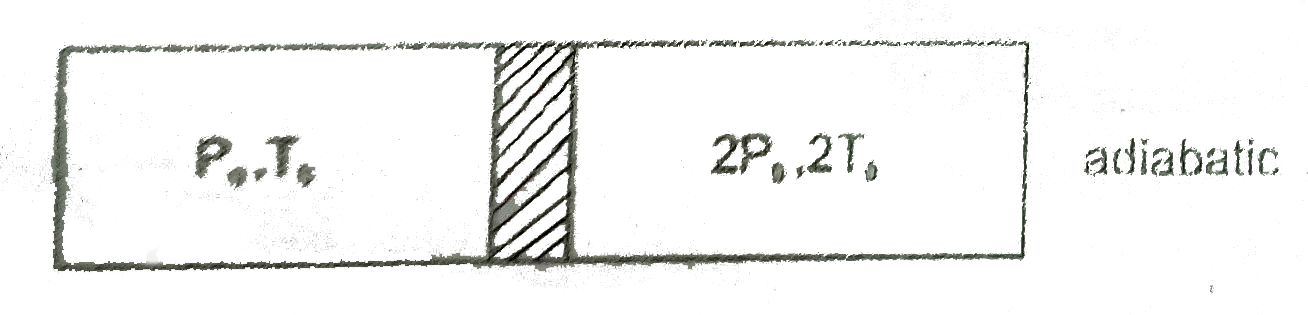
A cylindrical tube with adiabatic walls having volume `2V_(0)`contains an ideal monoatomic gas as shown in figure. The tube is divided into two equal parts by a fixed super conducting wall. Initially, the pressure and the temperature are `P_(0), T_(0)` on the left and `2P_(0), 2T_(0)` on the rigid. When system is left for sufficient amount of time the temperature on both sides becomes equal

A

Find work done by the gas on the right part?

B

Find the final pressure on the two sides

C

Find the final equilibrium temperature

D

How much heat has flows from the gas on the right to the gas on the left?

Text Solution

Verified by Experts

The correct Answer is:
A, B, C, D

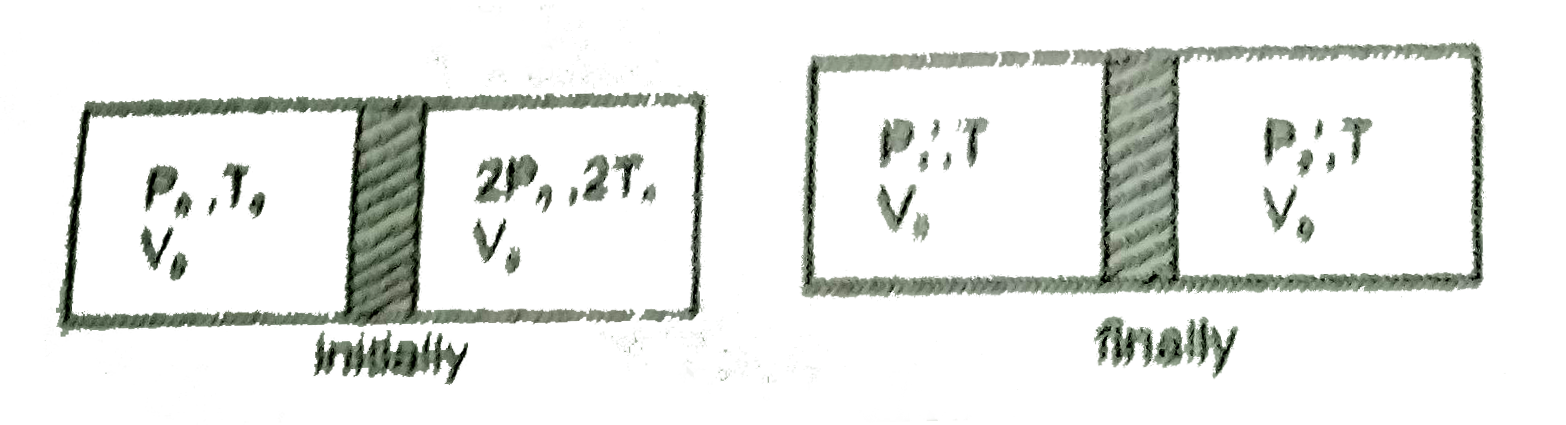
(a) As change in volume `DeltaV = 0`
`:.` Work done by gas on right part `= int p dV = 0`
(b) and (c ) Due to adiabatic walls, no heat transfer form cylindrical tube.
`U_(1)+U_(2) = U_(1) +U_(2)`
`(3)/(2)n_(1)RT_(1) +(3)/(2) n_(2)RT_(2) =(3)/(2)n_(1)RT+(3)/(2)n_(2)RT`

`T = (n_(1)T_(1)+n_(2)T_(2))/(n_(1)+n_(2))`
`= (((P_(0)V_(0))T_(0))/(RT_(0))+(2P_(0)(V_(0))2T_(0))/(R(2T_(0))))/((P_(0)V_(0))/(RT_(0))+(2P_(0)V_(0))/(R(2T_(0))))=(3T_(0))/(2)`
From mole conservation
`(P_(0)(V_(0)))/(RT_(0)) = (P_(1)(V_(0)))/(RT) rArr p' = (3P_(0))/(2)`
`rArr` similarly `p'_(2) = (3P_(0))/(2)`
(d) Heat flow form the gas right to left.
`Q = DeltaU +W ( :' W = 0)`
`Q = DeltaU = (3)/(2)n_(1)R (T-T_(1))`
`= (3)/(2) (P_(0)V_(0)R)/(RT_(0)) ((3T_(0))/(2)-T_(0)) = (3P_(0)V_(0))/(4)`
Promotional Banner

Topper's Solved these Questions

  • KTG & THERMODYNAMICS

    RESONANCE|Exercise Advancel Level Problems|1 Videos
  • KINETIC THEORY OF GASES AND THERMODYNAMICS

    RESONANCE|Exercise Exercise|64 Videos
  • MAGNETIC FIELD AND FORCES

    RESONANCE|Exercise Exercise|65 Videos

Similar Questions

Explore conceptually related problems

shows a cylindrial tube of volume V with adiabatic walls containing an ideal gas. The internal energy of this ideal gas is given by 1.5nRT. The tube is divided into two equal parts by a fixed diathermic wall. Initially, the pressure and the tempreture are p_(1), T_(1) on the left and p_(2), T_(2) on the right. the system is left for sufficient time so that the tempreture becomes equal on the two sides. (a) how much work has been done by the gas on the left part ? (b) find the final pressures on the two sides. (c ) find the final equilibrium tempreture. (d) how much heat has flown from the gas on the right to the gas on the left ?

A uniform tube of volume V contains an ideal monatomic gas at a uniform pressure P the temperature of the gas varies linearly along te length of the tube ad T and 2 T are the temperature at the ends.

A diathermic piston divides adiabatic cylinder of volume V0 into two equal parts as shown in the figure. Both parts contain ideal monoatomic gases. The initial pressure and temperature of gas in left compartment are P0 and T0 while that in right compartment are 2P0 and 2T0. Initially the piston is kept fixed and the system is allowed to acquire a state of thermal equilibrium. The pressure in left compartment after thermal equilibrium is achieved is

A diathermic piston divides adiabatic cylinder of volume V0 into two equal parts as shown in the figure. Both parts contain ideal monoatomic gases. The initial pressure and temperature of gas in left compartment are P0 and T0 while that in right compartment are 2P0 and 2T0. Initially the piston is kept fixed and the system is allowed to acquire a state of thermal equilibrium. The heat that flown from right compartment to left compartment before thermal equilibrium is achieved is

A diathermic piston divides adiabatic cylinder of volume V0 into two equal parts as shown in the figure. Both parts contain ideal monoatomic gases. The initial pressure and temperature of gas in left compartment are P0 and T0 while that in right compartment are 2P0 and 2T0. Initially the piston is kept fixed and the system is allowed to acquire a state of thermal equilibrium. If the pin which was keeping the piston fixed is removed and the piston is allowed to slide slowly such that a state of mechanical equilibrium is achieved. The volume of left compartment when piston is in equilibrium is

A cylindrical adiabatic container of total volume 2V_(0) divided into two equal parts by a conducting piston which is free to move as shown in figure. Each part containing identical gas at pressure P_(0) . Initially temperature of left and right part is 4T_(0) and T_(0) respectively. An external force is applied on the piston of area 'A' to keep the piston at rest. The value of external force required when thermal equilibrium is reached is.

A cylindrical tube ofuniform cross sectional area A is fitted with two frictionless pistons, as shown in figure-2.46. The pistons are connected to each other by a metallic wire. Initially the pressure of the gas is equal to atmospheric pressure P_0 and temperature is T^0 . If the temperature of the gas is increased to 2T_0 , find the tension in the wire.

The air tight and smooth piston of a cylindrical vessel are connected with a string as shown. Initially pressure and temperature of the gas are P_(0) and T_(0) . The atmospheric pressure is also P_(0) . At a later time, tension in the string is (3)/(8) P_(0)A where A is cthe cross-sectional are of the cylinder. at this time, the temperature of the gas has become.

RESONANCE-KTG & THERMODYNAMICS-SUBJECTIVE QUESTIONS
  1. A sample of 2 kg of monatomic helium (assumed ideal) is taken through ...

    Text Solution

    |

  2. Two moles of an ideal monoatomic gas are confined within a cylinder by...

    Text Solution

    |

  3. Two vessels A and B, thermally insulated, contain an ideal monoatomic ...

    Text Solution

    |

  4. One mole of a diatomic ideal gas (gamma=1.4) is taken through a cyclic...

    Text Solution

    |

  5. In the given figure, an ideal gas changes it state from A to state C b...

    Text Solution

    |

  6. One mole of an ideal monoatomatic gas is taken round the cylic process...

    Text Solution

    |

  7. Two moles of an ideal monoatomic gas, initially at pressure p1 and vol...

    Text Solution

    |

  8. A weightless piston divides a thermally insulated cylinder into two pa...

    Text Solution

    |

  9. Two containers A and B of equal volume V(0)//2 each are connected by a...

    Text Solution

    |

  10. In given figure, an adiabatic cylindrical tube of volume 2V(0) is divi...

    Text Solution

    |

  11. In the given figure a glass tube lies horizontally with the middle 20c...

    Text Solution

    |

  12. A cylindrical tube with adiabatic walls having volume 2V(0)contains an...

    Text Solution

    |

  13. A mass of 8g of oxygen at the pressure of one atmosphere and at temper...

    Text Solution

    |

  14. An ideal gas ((C(p))/(C(v))=gamma)has initial volume V(0) is kept in a...

    Text Solution

    |

  15. An ideal gas (C(p)//C(v) =gamma) having initial pressure P(0) and volu...

    Text Solution

    |

  16. An insulting container of volume 2V(0) is divided in two equal parts b...

    Text Solution

    |

  17. An ideal gas (gamma=3//2) is compressed adiabatically form volume 400c...

    Text Solution

    |

  18. Two samples A and B of the same gas have equal volumes and pressure. T...

    Text Solution

    |

  19. A Carnot engine cycle is shown in the Fig. (2). The cycle runs between...

    Text Solution

    |

  20. Cloud formation condition Consider a simplified model of cloub forma...

    Text Solution

    |

