Home
Class 11
PHYSICS
In the figure, the block B of mass m sta...

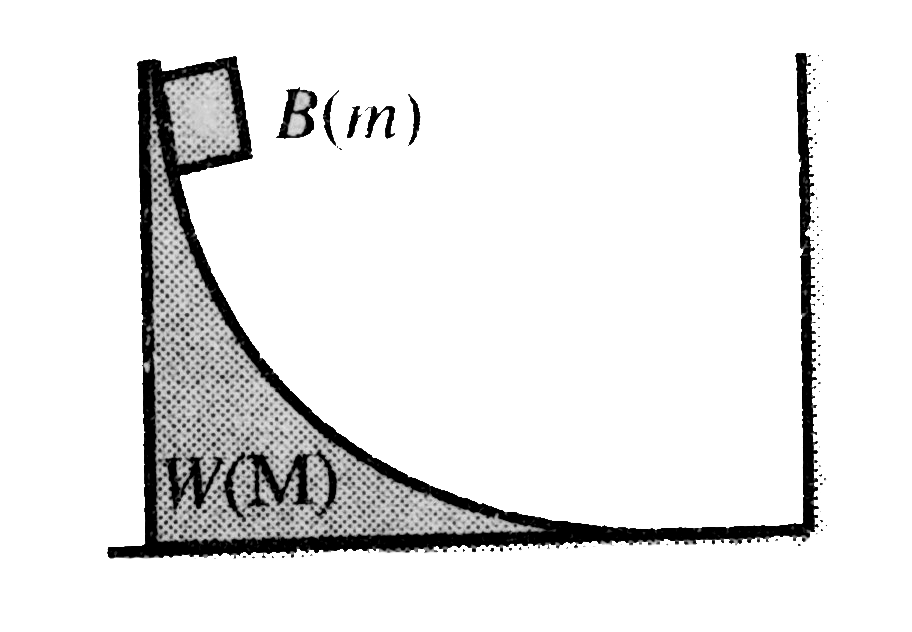
In the figure, the block `B` of mass `m` starts from rest at the top of a wedge `W` of mass `M`. All surfaces are without friction. `W` can slide on the ground. `B` slides down onto the ground, moves along it with a speed v, has an elastic collision with the wall, and climbs back on to `W`.

A

`B` will reach the top of `W` again

B

from the beginning, till the collision of with the wall, the centre of mass `'B+W'` is stationary in horizontal direction

C

after the collision the centre of mass `'B+W'` moves with the velocity `(2 m v)/(m+M)`

D

when `B` reaches its highest position on `W,` the speed of `W` is `(2 mv)/(m+M)`

Text Solution

Verified by Experts

The correct Answer is:
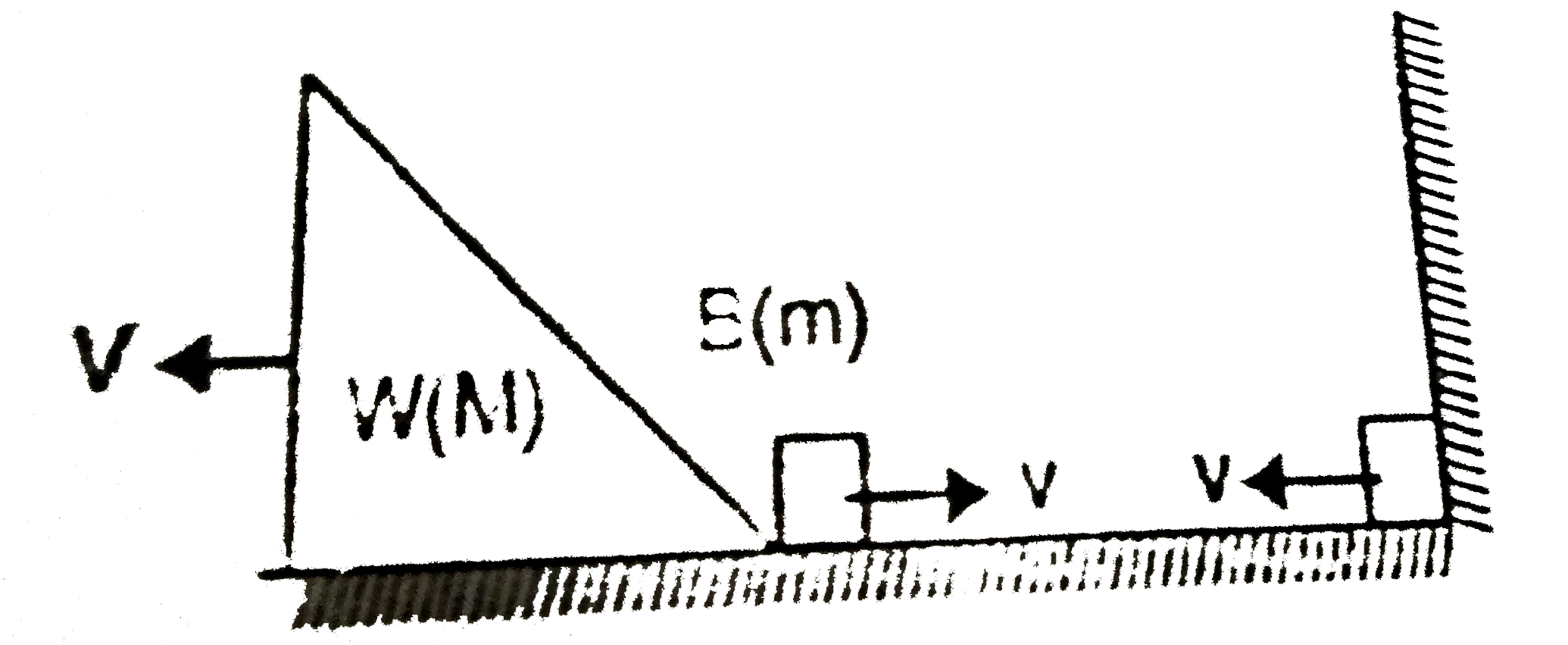
B, C, D


From linear conservation
`mv=MV`
`V=(mV)/(M)`
After the elastic collision with wall speed of the block `B` remain same in the direction `V`
`V_(cm)=(m(v)+M((mv)/(M)))/(m+M)`
`=(2mV)/(m+M)`
When block `B` will reach at maximum height on wedge
From momentum conservation
`(mv)/(M)M+mv=(m+M)V_(c)`
`V_(C)=(2mv)/((M+m))`.
Promotional Banner

Topper's Solved these Questions

  • DAILY PRACTICE PROBLEMS

    RESONANCE|Exercise dpp 58|9 Videos
  • DAILY PRACTICE PROBLEMS

    RESONANCE|Exercise dpp 59|5 Videos
  • DAILY PRACTICE PROBLEMS

    RESONANCE|Exercise dpp 56|7 Videos
  • CURRENT ELECTRICITY

    RESONANCE|Exercise Exercise|54 Videos
  • ELASTICITY AND VISCOCITY

    RESONANCE|Exercise Advanced Level Problems|9 Videos

Similar Questions

Explore conceptually related problems

In the figure, the block B of mass m starts from rest at the top of a wedge W of mass M. All surfaces are without friction. W can slide on the ground. B slides down onto the ground, moves along it with a speed v, has an elastic collision with the wall, and climbs back two W.

A block of mass m is released from the top of a wedge of mass M as shown in figure. Find the displacement of wedges on the horizontal ground when the block reaches the bottom of the wedges. Neglect friction everywhere.

A block of mass M is placed on the top of a bigger block of mass 10 M as shown in figure. All the surfaces are frictionless. The system is released from rest, then the distance moved by the bigger block at the instant the smaller block reaches the ground :

A block of mass m lies on wedge of mass Mas shown in figure. Find the minimum friction coeffcient required between wedge Mand ground so that it does not move while block m slips down on it.

A block of mass m rests on a stationary wedge of mass M. The wedge can slide freely on a smooth horizontal surface as shown in figure. If the block starts from rest

Block B has mass m and is released from rest when it is on top of wedge A, which has a mass 3m. Determine the tension in cord CD needed to hold the wedge from moving while B is sliding down A. Neglect friction.

The block B starts from rest and slides on the wedge A which can move on a horizontal surface, Neglecting friction, determine (a) the acceleration of wedge, (b) the acceleration of the block relative to the wedge.

A block of mass m is placed at the top of a smooth wedge ABC. The wedge is rotated about an axis passing through C as shown in the figure - 3.81. The minimum value of angular speed omega such that the block does not slip on the wedge is :

A block of mass m is placed on hthe top of bigger wedge M. All the surfaces are frictionless. The system is released from rest. Find the distance moved by smaller block (w.r.t triangular wedge) when bigger wedge travles distance X on plane surface

A particle of mass m moving with speed u hits a wedge of mass M as shown in figure. If coefficient of restitution is e and friciton can be neglected, then find the speed of the wedge with respect to ground just after the collision.

