Home
Class 11
PHYSICS
Mass m is connected with an ideal spring...

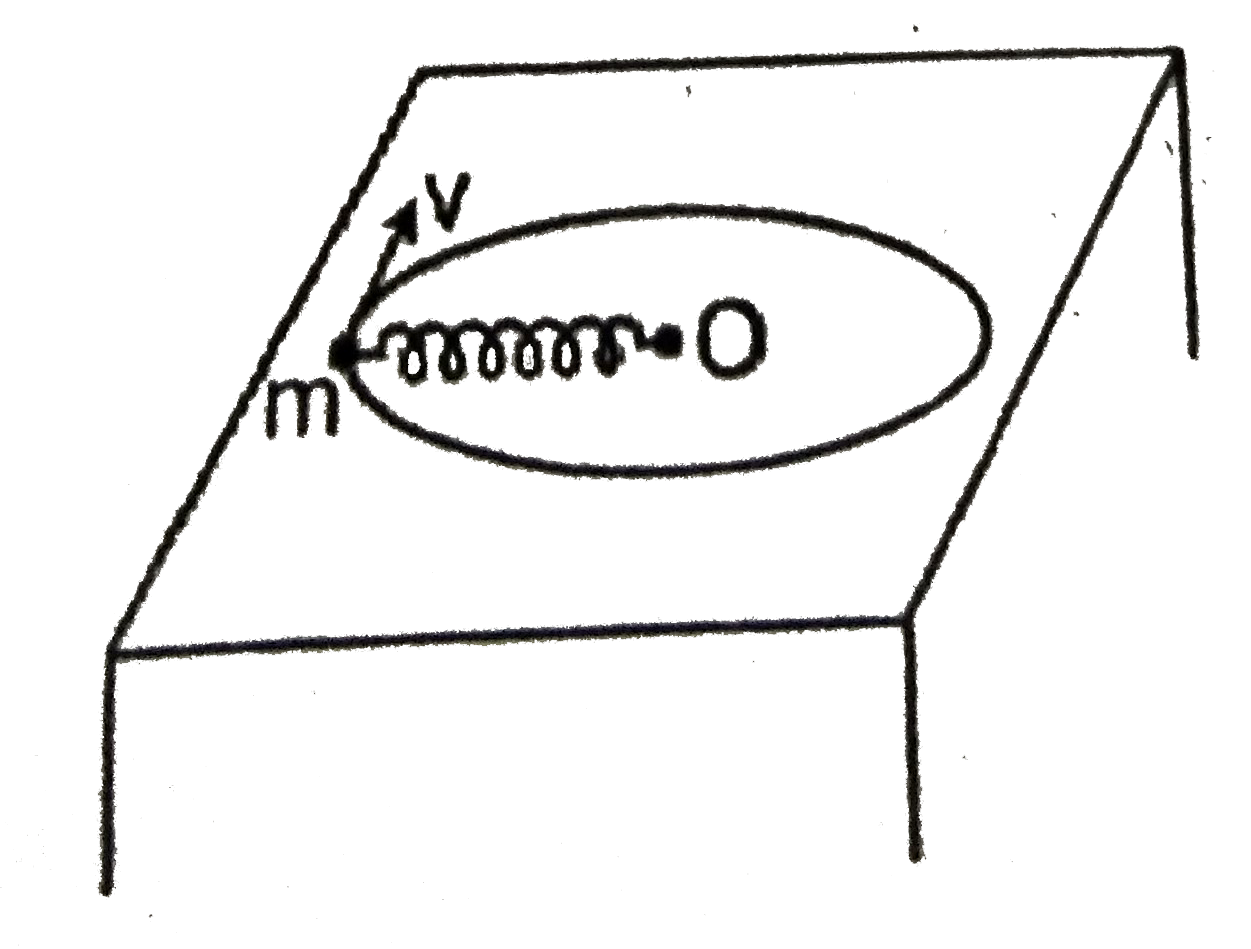
Mass `m` is connected with an ideal spring of natural length `l` whose other end is fixed on a smooth horizontal table. Initially spring is in its natural length `l`. Mass `m` is given a velocity `'v'` perpendicular to the spring and released . The velocity perpendicular to the spring when its length `l+x` , will be

A

`(2vl)/(l+x)`

B

`(2v^(2)+l)/(l+x)`

C

`(vl)/(l+x)`

D

zero

Text Solution

Verified by Experts

The correct Answer is:

C

since torque about `O` is zero.
angular momentum of mass `m` is conserved
`:. Mvl=mv_(_|_) (l+x), v_(_|_) =(vl)/(l+x)`
Promotional Banner

Topper's Solved these Questions

  • DAILY PRACTICE PROBLEMS

    RESONANCE|Exercise dpp 64|5 Videos
  • DAILY PRACTICE PROBLEMS

    RESONANCE|Exercise DPP 65|5 Videos
  • DAILY PRACTICE PROBLEMS

    RESONANCE|Exercise DPP 62|4 Videos
  • CURRENT ELECTRICITY

    RESONANCE|Exercise Exercise|54 Videos
  • ELASTICITY AND VISCOCITY

    RESONANCE|Exercise Advanced Level Problems|9 Videos

Similar Questions

Explore conceptually related problems

A block of mass m is attached to a spring of force constant k whose other end is fixed to a horizontal surface. Initially the spring is in its natural length and the block is released from rest. The average force acting on the surface by the spring till the instant when the block has zero acceleration for the first time is

" A spring of natural length L compressed to length "7L/8" exerts a force "F_(0)" .The work done by the spring in restoring itself to natural length is "

A dumbbell consists of two balls A and B of mass m=1 kg and connected by a spring. The whole system is placed on a smooth horizontal surface as shown in the figure. Initially the spring is at its natural length, the ball B is imparted a velocity v_(0)=8/(sqrt(7))m//s in the direction shown. The spring constant of the spring is adjusted so that the length of the spring at maximum elongation is twice that of the natural, length of the spring. Find the maximum potential energy stored (in Joule) in the spring during the motion.

Find the maximum tension in the spring if initially spring at its natural length when block is released from rest.

One end of an ideal spring of unstreched length l_(O)=1m , is fixed on a frictionless horizontal table. The other end has a small disc of mass 0.1 kg attached to it. The disc is projected with a velocity upsilon_(0)=11 m//s perpendicular to the spring. What is the force constant of spring?

One end of an ideal spring of unstreched length l_(O)=1m , is fixed on a frictionless horizontal table. The other end has a small disc of mass 0.1 kg attached to it. The disc is projected with a velocity upsilon_(0)=11 m//s perpendicular to the spring. Choose the correct statements

Two blocks A and B each of mass m are connected by a light spring of natural length L and spring constant k. The blocks are initially resting on a smooth horizontal floor with the spring at its natural length, as shown. A third identical block C, also of mass m, moves on the floor with a speed v along the line joining A to B and collides with A. Collision is elastic and head on. Then -

Two blocks A and B of masses m and 2m are connected by a massless spring of natural length L and spring constant k . The blocks are intially resting on a smooth horizontal floor with the spring at its natural length , as shown . A third identical block C of mass m moves on the floor with a speed v_(0) along the line joining A and B and collides elastically with A . FInd (a) the velocity of c.m. of system (block A + B + spri ng) and (b) the minimum compression of spring.

Two blocks A and B each of mass m are connected by a massless spring of natural length L and spring constant k. The blocks are initially resting on a smooth horizontal floor with the spring at its natural length. A third identical block C also of mass m moves on the floor with a speed v along the line joining A and B and collides with A. Then The kinetic energy of the A-B system at maximum compression of the spring is mv^(2)//4 The maximum compression of the spring vsqrt(m//3k) The kinetic energy of the A-B system at maximum compression The maximum coppression of the spring is vsqrt(m//k)

Two blocks A and B, each of mass m, are connected by a masslesss spring of natural length L and spring constant K. The blocks are initially resting on a smooth horizontal floor with the spring at its natural length, as shown in fig. A third identical block C, also of mass m, moves on the floor with a speed v along the line joining A and B, and collides elastically with A. Then
