Home
Class 12
PHYSICS
In the figure shown below, the maximum a...

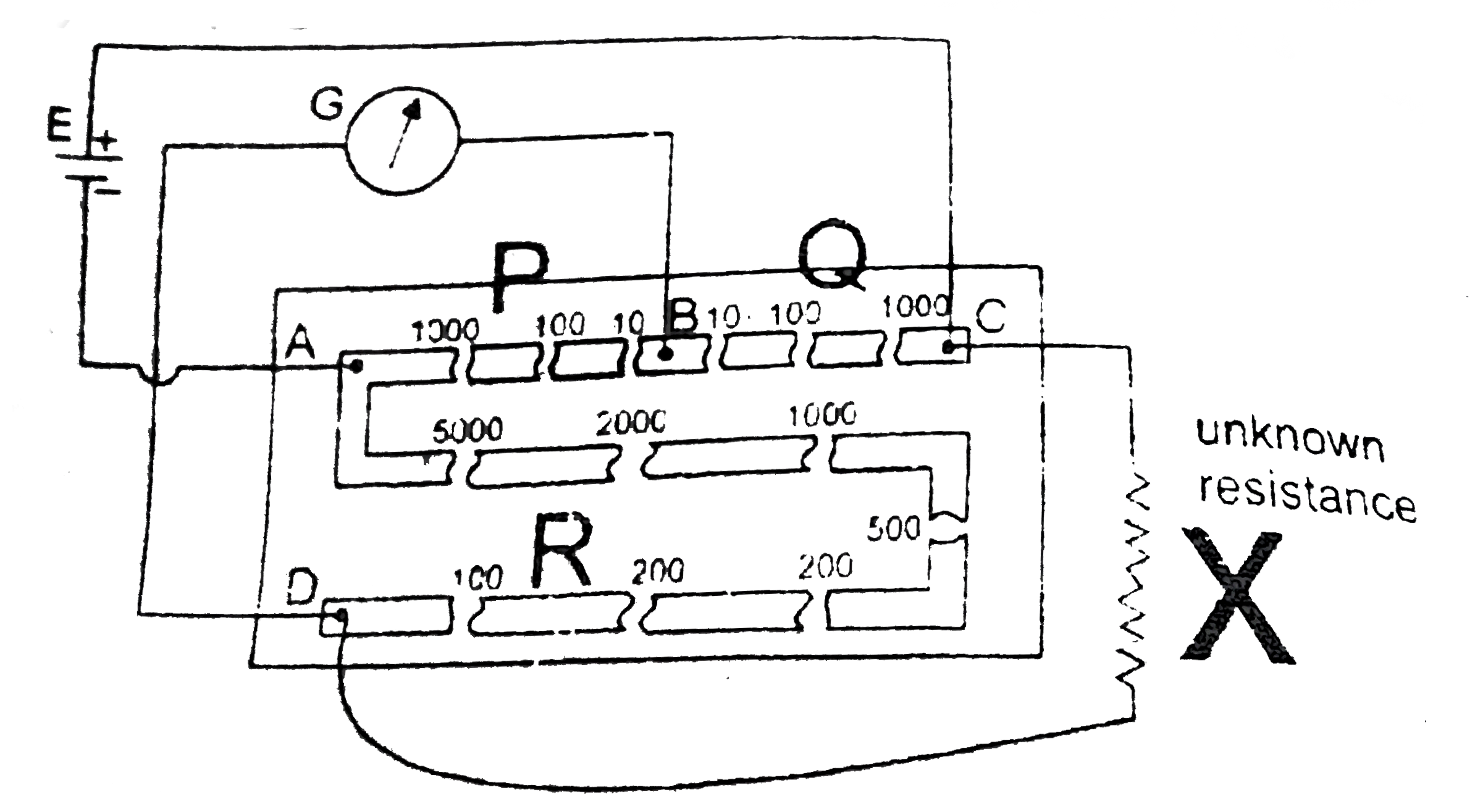
In the figure shown below, the maximum and the minimum possible unknown resistance (X), that can be measured by the post office box are `X_(max)` and `X_(min)` respectively : (In this experiment we take out only one plug in arm AB and only one plus in arm BC, but in arm AD we can take out many plugs) :

A

`X_(max) = 500 k Omega,X_(min) = 1 Omega`

B

`X_(max) = 900 k Omega,X_(min) =1 Omega`

C

For the closer measure of `X,(P)/(Q)` ratio should be increased

D

For the closer meaure of `X,(Q)/(P)` ratio should be increased

Text Solution

Verified by Experts

The correct Answer is:

B, C

`(P)/(Q)=(R)/(X)`
`X = (Q)/(P)R`
`(X)_(max) = (Q_(max))/(P_(min)) xx R_(max) = (1000)/(10) xx 9000 = 900 k Omega`
`(X)_(min) = (Q_(min))/(P_(max))xxR_(min) = (10)/(1000) xx 100 = 1 Omega`
(D) as `X = (Q)/(P) R` so to increase accuracy
`(P)/(Q)` ratio should be increased, so that R can be divided by a larger number. (Read the experiment from "Measurement errors and experiment sheet")
Promotional Banner

Topper's Solved these Questions

  • DAILY PRACTICE PROBLEM

    RESONANCE|Exercise DPP No.45|20 Videos
  • DAILY PRACTICE PROBLEM

    RESONANCE|Exercise DPP No.46|11 Videos
  • DAILY PRACTICE PROBLEM

    RESONANCE|Exercise DPP No.43|20 Videos
  • CURRENT ELECTRICITY

    RESONANCE|Exercise High Level Problems (HIP)|21 Videos
  • ELECTRO MAGNETIC WAVES

    RESONANCE|Exercise Exercise 3|27 Videos

Similar Questions

Explore conceptually related problems

What are the maximum and minimum values of unknown resistance X , which can be determined using the post office box shown in the fig.3.34?

X and Y are two volatile liquids with molar weights of 10gmol^(-1) and 40gmol^(-1) respectively. Two cotton plugs, one soaked in X and the other soaked in Y , are simultaneously placed at the ends of a tube of length L=24 cm, as shown in the figure. The tube is filled with an inert gas at 1 atm pressure and a temperature of 300K . Vapours of X and Y react to form a product whichh is first observed at a distance d cm from the plug soaked in X . Take X and Y to have equal molecular diameters and assume ideal behaviour for the inert gas and two vapours. The value of d in cm (shown in figure), as estimated from Graham's law, is

X and Y are two volatile liquids with molar weights of 10gmol^(-1) and 40gmol^(-1) respectively. Two cotton plugs, one soaked in X and the other soaked in Y , are simultaneously placed at the ends of a tube of length L=24 cm, as shown in the figure. The tube is filled with an inert gas at 1 atm pressure and a temperature of 300K . Vapours of X and Y react to form a product whichh is first observed at a distance d cm from the plug soaked in X . Take X and Y to have equal molecular diameters and assume ideal behaviour for the inert gas and two vapours. The experimental value of d is found to be smaller than the estimate obtained using Graham's law. This is due to
