Home
Class 12
PHYSICS
A particle of charge = 1 muC and mass m=...

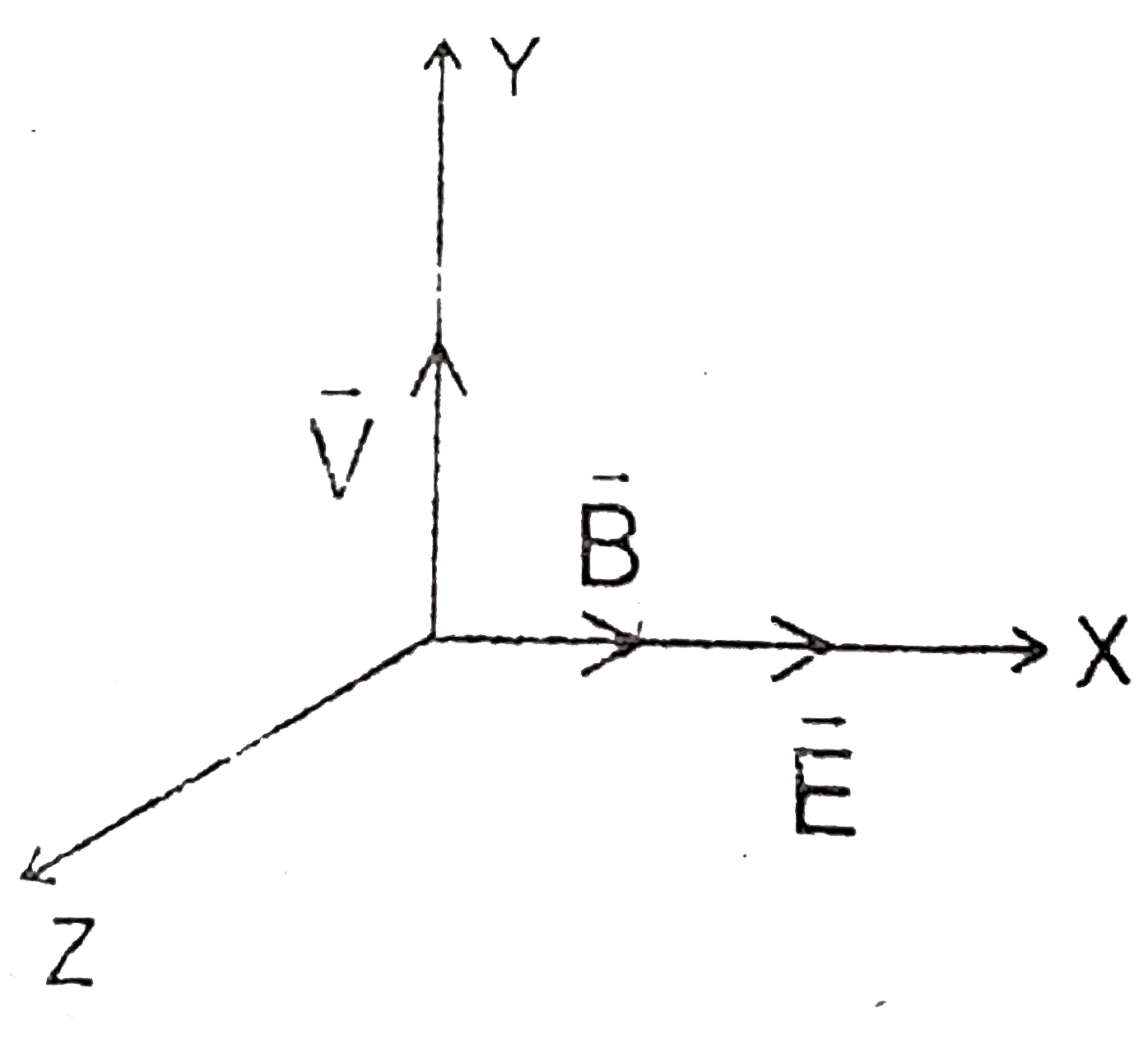
A particle of charge `= 1 muC` and mass m=1 gm starts moving from origin at t = 0 under an electric field of `10^(3) N//C` along x-axis and magnetic field of 10 tesla along the same axis with the velocity of `vec(v) = 20 hat(j)` m/sec as shown, the speed of the particle at the time of `20 sqrt(3)sec` will be :

A

20 m/sec

B

40 m/sec

C

10 m/sec

D

None

Text Solution

Verified by Experts

The correct Answer is:

B

As `V^(2)=V_(x)^(2)V_(y)^(2)=((qE)/(m)t)^(2)+(20)^(2)`
`=((10^(-6)10^(3))/(10^(-3))20 sqrt(3))^(2)+(20)^(2)=1600`
`V = 40 m//sec`
Promotional Banner

Topper's Solved these Questions

  • DAILY PRACTICE PROBLEM

    RESONANCE|Exercise DPP No.52|9 Videos
  • DAILY PRACTICE PROBLEM

    RESONANCE|Exercise DPP No.53|20 Videos
  • DAILY PRACTICE PROBLEM

    RESONANCE|Exercise DPP No.50|9 Videos
  • CURRENT ELECTRICITY

    RESONANCE|Exercise High Level Problems (HIP)|21 Videos
  • ELECTRO MAGNETIC WAVES

    RESONANCE|Exercise Exercise 3|27 Videos

Similar Questions

Explore conceptually related problems

A particle of charge q=4muC and mass m = 10 mg starts moving from the origin under the action of an electric field vecE=4hati and magnetic field vecB=(0.2T)hatk . Its velocity at (x, 3, 0) is (4veci+3vecj) . The value of x is -

A particle of charge q and mass m starts moving from the origin under the action of an electric field vec E = E_0 hat i and vec B = B_0 hat i with a velocity vec v = v_0 hat j . The speed of the particle will become 2v_0 after a time.

A particle of charge q and mass m starts moving from the origin under the action of an electric field vecE=E_0 hat i and vec B=B_0 hat i with velocity vec v=v_0 hat j . The speed of the particle will become 2v_0 after a time

An a particle is moving in a magnetic field of (3 hat(i) + 2 hat (j)) tesla with a velocity of 5xx10^(5) hat (i) m/s. The magnetic force acting on the particle will be-

A particle of charge q and mass m released from origin with velocity vec(v) = v_(0) hat(i) into a region of uniform electric and magnetic fields parallel to y-axis. i.e., vec(E) = E_(0) hat(j) and vec(B) = B_(0) hat(j) . Find out the position of the particle as a functions of time Strategy : Here vec(E) || vec(B) The electric field accelerates the particle in y-direction i.e., component of velocity goes on increasing with acceleration a_(y) = (F_(y))/(m) = (F_(e))/(m) = (qE_(0))/(m) The magnetic field rotates the particle in a circle in x-z plane (perpendicular to magnetic field) The resultant path of the particle is a helix with increasing pitch. Velocity of the particle at time t would be vec(v) (t) = v_(x) hat(i) + v_(y) hat(j) + v_(z) hat(k)

A particle of charge q_(0) and of mass m_(0) is projected along the y -axis at t=0 from origin with a velocity V_(0) . If a uniform electric field E_(0) also exist along the x -axis, then the time at which debroglie wavelength of the particle becomes half of the initial value is:

A particle with 10^(-11) coulomb of charge and 10^(-7)kg mass is moving wilth a velocity of 10^(8)m//s along the y -axis. A uniform static magnetic field B=0.5 Tesla is acting along the x -direction. The force on the particle is

Three particles start from the origin at the same time, one with a velocity v_(1) along the x-axis, second along the negative y-axis with a velocity v_(2) and third particle moves along the line x = y. The velocity of third particle, so that three may always lie on the same line is:

v_(x) is the velocity of a particle moving along the x-axis as shown in the figure. If x=2.0m at t=1.0s, what is the position of the particle at t=6.0s ?

RESONANCE-DAILY PRACTICE PROBLEM-DPP No.51
  1. The secondary coil of an ideal step down transformer is delivering 500...

    Text Solution

    |

  2. An inductor (L = (1)/(100 pi) H), a capacitor (C = (1)/(500 pi) F) and...

    Text Solution

    |

  3. Consider a L-R circuit shown in figure. There is no current in circuit...

    Text Solution

    |

  4. Consider a L-C oscillation circuit. Circuit elements has zero resistan...

    Text Solution

    |

  5. A particle of charge = 1 muC and mass m=1 gm starts moving from origin...

    Text Solution

    |

  6. Consider atoms H, He^(+), Li^(++) in their ground states. Suppose E(1)...

    Text Solution

    |

  7. A potentiometer circuit has been setup for finding. The internal resis...

    Text Solution

    |

  8. If the kinetic energy of the particle is increased to 16 times its pre...

    Text Solution

    |

  9. A small sized mass m is attached by a massless string (of length L) to...

    Text Solution

    |

  10. One end of light inelastic string is tied to a helium filled ballloon ...

    Text Solution

    |

  11. The SI unit of inductance the Henry can not be written as :

    Text Solution

    |

  12. When a perosn throws a meter stivk it is found that the centre of the ...

    Text Solution

    |

  13. A particle of positive charge q and mass m enters with velocity Vhati ...

    Text Solution

    |

  14. The radius of a metal sphere at room temperature T is R, and the coeff...

    Text Solution

    |

  15. Direction : Resistive force proportional to object velocity At low...

    Text Solution

    |

  16. Direction : Resistive force proportional to object velocity At low...

    Text Solution

    |

  17. Direction : Resistive force proportional to object velocity At low...

    Text Solution

    |

  18. Direction : Resistive force proportional to object velocity At low...

    Text Solution

    |

  19. Direction : Resistive force proportional to object velocity At low...

    Text Solution

    |

  20. Direction : Resistive force proportional to object velocity At low...

    Text Solution

    |
