Home
Class 12
PHYSICS
A uniform rod AB of mass m and length l ...

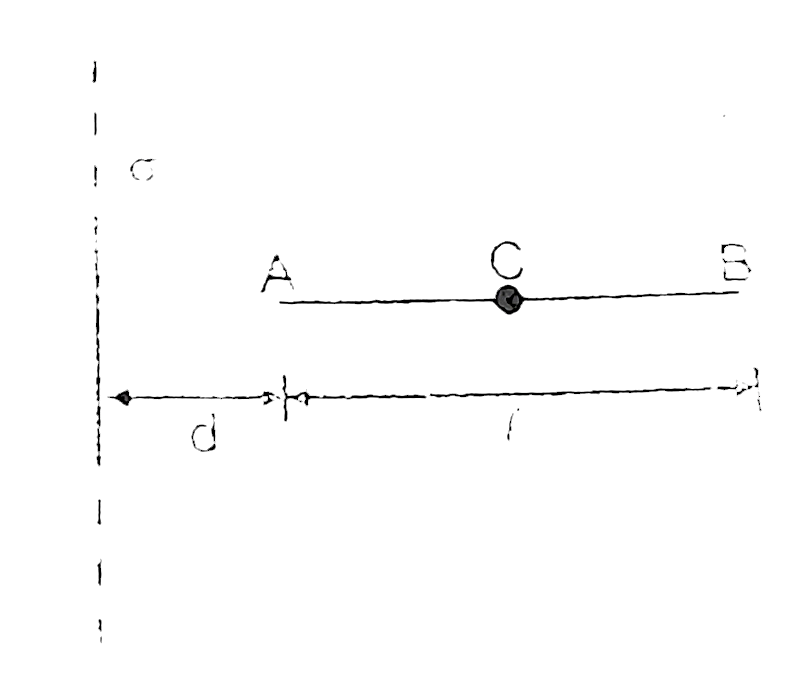
A uniform rod AB of mass m and length `l` is hinged at its mid point C. The left half (AC) of the rod has linear charge density `-lamda` and the right half (CB) has `+ lamda` where `lamda` is constant. A large non conducting sheet of uniform surface charge density `sigma` is also present near the rod. Initially the rod is kept perpendicular to the sheet. The end A of the rod is initialy at a distance d. Now the rod is rotated by a small angle in the plane of the paper and released. Prove that the rod will perform SHM and find its time period.

Text Solution

Verified by Experts

The correct Answer is:
`T=2 pi sqrt((2m in_(0))/(3 lamda sigma))`

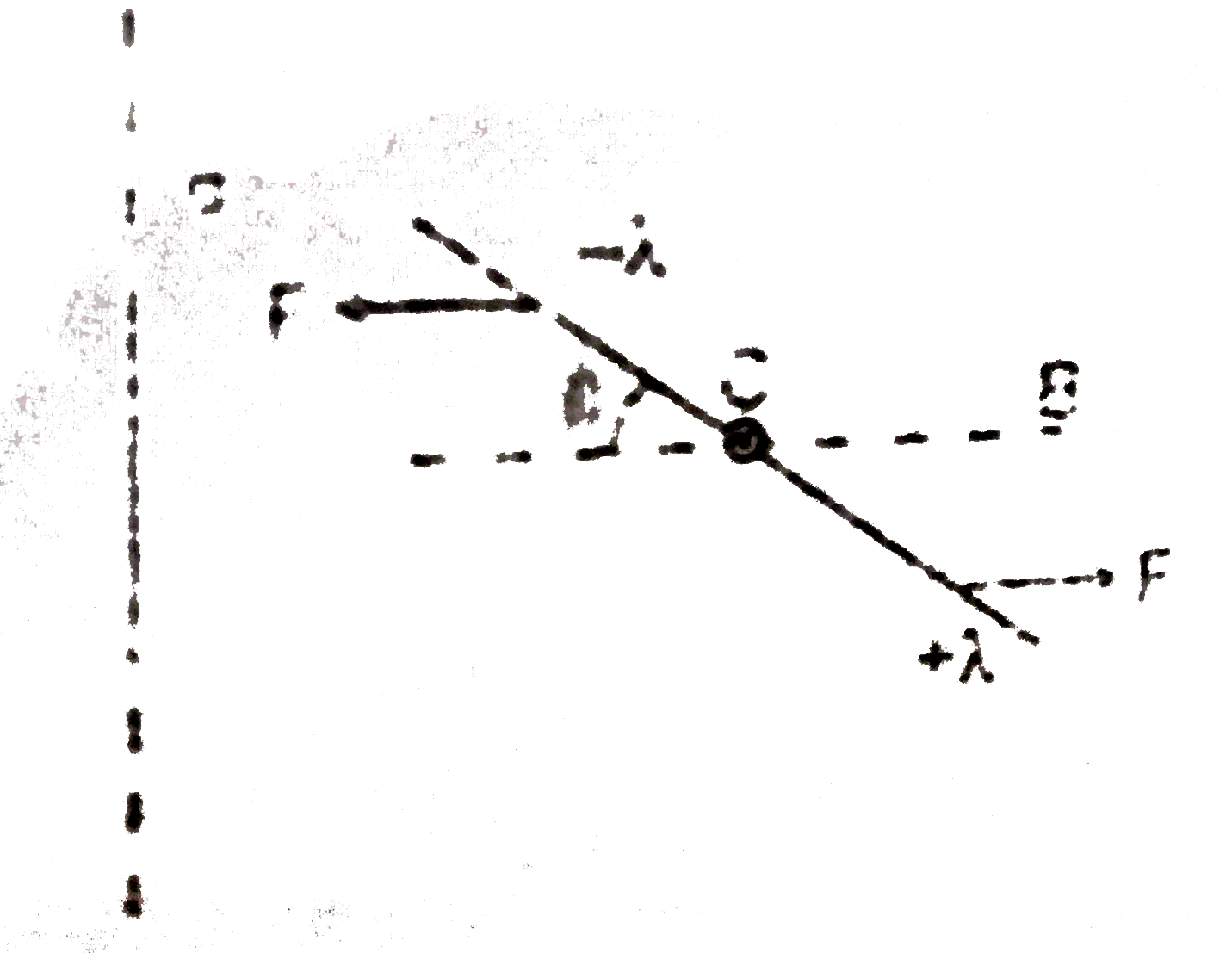
The sheet produces a uniform electric field `E = (sigma)/(2 in_(0))` towards right. The part AC and BC will experience electric force F as shown. They can be considered to be activing at the mid points of those parts respectively. The rod will experience torque about the point c in the anticlockwise direction

whose magnitude is `tau = F (l)/(2) sin theta = (Fl)/(2) theta`:
But `F = lambda (l)/(2). (sigma)/(2 in_(0)) = (lambda l sigma)/(4 in_(0))`
`tau = ((lambda l^(2) sigma)/(8 in_(0))) theta`
Now since `tau` is towards the mean position & `tau prop theta`
`:.` it will do SHM `rarr` Hence proved
& `tau = 1 prop = (lambda l^(2)sigma)/(8 in_(0))`
`rArr (ml^(2) sgma)/(12) alpha = (lambda l^(2) sigma)/(8 in_(0)) alpha`
`alpha = ((3 lambda sigma)/(2m in_(0))) theta`
`:. omega^(2) = (3 lambda sigma)/(2 m in_(0)) rArr ((2pi)/(T))^(2)`
`rArr T = 2pi sqrt(2m in_(0))/(3lambda sigma)`
Promotional Banner

Topper's Solved these Questions

  • DAILY PRACTICE PROBLEM

    RESONANCE|Exercise DPP No.61|20 Videos
  • DAILY PRACTICE PROBLEM

    RESONANCE|Exercise DPP No.62|9 Videos
  • DAILY PRACTICE PROBLEM

    RESONANCE|Exercise DPP No.59|9 Videos
  • CURRENT ELECTRICITY

    RESONANCE|Exercise High Level Problems (HIP)|21 Videos
  • ELECTRO MAGNETIC WAVES

    RESONANCE|Exercise Exercise 3|27 Videos

Similar Questions

Explore conceptually related problems

A large nonconducting sheet M is given a uniform charge density. Two unchared small metal rods A and B are placed near the sheet as shown in figure

Show that the centre of mass of uniform rod of mass M and length L lies at the middle point of the rod.

A large sheet carries uniform surface charge density sigma . A rod of length 2l has a linear charge density lamba on one half and -lambda on the second half. The rod is hinged at the midpoint O and makes an angle theta with the normal to the sheet. The torque experience by the rod is

Find the total force on charge q due to a charge rod having linear charge density lamda C/m placed as shown in figure.

In the figure shown S is a large nonconducting sheet of uniform charge density sigma . A rod R of length l and mass 'm' is parallel to the sheet and hinged at its mid point. The linear charge densities on the upper and lower half of the rod are shown in the figure. Find the angular acceleration of the rod just after it is released.

A uniform rod of mass m and length l is struck at an end by a force F perpendicular to the rod for a short time interval t. Calculate the speed of the centre of mass,

A rod AB of mass M and length L is shown in figure. End A of rod is hinged and end B is lying on the ground. Find the Normal reaction by ground on the rod

In the figure shown S is a large nonconducting sheet of uniform charge density sigma . A rod R of length l and mass 'm' is parallel to the sheet and hinged at its point. The linear charge densities on the upper and lower half of the rod are shown in the figure. Find the angular acceleration of the rod just after it is released [(3sigmalambda)/(2m in_(0))]

An infinitely large non-conducting sheet of thickness t and uniform volume charge density rho is given in which left half og the sheet contains charge density rho and right half contains charge density. Find the electric field at the symmetry plane of this sheet

A uniform rod of mass M and length L is hinged at its end. The rod is released from its vertical position by slightly pushing it. What is the reaction at the hinge when the rod becomes horizontal, again vertical.

