Home
Class 12
PHYSICS
In the path of a uniform light beam of l...

In the path of a uniform light beam of large cross-sectional area and intensity I. a solid sphere of redius R which is perfectly reflecting is placed . Find the force exerted on this sphere due to the light beam.

Text Solution

Verified by Experts
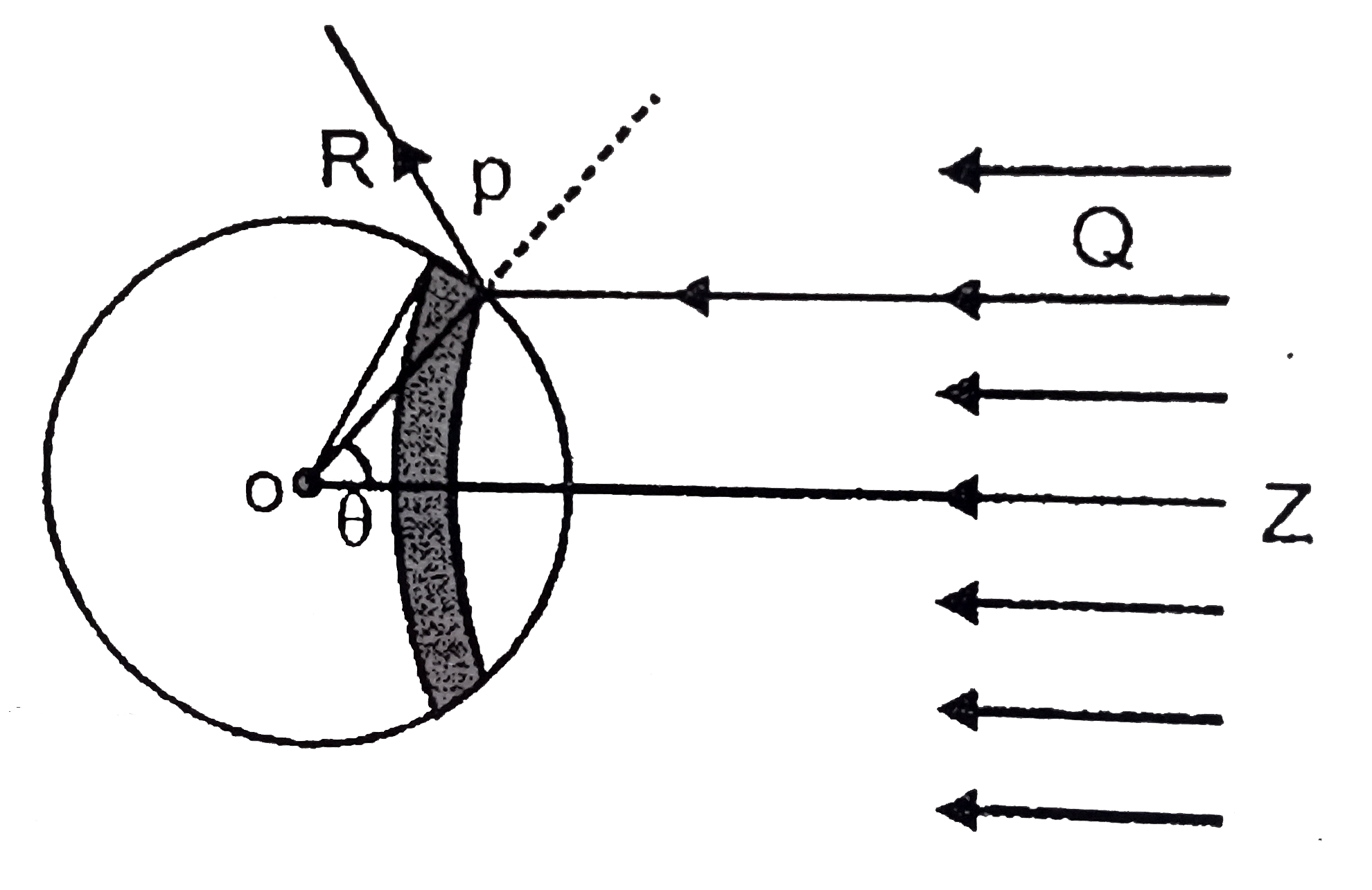
Let `O` be the centre of the sphere and `OZ` be the line opposite to the incident beam (figure). Consider a radius `OP` of the sphere making an angle `theta` with `OZ`. Rotate this radius about `OZ` to get a circle on the sphere. Change `theta` to `theta+d theta` and rotate the radius about `OZ` to get another circle on the sphere. The part of the sphere between these circles is a ring of area `2pir^(2) sin theta d theta`. Consider a small part `DeltaA` of this ring at `P`. Energy of the light falling on this part in time `Delta t` is
`DeltaU=IDeltat(DeltaA cos theta)`

The momentum of this light falling on `DeltaU//c` along `QP`. The light is reflected by the sphere along `PR`. The change in momentum is
`DeltaP=2(DeltaU)/(c)cos theta=(2)/(c)I Deltat(DeltaA cos^(2)theta)` (direction along `vec(OP)`)
The force on `DeltaA` due to the light faling on it, is
`(DeltaP)/(Deltat)=(2)/(c )IDeltaA cos^(2)theta`. ( direction along `vec(PO)`)
The resultant force on the ring as well as on the sphere is along `ZO` by symmetry. The component of the force on `DeltaA` along `ZO`
`(Deltarho)/(Deltat)cos =(2)/(c )IDeltaA cos^(3)theta`. (along `vec(ZO)`)
The force acting on the ring is `df=(2)/(c )I(2 pir^(2) sin theta d theta) cos^(3) theta`
The force on the entire sphere is `F=int_(0)^(pi//2)(4pir^(2)l)/(c )cos^(3) theta sin theta d theta`
`=- underset(0)overset(pi//2)int(4pir^(2)l)/(c )cos ^(3) theta d(cos theta)=underset(theta=0)overset(pi//2)int(4pir^(2)l)/(c )[(cos^(4)theta)/(4)]^(pi//2)=(pir^(2)I)/(c )`
Note that intergraion is done only for the hemisphere that faces the incident beam.
Promotional Banner

Topper's Solved these Questions

  • ATOMIC PHYSICS

    RESONANCE|Exercise Solved miscellaneous problems|14 Videos
  • ATOMIC PHYSICS

    RESONANCE|Exercise Exercise 1 Part-1 subjective questions|35 Videos
  • ALTERNATING CURRENT

    RESONANCE|Exercise HIGH LEVEL PROBLEMS|11 Videos
  • CAPACITANCE

    RESONANCE|Exercise High Level Problems|16 Videos

Similar Questions

Explore conceptually related problems

There is a parallel beam of light of larger aperture . Let I be the intensity of light . Perfectly reflecting sphere of radius r is kept in the path of this parallel beam . Find the force exerted by the light beam on sphere .

A sphere of radius 1.00 cm is placed in the path of a parallel beam of light of large aperture. The intensity of the light is 0.50 W cm^-2 . If the sphere completely absorbs the radiation falling on it, find the force exerted by the light beam on the sphere.

If a parallel beam of light having intensity I is incident normally on a perfectly reflecting surface, the force exerted on the surface, equal F. When the surface is held at an angle theta , the force is

A light beam of wavelength lambda incident on a silver sphere of radius r. suspended by a nonconducting thread. Find potentical aquired by sphere

Figure2.25 shows a cone of radius R and height H with perfectly reflecting lateral surface, is placed in the path of a light beam of intensity I. Find the force exerted on this cone.

A horizontal ray of light is incident on a solid glass sphere of radius R and refractive index mu . What is net deviation of the beam when it emerged from the other side of the sphere?

A parallel beam of monochromatic light of frequency v is incident on a surface. Intensity of the beam is I and area of the surface is A. Find the force exerted by the light beam on the surface for following cases– (i) the surface is perfectly absorbing and the light beam is incident normally on it. (ii) the surface is perfectly reflecting and the light beam is incident normally. (iii) the surface is perfectly absorbing and the light beam is incident at an angle of incidence theta . (iv) the surface is perfectly reflecting and the light beam is incident at an angle of incidence theta .

A ray of light, travelling parallel to diameter of a sphere enters the sphere through a hole at point A as shown in the figure. The inner surface of the sphere is made perfectly reflecting. Find the number of reflections suffered by the ray before coming out of the sphere.

A parellel beam of monochromatic light of wavelength 500 nm is incident normally on a perfectly absorbing surface. The power through any cross section of the beam is 10 W. Find (a) the number of photons absorbed per second by the surface and (b) the force exerted by the light beam on the surface.

RESONANCE-ATOMIC PHYSICS-Advanved level problems
  1. In the path of a uniform light beam of large cross-sectional area and ...

    Text Solution

    |

  2. A small particle of mass m move in such a way the potential energy (U ...

    Text Solution

    |

  3. Suppose the potential energy between an electron and aproton at a dist...

    Text Solution

    |

  4. In atension from state n to a state of excitation energy 10.19 eV, hyd...

    Text Solution

    |

  5. Suppose in certine condition only those transition are allowed to hydr...

    Text Solution

    |

  6. Find the velocity of photoelectrons liberated by electromagnetic radia...

    Text Solution

    |

  7. (a) Find the maximum wavelength lambda(0) of light which can ionize a ...

    Text Solution

    |

  8. A beam of monochromatic light of wavelength lambda ejects photoelectro...

    Text Solution

    |

  9. Hydrogen atom in its good state is excited by means of monochromatic r...

    Text Solution

    |

  10. Average lifetime of a hydrogen atom excited to n =2 state is 10^(-6)s ...

    Text Solution

    |

  11. In a hydrogen like ionized atom a single electron is orbiting around ...

    Text Solution

    |

  12. For atoms of light and heavy hydrogen (H and D) fine the difference, ...

    Text Solution

    |

  13. An electron in the ground state of hydrogen atom is revolving in antic...

    Text Solution

    |

  14. A proton and electron, both at rest initially, combine to form a hydro...

    Text Solution

    |

  15. A neutron of kinetic 6.5 eV collides inelastically with a singly ioniz...

    Text Solution

    |

  16. Suppose the potential energy between electron and proton at a distance...

    Text Solution

    |

  17. A positronium consists of an electron and a positron revolving about t...

    Text Solution

    |

  18. In a photoelectric effect set up, a point source of light of power 3.2...

    Text Solution

    |

